AI vision inspection systems outperform traditional pharma quality systems by reducing false rejects, adapting to packaging variations without recalibration, and integrating with smart manufacturing platforms for automated batch-level decisions.
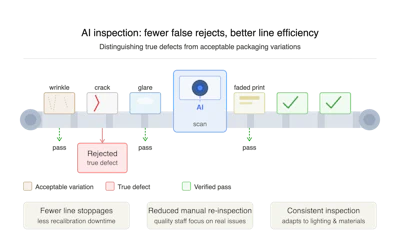
- AI inspection systems reduce false reject rates by distinguishing acceptable packaging variations from true defects, improving line efficiency and reducing manual re-inspection burdens
- Unlike rule-based systems requiring extensive recalibration, AI platforms learn from operational data and adapt dynamically to packaging complexity, lighting changes, and environmental variability
- AI inspection improves serialization verification by handling imperfect but acceptable code variations, clogged ink nozzles, and placement accuracy—critical for regulatory compliance
- Integration with MES platforms and IoT devices enables automated batch-level quality decisions and predictive maintenance, shifting from isolated tools to connected smart manufacturing workflows
- Human oversight and rigorous validation (IQ, OQ, PQ) remain essential to safeguard inspection accuracy and mitigate quality risks in AI-powered systems
Key Takeaways:
- AI-based inspection systems reduce false reject rates by distinguishing acceptable packaging variations from true defects, directly improving line efficiency and reducing manual re-inspection burdens.
- Unlike rule-based systems that require extensive recalibration, AI inspection platforms learn from operational data and adapt dynamically to the complexity of modern pharmaceutical packaging lines.
- AI inspection's integration with MES platforms and IoT devices is enabling automated batch-level quality decisions, signaling a shift from isolated inspection tools to connected smart manufacturing workflows.
Packaging inspection has long been an integral part of the manufacturing process, with the industry traditionally utilizing rule-based inspection systems to detect and reject faulty packages. Although these systems significantly improved inspection compared to manual systems, they were not designed to handle the complexities of modern packaging requirements, such as serialization, variable packaging formats, and higher speeds. As packaging variability increases, these rule-based systems often struggle to maintain inspection consistency, creating an operational burden during process optimization.
AI-based inspection systems are helping pharma manufacturers to reduce unnecessary rejection rates and improve inspection stability. These systems can adapt to changing inspection conditions, thereby improving the reliability of pharmaceutical packaging operations.
Why Traditional Vision Inspection Systems Face Limitations in Modern Pharmaceutical Packaging
Traditional vision inspection relies on fixed rules, templates, or predefined defect parameters to analyze packaging and make inspection decisions. This approach often struggles to detect packaging variations caused by wrinkles, reflective materials, irregular shapes, and changing lighting conditions.
These variations can increase operational challenges by causing frequent line stoppages for rule adjustments and recalibration of inspection hardware. As a result, these variations increase the false-reject rate. Manufacturers may also face difficulties scaling inspection systems across multiple packaging formats and product lines.
As a result, packaging and quality personnel are often required to manually re-inspect rejected items. This reduces the efficiency of packaging automation and limits the overall benefits of automated inspection systems.
Improving Pharmaceutical Packaging Performance
An AI-based inspection system helps address the operational limitations of traditional inspection systems by improving inspection consistency and operational reliability. Some ways in which an AI inspection system improves pharmaceutical packaging are described below.
Reduction of False Rejects
Traditional inspection systems often exhibit high false-reject rates due to rigid inspection models and fixed threshold limits. As a result, packages with minor but acceptable variations may still be marked as rejected items.
For example, hardware-related issues, such as lighting degradation, can interfere with inspection accuracy.
An AI-based inspection system helps reduce the false rejects by distinguishing normal packaging variations from actual defects. This is because AI inspection systems are trained using both acceptable and defective samples, allowing them to distinguish acceptable variations from true defects. Additional benefits include improved adaptability to variations in camera lighting, contrast, and packaging conditions.
Serialization Verification
Traditional vision inspection often struggles to handle imperfect but acceptable serialization variations.
For example, clogged ink nozzles can disrupt printed text and serialization codes on packaging.
An AI inspection system helps improve serialization detection, code readability, and accuracy. These systems can also verify accurate code placement and orientation during packaging inspection.
The AI inspection system's ability to verify serialization code improves traceability reliability, as serialization is a critical regulatory requirement for pharmaceutical product tracking.
Adaptive Inspection for Packaging Variability
Traditional inspection relies on rigid threshold limits, with static rules defining the acceptability of packaged products. These systems also require extensive programming or model training to handle different packaging variations and classify products as accepted or rejected.
Even a slight variation in packaging design may trigger false rejects in traditional inspection systems.
AI inspection systems can learn from operational data without requiring extensive recalibration. These systems learn the core packaging structure and can identify anomalies not explicitly defined during model training. Similarly, AI inspection can adapt to factors, such as hardware issues and print inconsistencies, without flagging unnecessary rejected packages.
For example, bubbles may appear in injectable packaging. They can vary in position and size during inspection. A rule-based inspection system may classify these bubbles as defects, thereby increasing false-reject rates. An AI inspection system can adapt to these types of variations and avoid incorrectly classifying bubbles as rejected defects.

A key element in deploying AI vision systems is rigorous validation and active human oversight of inspection algorithms. This safeguards inspection accuracy and mitigates quality risks.
The trained model is validated and tested using both accepted and rejected packaging samples, with full documentation maintained. If retrained for process variations, the model must be revalidated. Validation activities, such as IQ, OQ, and PQ, ensure proper installation, operation, and performance.
Human oversight is critical, with operators or quality staff reviewing rejected samples from AI systems. They also review new defect patterns to determine whether they should be classified as packaging defects for future inspections.
AI Inspection Is Becoming More Integrated with Smart Manufacturing
AI inspection systems are increasingly becoming part of connected packaging workflows within the pharma manufacturing process, rather than functioning as isolated inspection tools. Inspection data can be integrated with manufacturing platforms and IoT devices to improve batch-level decisions, traceability, and automated packaging workflow.
An AI inspection system can also be integrated with a Manufacturing Execution System (MES) to support process decisions that previously required manual intervention and oversight. This allows batch information to be visualized by quality personnel and other relevant departments, while supporting automated review processes before products are released to the market.
For example, if rejection rates in a batch exceed a set threshold, the MES can automatically hold the batch and prevent its release.
AI inspection systems connect with IoT devices to boost packaging efficiency and coordinate operations. IoT devices help with predictive maintenance, traceability, and automate packaging.
For example, connected packaging systems can use robotics or SCADA to automatically remove rejected containers from the line.
AI Helps Handle Environmental Variability
Traditional inspection systems often struggle with changing environmental conditions, such as variations in lighting and the presence of reflective packaging materials. These factors can increase false reject rates and reduce inspection accuracy.
To address these issues, traditional inspection systems often require reprogramming or rule modifications, resulting in production interruptions and operational downtime.
An AI inspection system, with adaptive learning capabilities, can better distinguish true defects from variability caused by changing environmental conditions.
For example, ambient dust between the camera and the package can interfere with light transmissions, causing the vision system to interpret the disruption as particles or defects. AI inspection systems trained on historical operational data can be trained to filter out noise from dust and reduce unnecessary false rejects.