Create a free Healthcare Packaging account to continue reading
Dissolving the Problem: Water-Soluble Packaging Brings a New Approach to Medical Waste Management in the OR
The partnership between SmartSolve and Safetec combines water-soluble packaging with medical waste solidification to improve OR safety, simplify workflows, and reduce packaging waste.
Water-soluble packaging innovations are transforming medical waste management in operating rooms by using dissolving pouches that eliminate manual handling steps, reduce worker exposure to infectious fluids, and create zero packaging waste. SafeTec's partnership with SmartSolve has introduced self-dissolving pouches made from wood pulp fiber that safely deliver medical waste solidifier directly into suction canisters without requiring healthcare workers to cut, measure, or pour contents.
Water-soluble pouches made from wood pulp fibers dissolve completely upon contact with liquid, eliminating traditional plastic or multi-material packaging waste
The self-dissolving format reduces handling steps in operating rooms, allowing medical waste solidifier to work within 30 seconds to one minute without manual measuring or pouring
Healthcare workers face reduced exposure risk to infectious bodily fluids since solidified waste prevents splashing and spills that occur with liquid waste management
Extended Producer Responsibility (EPR) legislation expanding across the United States makes biodegradable, water-soluble packaging increasingly attractive for healthcare manufacturers
SmartSolve's dissolving substrates biodegrade instead of persisting as mixed-material laminates, reducing microplastics and changing the environmental footprint of medical waste streams
Healthcare packaging innovation often focuses on sterile barriers, drug delivery systems, or sustainability initiatives. But sometimes innovation comes from solving an overlooked problem—what happens after a procedure ends.
For Safetec of America, a manufacturer of infection control, first aid, and compliance products, that problem centered on safely handling liquid medical waste in operating rooms. Through a long-standing partnership with SmartSolve, the company has introduced a self-dissolving, zero-waste pouch that delivers medical waste solidifier directly into suction canisters without requiring healthcare workers to cut open, measure, or pour the contents.
The technology simplifies a routine but important task while reducing packaging waste and minimizing opportunities for exposure to infectious fluids.
Paper That Disappears
At the heart of the innovation is a material many people don’t realize exists: water-soluble paper.
“Everything in the SmartSolve portfolio is paper-based and water soluble, and that’s not exactly a household term yet,” explains Ashleigh Hotz, senior director of sales and marketing at SmartSolve. “Most people don’t know that there is technically a dissolving paper out there because it’s traditionally been used in very back-of-house applications.”
Rather than relying on plastics or multi-material laminates, the material is made primarily from wood pulp fibers combined with carboxymethyl cellulose.
“You can think of it like a chain-link fence,” says Hotz. “Once the material comes in contact with water, those wood pulp fibers start to separate, but they remain. Everything that remains is flushable, meeting, and actually exceeding, the same standards used for toilet paper and flushable wipes.”
SmartSolve coats the dissolving substrate to create different packaging technologies, including pressure-sensitive labels and flexible packaging. Safetec’s application uses the flexible pouch format to contain its medical waste solidifier.
Eliminating Steps Inside the OR
For Safetec, the appeal wasn’t simply sustainability. It was workflow.
Operating rooms are fast-paced environments where efficiency and worker safety are closely linked. Before the new format, healthcare workers typically opened a packet, measured the correct amount of solidifier, and poured it into a suction canister containing liquid medical waste. The process worked, but it introduced additional handling steps during an already busy workflow.
“We were looking for something that would eliminate that step of having to cut, measure, and pour,” says Victoria Robinson, marketing manager at Safetec. “With SmartSolve’s packaging, we were able to put our medical-grade solidifier inside a convenient package that you literally just drop in and let it do its thing.”
The pouch itself dissolves almost immediately upon contact with the liquid, allowing the solidifier to begin working without delay.
“I’ve seen it solidify anywhere from 30 seconds to one minute, depending on how much liquid is in the container,” Robinson says. “The packaging dissolves so fast that the solidifier reaches the contents much quicker.”
The dimensions of the pouch were also engineered specifically for the application, fitting perfectly into the porthole of a suction canister.
Safetec of AmericaProtecting Healthcare Workers
While the dissolving pouch improves convenience, its greatest value may lie in reducing opportunities for exposure to infectious waste.
OSHA compliance remains a significant concern when handling liquid medical waste because spills and splashes can expose healthcare workers, and potentially patients, to infectious bodily fluids.
"Think about when you're handling liquids, even for us as average people…you drop a gallon of milk on the floor and it splatters everywhere," explains Robinson. "It's the same kind of idea in the medical space. If you have liquid bodily fluids and there's a hole in the bag, the contents will go everywhere, which is not safe for patients or healthcare workers."
Solidifying the waste changes the equation.
“When you solidify that product, it helps alleviate some of that potential for being infected by the waste if it does happen to spill or splash,” she says.
The simplified, prefilled package also reduces accidental spills of the solidifier itself while eliminating measuring errors and reducing handling time. Although Safetec doesn’t have formal usability studies from operating room staff, Robinson says feedback from customers has been overwhelmingly positive.
“People absolutely love it,” she says. “For people that have been using your traditional cut-and-pour pouch, this is just so much easier.”
Less Packaging, Less Waste
The drop-in pouch also changes the waste stream itself. Traditional packaging formats often rely on plastic bottles or tear-open pouches that must be discarded after use. By comparison, the SmartSolve package dissolves completely during use.
For SmartSolve, however, sustainability extends beyond reducing plastic use. Hotz argues that conventional packaging frequently falls short because of what happens at end of life.
“A lot of packaging today is multi-material,” she says. “It’s film laminated to foil. It’s paper bonded to plastic. Those mixed-material laminates are very difficult to recycle.”
Instead of trying to improve recycling rates for difficult-to-process materials, SmartSolve approaches the problem differently.
“Our materials are designed to dissolve in water and biodegrade instead of persisting like mixed materials do,” says Hotz. “For healthcare organizations measuring their environmental footprint, that changes both the volume of durable waste headed to the landfill and the environmental profile of what’s left behind.”
The discussion also reflects growing attention to microplastics.
“Five years ago, consumers were mostly concerned about sea turtles,” says Hotz. “Now we’re learning that microplastics are ending up in our major organs and even breast milk. Where we can eliminate plastic, that’s the angle we’re looking at.”
Sustainability Meets Convenience
While sustainability remains important, both companies see the conversation evolving.
“I don’t know that people are really paying just for sustainability,” says Hotz. “What they really want is convenience.”
In healthcare, that means reducing unnecessary steps for clinicians while maintaining safety.
“If an OR worker says, ‘The experience of dumping this other thing in here isn’t so great,’ and now you’ve created something that’s incredibly easy to use, that’s a better experience,” she continues. “We’re seeing that across multiple markets, not just healthcare.”
Robinson agreed that sustainability is increasingly becoming an expectation among healthcare customers, particularly large distributors.
“We participate in sustainability audits,” she says. “It’s nice when we can turn around and say we do have a product where we’re considering sustainability and implementing it into our products. Would we love to do more? Absolutely.”
Preparing for a Changing Regulatory Landscape
The companies also see regulatory changes influencing future packaging decisions. Extended Producer Responsibility (EPR) legislation is expanding across the United States, requiring manufacturers to consider what happens to packaging after use.
“EPR is here,” says Hotz. “It’s not going anywhere.”
Because SmartSolve’s materials are designed to disperse and biodegrade, Hotz believes they could eventually qualify for favorable treatment under emerging EPR frameworks.
“We’re assessing it carefully because nothing is written in stone yet,” she says. “But our initial investigation suggests our materials could provide a benefit in those states.”
Innovation with Worker Safety at the Center
Despite conversations around sustainability and regulatory compliance, Robinson emphasizes that Safetec’s mission has always centered on protecting healthcare workers. In fact, the company’s medical waste solidifier originated during the AIDS epidemic, when hospitals were seeking better ways to safely manage infectious blood and bodily fluids.
“Our solidifier was really born from trying to keep healthcare workers safe during that epidemic,” Robinson says. “It’s nice to see the transition from solving one problem with the solidifier to now solving another problem through better packaging.”
That next-generation packaging came out of a straightforward complaint from end users in operating rooms: the old format was cumbersome. Workers were cutting open pouches, trying to measure the right volume, and pouring carefully through the narrow opening of a suction canister, all while managing a room full of blood, infectious fluids, and time pressure.
See What’s Possible in Life Sciences Packaging at PACK EXPO International
Explore new machinery & materials from 2,700 exhibitors. Gain insights from 150+ free educational sessions. Find solutions to tackle the toughest challenges—for life sciences & beyond—at North America’s largest packaging & processing event.
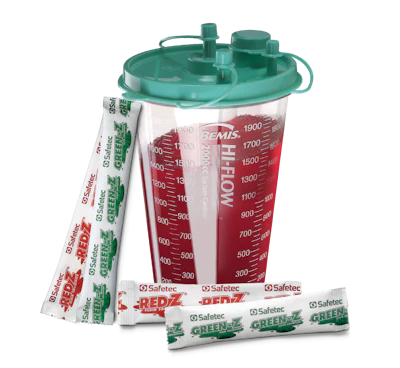
 Safetec of America
 Safetec of America