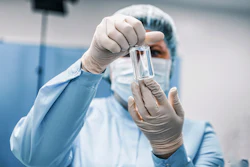
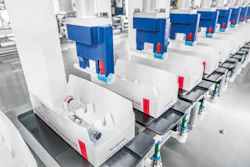
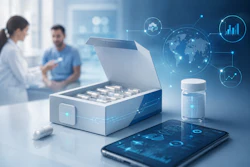
BayCare Health System, a not-for-profit academic healthcare system in West Central Florida, is partnering with autonomous delivery company Zipline to build a healthcare drone delivery network for medications. Temperature testing must verify medications remain within required ranges throughout the entire delivery cycle, including scenarios where packages sit unattended for 18-20 hours.
Follow this podcast on your favorite streaming platform - links can be found by clicking here.
Transcript
Welcome to Through the Line, the podcast exploring innovations and information across the packaging and processing landscape. From topics impacting consumer packaged goods and healthcare packaging to the latest technologies in food processing operations.
Hi, Liz Cuneo here, editor-in-chief of healthcare packaging. What follows is an AI-generated podcast, all about a recent article on our site. The article is about BayCare Health System, how they're collaborating with Zipline to launch Autonomous Drone Delivery Network in Florida. This initiative aims to transport medicines, lab samples, and medical supplies directly to patients and facilities. Listen in to learn more.
Today we are exploring how the transition to autonomous drone delivery for pharmaceuticals is testing the physical limits and engineering standards of temperature-controlled packaging.
It really is a fascinating shift, especially for the engineers behind the scenes. And welcome to our deep dive into the source material for today.
Our mission today is to analyze the structural and thermal packaging constraints introduced by drone networks. We are using a real-world partnership between Baycare Health System and Zipline as our primary case study. So to really understand this transition from ground to air delivery, I think we need to frame it as a major paradigm shift for the packaging industry.
Oh, absolutely. It is a massive leap.
It is like comparing it to the historical shift from ocean freight to the very first air mail system.
Aaron Powell That is a great comparison, actually. Trevor Burrus, Jr.
Because when goods moved by ship, weight and precise dimensions were their secondary concerns.
Yeah, you could just rely on thick, heavy wooden crates and just abundant packing materials.
Exactly. But the moment packages took to the sky, suddenly every single ounce mattered. Every new vibration profile fundamentally changed the package engineering. Trevor Burrus, Jr.
The margin of error shrank from pounds to ounces overnight, and we are facing a remarkably similar leap today.
So before we examine the packaging itself, we really must understand the logistical failures of traditional delivery that necessitate this shift to the sky.
Aaron Powell Because building a drone network is not cheap or simple. There has to be a strong motivation.
Aaron Powell So what are the factual details of this Baycare and Zipline partnership?
Baycare Health System is a not-for-profit academic healthcare system in West Central Florida, and they are partnering with this autonomous delivery company, Zipline.
And the main goal here is bypassing the grid. Right.
They want to deliver medications, lab samples, and critical supplies by air to completely bypass traffic and unpredictable road conditions.
Which is a huge deal in densely populated areas like West Central Florida.
Yeah, it really is. And this service is totally optional. It is launching in 2027 in the St. Petersburg Clearwater area.
And then expanding from there.
Yes, eventually across the broader Tampa Bay region. It will feature two charging stations in Pinellas County.
Okay. And what kind of range do those stations have?
Each one supports an operating area of roughly a 10-mile radius.
Got it. And this isn't just a theoretical concept, is it?
No, not at all. The Cleveland Clinic in the Midwest is actually already using Zipline for deliveries within a five-mile radius of its Beechwood administrative campus.
Wow. Okay. So the precedent is already there.
Yeah. And if we connect this to the bigger picture, it is not just about speed. Faster delivery improves convenience, sure.
But there is a deeper medical value here.
Exactly. The real medical value is patient adherence. You are ensuring patients don't miss a vital dose simply because a delivery van was stuck in traffic.
Okay. Let's unpack this. Because if drones solve the traffic problem for the healthcare providers, do they just transfer the logistical headache straight onto the desks of the packaging engineers?
That is the exact trade-off. Yeah.
Because drone flight changes the physical forces acting on a package so drastically.
It completely changes the transportation environment. And that logically demands rigorous new testing standards.
Aaron Powell We are talking about different vibration profiles, right?
Vibrations, totally new acceleration forces, severe weather exposure, and just completely different handling conditions compared to ground couriers.
So walk us through the actual mechanics of a zip line delivery. How does it physically work?
Okay, so it starts with zipline drones retrieving an order from a designated dropbox at a big care site.
And then it flies autonomously to the patient.
But here's the key part it doesn't actually land at the patient's house.
Oh, really? It just stays in the air.
Yeah, it hovers up to 300 feet in the air.
300 feet. That is basically a 30-story building.
Exactly. And from that height, a pod containing the order descends to the ground on a tether.
Wow.
And it is highly precise. It can make these deliveries even in high winds and bad weather. Yeah. It just leaves the package and the tether returns to the drone.
So hearing that, I immediately think about Baycare's director of pharmacy, Michelle Caraschio. She must have strict standards for this.
Oh, absolutely. She insists that their existing specialty pharmacy shipments, which currently use coolers, ice packs, and specialized envelopes, must be independently tested for package integrity.
To see if they can actually survive this wild new delivery sequence.
Because a platform's ability to just fly in bad weather is only half the equation here.
The other half is the cargo.
Exactly. The core issue for packaging operations is demonstrating that the drug remains completely intact and uncompromised through that whole physical ordeal.
Aaron Powell I think an analogy to an amusement park drop ride works perfectly here.
Oh yeah. That is a great way to do it.
A cooler meant to sit shotgun in a delivery van might be fine, but it is absolutely not engineered to withstand a 300-foot tether descent in high winds.
No, it is a completely different kinetic environment.
Because surviving the flight physically is really only step one. The next logical challenge is the temperature.
And that is where the math gets incredibly strict. Maintaining the drug's chemical integrity within highly constrained weight limits.
Let's get into those factual details. What is the weight limit for the zip line system?
The system has a strict eight-pound delivery weight limit.
Eight pounds total.
Total. That eight pounds must include the medication, the primary and secondary packaging, all insulated components, the refrigerants or ice packs, the cushioning, the documentation, and the actual delivery container.
That is practically nothing when you are dealing with refrigerated medications.
And Baycare deals with a lot of those. Temperature maintenance is paramount to meet their strict label requirements.
So how long does the package need to stay cold?
Baycare's temperature testing protocols evaluate packages for 18 to 20 hours of exposure.
Wait, 18 to 20 hours? But the drone flight only takes, what, a couple of hours maximum?
The expected delivery window is only about two hours, yeah.
So why on earth are they testing for 20 hours of thermal stability?
What's fascinating here is the human element. The extended testing accounts for unpredictable scenarios.
Like what exactly?
Like a scenario where a patient has a sudden family emergency and has to leave the house. The package gets delivered and just has to sit outside, unattended, on a porch in the Florida heat.
Oh wow. Yeah, that makes total sense.
Zipline has conducted its own tests, obviously. But Baycare insists on independent verification to ensure their specific pharmacy label requirements are met.
Here's where it gets really interesting for the listener. This creates what is basically a packaging budget.
A packaging budget. I like that.
Because for you, the packaging professional, every single ounce you spend on a heavy refrigerant is an ounce deducted from the actual payload.
It forces a total masterclass in material efficiency. You cannot just throw a giant three-pound ice pack in there anymore.
Exactly. But let's say you solve that math. Even if the package is perfectly engineered for flight and temperature, the system still fails if the handoff to the end user is compromised.
Absolutely. The final step is crucial. Security and the last mile.
How does Baycare handle that final step?
It depends. For facility-to-facility deliveries, like between hospitals, Baycare aims for what they call a soft handoff.
Meaning what exactly?
It combines the physical delivery with instantaneous digital communication and notifications, so the staff knows exactly when it arrives and can retrieve it quickly.
Which drastically reduces the unattended time.
Exactly. It saves the thermal budget.
But what about deliveries to actual patients at their homes?
That is an opt-in system. Patients who opt-in receive precise delivery windows and real-time tracking on their phones.
And the drone can target specific drop zones, right?
Yeah. They have the ability to have packages dropped in backyards or private locations, which is huge for preventing theft of these expensive specialty drugs.
This raises an important question, though, about system trust.
This raises an important question indeed, because autonomous medical logistics relies entirely on trust.
The public has to trust drones flying over their houses.
Exactly. And that is why it is so important that Zipline is fully FAA approved.
And they operate zero emission aircraft, which is great.
Yeah. And they have the experience. They have flown over 135 million autonomous commercial miles.
That is a staggering number of miles.
Delivering 20 million items globally. The combination of redundant flight critical systems and minimal human interaction is what makes this palatable to regulators and the public.
It kind of mirrors consumer delivery apps like Uber Eats or Amazon.
Oh, totally. The user experience is very similar.
But we have to emphasize that the stakes here are drastically higher. A cold pizza is an annoyance. A spoiled specialty medication is a literal health crisis.
Aaron Powell A health crisis and a massive financial loss.
And what about patient privacy? Because these are medical deliveries.
Privacy is locked down. Zipline does not access Baycare patient information at all.
Aaron Powell So they don't know what drug is in the pot or who is receiving it?
Nope. They only collect the weight, the volume, and the carriage requirements.
Yeah.
Specific temperature or handling instructions.
So what does this all mean? Let's distill the core takeaways for the packaging professional listening right now.
The main takeaway is that drone delivery is no longer science fiction. It is here.
And it demands immediate innovations from your industry? Innovations in light weighting, thermal efficiency, and structural integrity.
Aaron Powell Because you are dealing with entirely new physical stressors now.
Exactly. So to wrap up this deep dive, do you have a final thought to leave our listeners with?
I do, yeah. I want to leave you with a final provocative thought to mull over. We have talked a lot about the strict constraints of drone delivery engineering, ultra-efficient, lightweight, eight-pound temperature controlled pods.
It's a huge challenge.
But think about the future. How will those specific hard-won innovations eventually trickle down to revolutionize and optimize traditional ground shipping?
Oh, that is a great point.
If you can make an ultra-efficient pod for a drone, imagine how much more efficient a standard delivery van could become using those exact same materials. The sky is forcing the innovation, but the ground is going to benefit from it too.
That is a brilliant way to look at it. That wraps up our analysis of this paradigm shift. Thank you for joining us on this deep dive.
Thank you for listening to Through the Line Packaging and Processing. You can listen to more episodes on all streaming platforms. Be sure to visit us at packworld.com, profoodworld.com, and healthcarepackaging.com for more packaging and processing news. This podcast was edited by Bri Guntz.