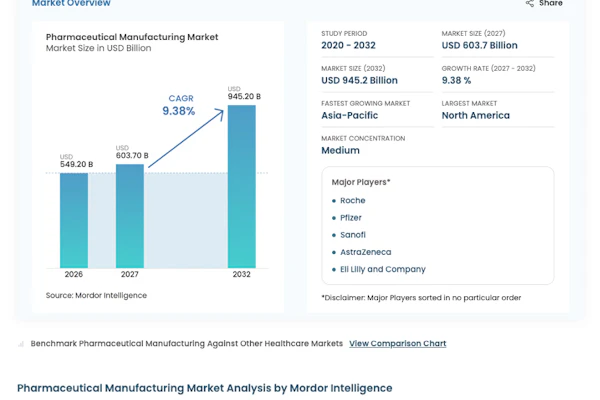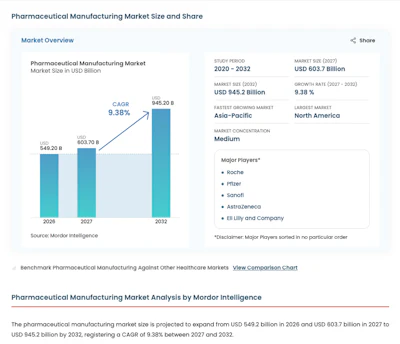
Contract manufacturing partnerships and advanced automation technologies are driving the global pharmaceutical manufacturing market toward $945.2 billion by 2032, as companies invest in specialized facilities and flexible production capacity to handle complex biologics and therapies.
- The global pharmaceutical manufacturing market is projected to reach $945.2 billion by 2032, driven by demand for contract manufacturing and production flexibility.
- North America leads with 36.41% market share in 2026.
- Asia-Pacific is the fastest-growing region due to expanding production capabilities and government initiatives encouraging domestic manufacturing.
- Pharmaceutical companies increasingly rely on contract development and manufacturing organizations (CDMOs) to access specialized expertise and flexible capacity.
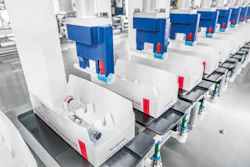
- Automation and continuous manufacturing technologies are modernizing production facilities, improving quality oversight and operational efficiency.
Bringing the next generation of medicines to market will take more than a promising drug pipeline. It will require manufacturing operations equipped to handle complex biologics, adapt to changing production demands, and deliver consistent quality at scale. That challenge is driving investment in automation, specialized facilities, and contract manufacturing partnerships. According to Mordor Intelligence, these forces could help push the global pharmaceutical manufacturing market to $945.2 billion by 2032—making manufacturing capacity and flexibility central to the industry’s next phase of growth.
As you’ve likely noticed, the industry is undergoing a shift toward more specialized and technology-driven production. Growing demand for complex therapies, including oncology medicines and biologics, is increasing the need for advanced manufacturing infrastructure and specialized quality-control systems. At the same time, pharmaceutical companies are relying more heavily on contract development and manufacturing organizations (CDMOs) to access production expertise and flexible capacity. However, pricing pressure, regulatory requirements, and dependence on internationally sourced manufacturing inputs continue to influence investment decisions.
Pharmaceutical Manufacturing Market Share by Region
· North America accounted for the largest regional share of the pharmaceutical manufacturing market, representing 36.41% in 2026. Its established pharmaceutical industry, significant research and development expenditure, advanced production infrastructure, and presence of major drug manufacturers support its leading position.
· Asia-Pacific is projected to be the fastest-growing region during 2027–2032. Expanding pharmaceutical production capabilities, investments in domestic active pharmaceutical ingredient manufacturing, and rising demand for medicines across major economies are supporting regional growth. Government initiatives encouraging local production and supply-chain diversification are also strengthening the region's manufacturing outlook.
"Pharmaceutical manufacturing is increasingly shaped by the need to balance production scale with flexibility, quality, and supply reliability. As biologics, biosimilars, and specialized therapies gain importance, manufacturers are investing in advanced capabilities and external partnerships to support evolving production requirements," says Soumya Goud, Senior Research Manager at Mordor Intelligence.
Pharmaceutical Manufacturing Market Trends & Forecast
1. Increasing R&D Investment Strengthens Commercial Production Requirements
Rising pharmaceutical research and development expenditure is creating opportunities for manufacturers as new drug candidates progress toward commercialization. The development of complex therapies requires specialized production processes, validated facilities, and consistent quality systems. As pharmaceutical companies advance their pipelines, manufacturing readiness is becoming an important consideration earlier in the development process. This is encouraging investment in process development, production infrastructure, and specialized manufacturing capabilities.
2. Automation and Continuous Processing Reshape Production Efficiency
Pharmaceutical manufacturers are increasingly evaluating automation and continuous manufacturing technologies to improve production consistency and operational efficiency. Digital monitoring, AI-enabled automation, and advanced process controls can help manufacturers identify deviations, improve quality oversight, and optimize existing production lines. Continuous manufacturing is also gaining attention as companies seek to reduce production interruptions and improve capacity utilization. These investments are supporting the gradual modernization of conventional manufacturing facilities.
As drug pipelines advance, manufacturers will need to prepare earlier for increasingly complex production requirements. Investments in specialized capabilities, automation, and continuous processing could help turn that readiness into reliable commercial output. Realizing the market’s growth potential will depend on expanding capacity while maintaining quality, improving efficiency, and adapting to the therapies coming next.