Healthcare packaging policy plays a critical role in public health preparedness by ensuring medicines and medical devices reach patients safely, but regulatory changes like recycled-content mandates and chemical restrictions require years of validation and testing that policymakers often underestimate, making it essential to balance sustainability goals with realistic supply chain capabilities and patient safety requirements.
- Healthcare companies typically need 12 to 18 months minimum to comply with packaging regulations, with complex material changes taking years due to validation, sterilization, and biocompatibility testing requirements.
- Packaging shortages can remove fully functional medical devices from supply as effectively as missing components, making a reliable packaging supply chain directly critical to patient safety.
- Recycled-content mandates may exceed what supply chains can deliver—there is insufficient suitable recycled material available for demanding healthcare applications requiring high barriers and sterilization.
- Temporary exemptions for medical devices acknowledge industry progress toward sustainability while providing time to develop compliant solutions without risking product integrity or patient access.
- Healthcare packaging must withstand manufacturing, sterilization, warehousing, transportation, and storage while maintaining sterile barriers, requiring extensive validation before any material changes reach patients.
Healthcare packaging may not be the first thing that comes to mind when you hear ‘public health preparedness’ but it does plays a key role in ensuring medicines and medical devices reach patients safely. Of course, without the materials, converting capacity, equipment, and transportation systems needed to protect these products throughout the supply chain, they would never make it into patients’ hands. That's why policy becomes such an important topic of discussion.
As policymakers introduce extended producer responsibility (EPR) programs, recycled-content mandates, and chemical restrictions, packaging suppliers and healthcare manufacturers face growing pressure to change materials and formats. But those transitions cannot happen overnight, particularly when patient safety, product integrity, and sterility are involved.
Dan Felton, President & CEO, Flexible Packaging Association, says policymakers do not always recognize the time and complexity involved in implementing packaging changes.
“While industry can make changes—and is making changes—they don’t happen overnight,” says Felton. “When we look at making transitions in materials or formats, we have to ensure that the products we’re putting into the market, in the healthcare space, don’t hit a wall.”
That “wall” could be a shortage of suitable materials, a packaging structure that cannot run on existing equipment, an unvalidated sterilization process, or another obstacle that delays a healthcare product’s arrival in the market.
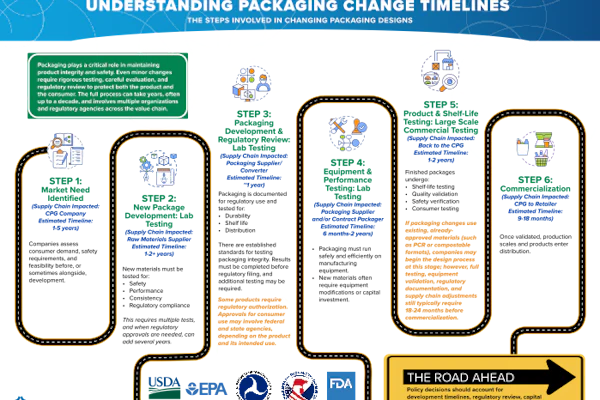
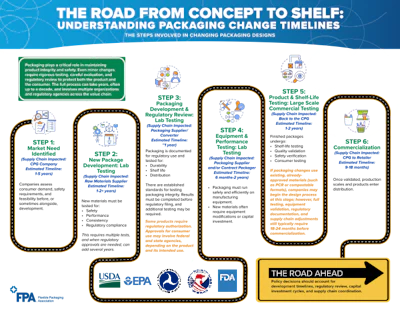
Packaging Changes Can Take Years
Once a law or regulation is finalized, companies may receive 12 to 18 months to comply, which is what Felton describes as the minimum the industry needs to modify products already on the market while preparing new products for launch.
The timeline depends on the scale and complexity of the change. Replacing a restricted chemical, for example, may take years if no proven substitute is readily available. Potential alternatives must be identified, tested, validated, sourced at the required volume, and incorporated into production.
“A reliable packaging supply chain matters to public health because a sterile device is only usable if its sterile barrier is intact, so packaging sits directly between a manufactured device and the patient who needs it,” says Ramanathan Dhakshinamoorthy, a Staff Quality Engineer in the medical device industry. “The difficulty is that packaging materials cannot simply be substituted when a supplier or grade is disrupted: a sterile-barrier system is qualified under ISO 11607, and changing it requires seal validation, integrity and aging studies, and sometimes biocompatibility work—a process that can take months. A packaging shortage can therefore take a fully functional device out of supply as effectively as a missing component does.”
As such, a change that appears simple on paper may affect multiple systems and require extensive validation before the new package can safely reach patients.
“In my experience, you have to build resilience before you need it. Qualifying second-source materials and suppliers in advance keeps supply steady, but the requalification effort it requires also discourages carrying that redundancy—so preparedness is really a matter of pre-validated flexibility rather than simply holding more stock. Much of the current conversation in the field is about exactly this: mapping and gaining visibility into the packaging supply chain, dual-sourcing sterile-barrier materials, and making requalification less burdensome so that redundancy is practical,” says Dhakshinamoorthy.
Policies Must Reflect Material Availability
Recycled-content mandates is one example of how regulations can accelerate progress but also exceed what the supply chain can realistically deliver. The packaging industry is already working to use more recycled content and reduce its reliance on virgin materials. However, the amount of suitable recycled material remains limited, particularly for demanding applications.
“If we had a 50% recycled-content requirement in all packaging in the United States, it’s impossible because there’s not going to be the supply available to do that,” says Felton.
He urges policymakers to understand what companies are already doing and distinguish between ambitious but achievable targets and requirements that cannot be met with the available supply.
“Sometimes you can push industry to go further and faster,” Felton says. “But then you have to look at the realities of what’s really possible.”
Healthcare packaging introduces additional constraints because not every recycled material is appropriate for products requiring high barriers, cleanliness, traceability, or sterilization. Even when medical packaging is exempt from a specific requirement, healthcare companies may still be investigating more sustainable structures in anticipation of future regulations and corporate sustainability goals.
“A shaky packaging supply chain doesn't just delay a launch—it puts product integrity and patient safety at risk,” says Katelyn Fitzgerald, Founder & CEO of Luminous Skin Lab. “The conversation I keep hearing across manufacturing is about single-sourcing and how one supplier hiccup can ripple straight to the treatment table.”
For healthcare packaging, EPR and material regulation discussions ultimately return to patient safety and product access.
Take a sterile dental instrument for example. A patient sitting in a dentist’s chair expects each instrument to be clean and sterile when the pouch is opened. Yet the package has already traveled through manufacturing, sterilization, warehousing, transportation, and storage before reaching that moment. The package must withstand the entire journey while maintaining its sterile barrier. Any material change must therefore be evaluated for its effects on sterilization, transportation, storage, opening, and use.
“It’s not just developed so when it gets ripped open while you’re sitting in the dentist’s chair, it’s good to go and it’s sterile,” says Felton. “There are a whole host of other considerations before that.”
Temporary Exemptions Can Provide Needed Time
Medical devices are often exempt from state EPR requirements, but Felton emphasizes that an exemption does not mean the industry is ignoring sustainability.
Members of the Sterilized Packaging Manufacturers Council are exploring recycled content, fiber-based alternatives, and other strategies to reduce environmental impact. The challenge is finding options that meet healthcare’s performance and safety requirements.
“The industry has not said we should be exempt from all these programs carte blanche,” Felton says. “What they have said—and had some success with—is that we would like some more time to work on these things we’re already working on.”
Temporary exemptions can acknowledge that companies are moving in the intended direction but are not yet ready to comply without risking product safety or availability.
Packaging policy will continue to push healthcare companies toward new materials and formats. The challenge is ensuring that the pace of regulation accounts for the realities of material supply, equipment, validation, sterilization, and distribution.
Sustainability remains important, but for healthcare packaging, progress must be measured alongside the package’s most fundamental responsibility: getting safe, effective products to patients when they need them.