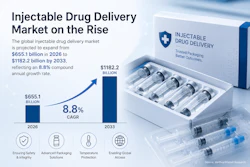
The global dual chamber device market is expected to grow from $6.25 billion in 2026 to $17.56 billion by 2040, driven by increased demand for home healthcare and patient-friendly drug delivery solutions.
- Market Growth: Dual chamber devices projected to reach $17.56 billion by 2040 from $6.25 billion in 2026, with a 7.7% compound annual growth rate
- Primary Driver: Rising demand for self-administered therapies and home healthcare solutions that improve patient convenience and dosing accuracy
- Manufacturing Challenge: Complex lyophilization process adds significant regulatory burden and production timelines for manufacturers
- Critical Risk: Moisture ingress and diluent leakage can compromise drug stability, making robust pharmaceutical packaging essential
- Key Advantage: Dual chamber devices offer enhanced drug stability, precise dosing, and simplified patient handling compared to conventional systems
Key Takeaways:
- The global market for dual chamber devices is forecast to grow from $6.25 billion in 2026 to $17.56 billion by 2040, reflecting a compound annual growth rate of 7.7%.
- Growth is primarily driven by the industry's shift toward patient-centric solutions that support self-administration and home healthcare, areas where dual chamber devices offer improved ease of use and dosing accuracy.
- Key manufacturing challenges include the complex lyophilization process, which adds time and regulatory burden, and the critical need for advanced packaging to prevent moisture and leakage that can compromise drug stability.
The market for dual chamber drug delivery devices is on a significant growth trajectory, spurred by rising demand for patient-friendly administration systems, according to a new report from Research and Markets. The analysis projects the global market will expand to $17.56 billion by 2040, up from an estimated $6.25 billion in the current year.
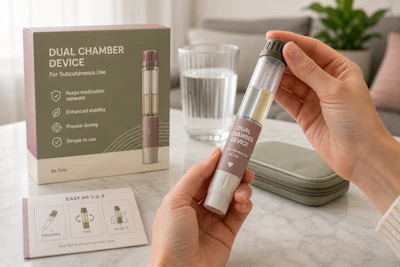
This expansion is largely a response to the healthcare industry's increasing focus on self-administered therapies and home care. Dual chamber devices (DCDs), which keep drug components separate until the point of administration, offer advantages over conventional systems, including enhanced drug stability, precise dosing, and simplified handling for patients. These benefits are accelerating their adoption as manufacturers develop next-generation solutions like dual chamber prefilled syringes and cartridges.
Production Complexity Presents a Major Hurdle
Despite the positive market outlook, manufacturers face notable operational and technical challenges that could impede progress. A primary constraint is the required freeze-drying, or lyophilization, step needed to prepare the drug product for the device's powder chamber.
According to the report, this process "entails stringent regulatory compliance and comprehensive safety evaluations, thereby increasing overall manufacturing complexity and processing timelines." This additional step adds a significant layer of operational management and regulatory risk for companies entering or scaling up in the DCD space.
Packaging Integrity Is Crucial for Product Stability
Beyond the lyophilization process, ensuring product integrity throughout the supply chain presents another critical challenge. The design of dual chamber devices makes them susceptible to specific types of degradation if not manufactured and packaged correctly.
The report identifies two key risks: "moisture ingress into the powder chamber and potential diluent leakage from the rear to the front chamber." Either of these issues can lead to drug degradation, compromising both the safety and efficacy of the final product. As a result, the development of robust and sustainable pharmaceutical packaging is a primary focus area for device designers and manufacturers to ensure stability from production to patient administration.