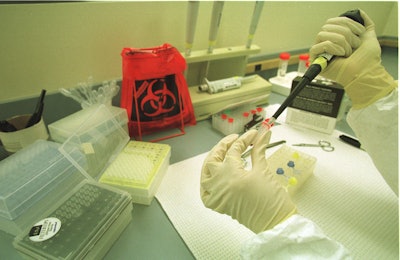
The FDA validated a rapid LAMP assay for detecting Salmonella across 27 different food product types, helping manufacturers and laboratories streamline testing and improve regulatory compliance.
- The loop-mediated isothermal amplification (LAMP) assay was validated by nine independent laboratories across nine ISO food categories including dairy, produce, seafood, and infant formula
- Testing covered 27 sample matrices with both low and high Salmonella levels, achieving 25-75% fractional recovery rates that demonstrate proper sensitivity
- The method targets the invA gene in Salmonella and follows FDA's Bacteriological Analytical Manual protocols for standardized detection
- Once widely adopted, the LAMP assay will make laboratory procedures more efficient and streamline regulatory screening for food safety compliance
Continuous improvement of pathogen detection methods helps food manufacturers and independent food safety testing laboratories streamline workflows. Researchers and validators’ work toward a refined Salmonella testing method sets the stage for wider applications, efficiency improvements, and smoother regulatory screening.
In “Independent laboratory validation of a Salmonella loop-mediated isothermal amplification assay in 27 human and animal food matrices of 9 ISO food categories,” researchers' “rapid, reliable, and robust” procedure that detects Salmonella in multiple food product types was successfully validated by nine independent laboratories, the 2025 research study outlines in Volume 132 of the Food Microbiology journal.
The FDA, in collaboration with various state and public health laboratories, validated the loop-mediated isothermal amplification (LAMP) assay, a molecular technique used to detect specific DNA or RNA, in 27 sample matrices that represent nine International Organization for Standardization (ISO) food categories. The categories include chocolate, bakery products and confectionary; dried cereals, fruits, nuts, seeds and vegetables; eggs and egg products; environmental samples; fish and seafoods; fresh produce and fruits; infant formula and infant cereals; milk and dairy products; and pet food and animal feed.
For each matrix, or sample type, each laboratory received 30 blinded portions spiked with low or high level of Salmonella and uninoculated (non-spiked) controls. The study says all portions were processed for Salmonella isolation according to the FDA's Bacteriological Analytical Manual (BAM) Chapter 5. Lab personnel used a LAMP method that targets the invA gene in the pathogen.
The assigned testing laboratories found negative results for uninoculated controls, fractional recoveries between 25% and 75% (which shows the method works at proper sensitivity), and acceptable relative level of detection (RLOD) values (which were below 1.5 for a paired study), and thus, successfully validated the method.
Once widely adopted, the LAMP assay can help make laboratory procedures for Salmonella detection more efficient and ultimately smoothen regulatory screening for the pathogen, the study notes.