QuadMedicine provides a wide range of CDMO services, from fundamental MAP research through prototyping, to MAP production for clinical trials. The company has extended its microneedle manufacturing capabilities with its R-MAP platform, commercialized under the name MELTRYX. The company’s goal is not simply to scale up the production of one microneedle patch, but to establish a reproducible manufacturing foundation for microstructured delivery technologies that can be adapted to different product architectures and applications.
In an interview ahead of a planned PharmSci 360 presentation, Dr. Hyun-Jong Cho, Director of Research at QuadMedicine, describes the challenges of building a reproducible GMP-ready manufacturing process for microneedle technologies—and why packaging, formulation, and delivery system design need to advance together. I reached out to him to learn more. But first, what is the R-MAP platform?
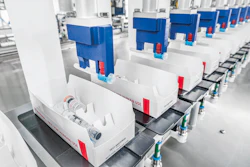
 QuadMedicine GMP IsolatorQuadMedicine
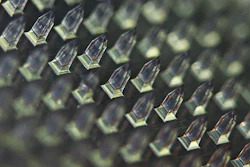
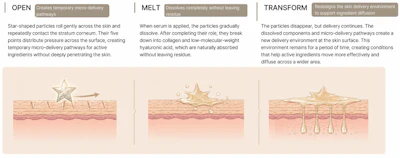
The microstructures are engineered from dissolvable biomaterials, including materials such as hyaluronic acid and hydrolyzed collagen, with controlled three-dimensional geometry. When applied to the skin, they create a controlled physical interaction with the skin surface and gradually hydrate and dissolve upon contact with moisture.
What makes R-MAP particularly interesting is not only the product itself, but what it demonstrates from a manufacturing perspective.
Liz Cuneo: What have been some of the challenges in moving from R&D or clinical-scale production into GMP-ready pharmaceutical manufacturing?
Dr. Cho: I think the biggest challenge is translating a manufacturing method that works in the laboratory into a process that is repeatable, controlled, and fully traceable in a GMP environment. You need to establish operating procedures and quality systems that are suitable for aseptic manufacturing. At the same time, you need to demonstrate that both the drug formulations and intermediate products remain stable throughout each stage of the manufacturing process until the entire lot is completed.
Ultimately, transitioning to the GMP level is about much more than demonstrating that you can make a good product. We need to demonstrate, with documentation and experimental data, that the process can repeatedly produce finished products of consistent quality, even though extended and complex manufacturing cycles.
Cuneo: What kinds of products will you be using with the microneedles?
Dr. Cho: We are currently working with global pharmaceutical companies on microneedle programs across a range of applications, including vaccines, peptides, and small-molecule drugs. Beyond pharmaceutical MAPs, we are also expanding our technology into other formats, such as our R-MAP platform for topical applications.
Cuneo: At what point in microneedle development does packaging come into the conversation?
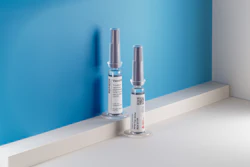
 QuadMedicine’s Patch-Type MAP ArchitectureQuadMedicine
Packaging is also closely connected to the way the user interacts with the product. The user needs to remove the product from the packaging and, depending on the product design, either attach it to an applicator or apply it directly.
We need to consider compatibility with the intended application device, how the package is opened, product orientation, and potential use errors. For that reason, I think the product, packaging, and applicator should be developed together rather than sequentially.
Cuneo: When we talk about microneedles, we’re talking about patches that someone would stick onto their skin. Is this something a person would do themselves, or would a doctor or nurse put it on the patient?
Dr. Cho: One of the key advantages of microneedle patches is the potential for self-administration. By reducing dependence on healthcare professionals, they could expand vaccine access and make repeated treatments more convenient, potentially improving patient compliance and overall healthcare delivery efficiency.
Cuneo: What does the primary packaging system for a microneedle product need to accomplish that might be different from conventional pharmaceutical or transdermal products?
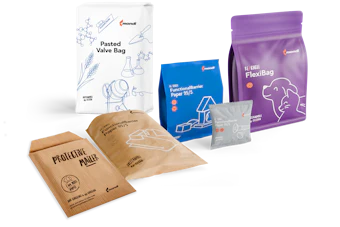
Dr. Cho: In addition to the barrier and sealing properties required for conventional pharmaceutical packaging, microneedle packaging needs to provide physical protection for the microstructures themselves.
The microneedles should not come into direct contact with other surfaces inside the packaging. Even when the product encounters pressure, vibration, or movement during storage and transport, the geometry and function of the microneedles need to remain intact.
At the same time, the package needs to protect both the drug and the microneedle structure from environmental factors such as moisture and oxygen, while minimizing the risk of damage or contamination during opening.
If the product uses an applicator, the packaging also needs to support correct orientation and reliable engagement with the applicator after opening. I would describe the primary packaging for a microneedle product not simply as a container, but as a functional component that helps maintain product performance and dosing accuracy.
 QuadMedicine’s R-MAP Microstructured ArchitectureQuadMedicine
Dr. Cho: This is a very important issue. Because microneedles can incorporate drugs in a low-moisture or completely solid state, they may offer improved stability compared with conventional liquid injection formulations and potentially reduce cold chain requirements.
However, converting a drug into a microneedle format does not automatically eliminate refrigeration or frozen storage requirements. Stability will still depend on the properties of the active pharmaceutical ingredient, formulation composition, residual moisture, the manufacturing process, and packaging performance.
I think a more realistic development strategy is to think about progressively relaxing storage requirements rather than assuming that every product can immediately become a room-temperature product.
For example, the objective might be to allow a refrigerated product to remain stable at room temperature for a defined period, or to move a product that previously required storage below −20°C into refrigerated conditions.
Ultimately, any such improvement has to be demonstrated on a product-by-product basis through long-term and accelerated stability testing.
Cuneo: Did you learn anything during development and testing that surprised you as you worked to scale microneedle manufacturing?
Dr. Cho: One of the biggest lessons we learned during scale-up was that product quality depends not only on each individual manufacturing step, but also on how those steps are connected.
In particular, it was challenging to maintain the stability of the drug formulation in an aseptic environment while loading it onto the microneedle platform, and then inspecting the intermediate product, all while maintaining the same level of reproducibility throughout the process.
At the R&D stage, we tend to focus primarily on whether an individual product performs as intended. But once you move into scale-up and mass production, relatively small variables—such as processing time, hold time between manufacturing steps, and environmental conditions—can become very important.
One of our key learnings was that successful scale-up is not simply about optimizing individual unit operations. It is about controlling the entire manufacturing process as one integrated and reproducible system.
Cuneo: Do you believe that your GMP-ready process moves the industry closer to having a standardized microneedle manufacturing platform, rather than developing an entirely new production process for each product?
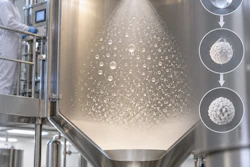
Dr. Cho: I believe there is significant potential for platformization if we can standardize the common manufacturing unit operations and quality control framework. For instance, fundamental operations such as drug formulation preparation, drying or stabilization, and intermediate product inspection can potentially be established as a common manufacturing platform.
Then, depending on the physicochemical properties, drug dose, and stability requirements of each drug, only the necessary elements would need to be modified or optimized.
This does not mean that every microneedle product would be manufactured under exactly the same process conditions. The idea is to establish a validated common manufacturing foundation and then optimize only the product-specific parameters that need to change.
As we accumulate manufacturing and quality data from each unit operation, I also believe there is an opportunity to use AI and advanced data analytics to detect process deviations earlier, optimize manufacturing parameters, and improve inspection efficiency. Over time, the platform can become increasingly data driven as well as standardized.
Cuneo: We talked a little about how the packaging for microneedle technology has to work for the end user, whether that’s the patient or a healthcare provider. How did you consider human factors into the packaging and delivery system design?
Dr. Cho: For a microneedle product, I don’t think we can treat the patch, packaging, application device, and instructions for use as completely separate components. How the user holds the product, the orientation in which it is applied, the amount of force used, and whether it remains in place for the required period can all potentially affect actual drug delivery.
Therefore, we need to consider the characteristics of the intended users from the early stages of development, whether they are healthcare professionals, general patients, or other specific populations. Potential use errors need to be identified and, wherever possible, prevented through design.
For example, a user might insert the product in the wrong orientation, apply insufficient force, or remove it before administration is complete. It is also important to provide intuitive feedback that allows the user to understand whether the product has been applied correctly.
Cuneo: What about the sustainability implications of the product? I imagine we’re moving away from something like a large plastic bottle. Are there other material savings from going this route?
Dr. Cho: I think sustainability in microneedles should be considered more broadly than environmental impact alone. It also includes the scalability of the platform across different pharmaceutical products and the potential efficiency of the global supply chain.
Unlike conventional liquid injectables, microneedles can potentially incorporate drugs in a low-moisture or solid state. The technology can potentially be applied across different product classes, including vaccines and peptides. It may also improve ease of administration and consistency of use, which could reduce some of the burden on both healthcare systems and patients.
However, a microneedle product is not automatically sustainable simply because it replaces a conventional injection. We still must consider product-specific stability, manufacturing costs, packaging materials, disposable applicators, and end-user waste.
Meaningful sustainability will require us to optimize the entire product system, including product performance and usability, but also opportunities to simplify packaging, potentially reduce cold chain requirements, and minimize the number of components required for administration.
Cuneo: Where do you see the greatest remaining barrier to broad-scale commercialization, whether in the U.S. or elsewhere? Is it manufacturing scale, packaging stability, regulatory validation, or cost?
Dr. Cho: One of the biggest remaining challenges is establishing robust manufacturing capability at each unit operation, and then demonstrating that, when all of those operations are connected, the overall process consistently produces finished products of the required quality.
That requires more than process reproducibility alone. Raw materials and intermediate products, in-process controls, finished product specifications, analytical methods, packaging, and stability all need to come together within a coherent framework.
In my view, commercialization is not simply about increasing production volume. The key is building sufficient evidence to demonstrate that both the process and product quality remain consistently controlled at the commercial manufacturing scale.
Want to learn more about this technology? Be sure to catch Industrializing Microneedle Array Patches: Lessons Learned from GMP-Ready Manufacturing Platform, Dr. Cho’s presentation at PharmSci 360 October 25-28.