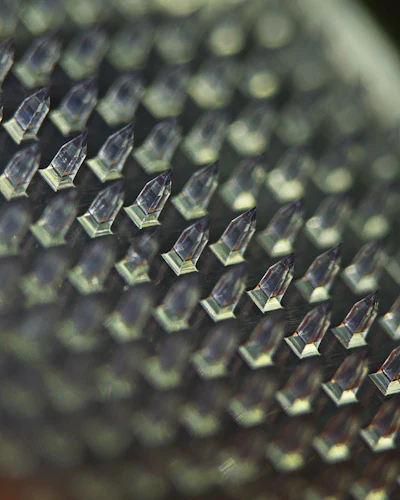
Microneedle array patches (MAPs) are pre-dosed delivery systems that eliminate cold chain dependency, reduce packaging complexity, and enable shelf-stable vaccine administration with improved efficacy compared to traditional injections.
- MAP technology packages therapeutics as a single, pre-dosed, shelf-stable patch, eliminating vials, syringes, and multi-component kits that create user error and waste
- Clinical trials show MAP vaccines demonstrate improved stability, safety, and immunological efficacy compared to conventional vaccine administration
- Removing cold chain dependency could eliminate the $34 billion spent annually on cold chain logistics in the U.S. and expand access to low-resource settings
- Packaging priorities shift from thermal protection to moisture barrier performance, requiring desiccants, tight seals, and careful material selection for dissolvable platforms
- Scalable manufacturing at millions of units monthly is critical for widespread adoption in clinical and direct-to-consumer settings
Key Takeaways:
- Microarray patch (MAP) technology has the potential to eliminate the need for multi-component kits with a single, shelf-stable patch format.
- One of the most exciting MAP promises is the potential to ease cold chain dependence.
The packaging community can help accelerate MAP readiness by treating packaging as a front-end design requirement, not a late-stage handoff.
Microneedle array patches (MAP) are in development as a new delivery system for vaccines. According to the National Library of Medicine, preclinical and clinical trials with a vaccine MAP showed improved stability, safety, and immunological efficacy compared to conventional vaccine administration.
Panther Life Sciences says its microarray patch (MAP) technology has the potential to eliminate the need for multi-component kits (vials, syringes, cold chain, sharps) with a single, shelf-stable patch format.
This shift from traditional injectables to these microneedle patches introduces a new model for pharma packaging and logistics, one that drastically reduces packaging complexity, waste, and infrastructure across the supply chain.
In a recent interview, I spoke with Jay Salazar, senior director of device development at Panther Life Sciences. He framed the technology as a “route to deliver therapeutics into immune-rich layers just beneath the skin.” This technology may even enable high efficacy at lower doses, and will likely force the packaging industry to rethink what “primary packaging” means for injectable-format therapies.
“We’re passionate about making microneedle arrays a reality,” Salazar says. “If we can remove cold chain dependency and simplify delivery, we have a real opportunity to expand access to people who are currently untreated or undertreated.”
That passion, he says, is centered on making microneedle arrays a reality, not just a promising lab concept. For packaging engineers, the implications are immediate: if MAPs can reduce reliance on cold chain and eliminate multi-component injectable kits, the packaging format, materials, and sustainability analysis will look very different.
From hypodermic kits to pre-dosed patches
Traditional injectable therapies commonly arrive as multi-component systems consisting of vials, syringes, needles, alcohol wipes, instructions, sharps handling, and secondary packaging designed to keep those components safe, sterile, and compliant. Even in controlled environments, that complexity introduces human factors risks and sustainability concerns due to excess material waste.
“With standard of care right now… you have these multi-component kits,” says Salazar. “You have a glass vial… you have to take that syringe and extract the dose… there’s a lot of room for user error… and from a sustainability standpoint, there’s a lot of packaging.”
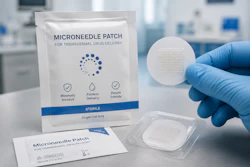
MAPs flip that script by packaging the dose as the device. “Imagine you open a package, you have one foil pouch,” Salazar explains. “You tear that foil pouch open, and then you remove your microneedle that is already pre-dosed, and you can apply it directly to the patient.”
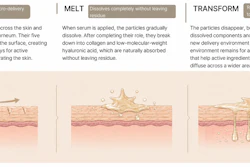
“With a light press, you could push it onto the skin… it would sit there for a period of time while the treatment is dissolving,” he says. “There’s no more sharps… and you can dispose of it as just a normal waste.”
For packaging engineers, this is a fundamental shift. Instead of packaging a drug container plus delivery system, the packaging protects a pre-dosed delivery platform. That changes everything from line design and inspection strategies to secondary packaging configuration and disposal guidance.
Moving away from cold chain
One of the most exciting MAP promises is the potential to ease cold chain dependence.
“I think really where microneedles sit and where they can be the most advantageous is in the infectious diseases space,” says Salazar. “If there's a way that we can create a shelf stable vaccine, that again, allows us to remove the cold chain requirement, we can get treatments to low resource settings where they don't have the cold chain infrastructure in place.”
Aside from aiding in global drug access, reducing reliance on cold chain helps to solve other issues present in high-resource markets.
“Even though we have the cold chain in place… there’s still a lot of issues associated with transporting treatments,” he says. “If it’s exposed to any extreme environment… there’ll be some sort of degradation of the molecule.”
He cites seasonal flu vaccination as an example of the challenge. “What we’ve seen is… 25% of seasonal influenza vaccine shows up at pharmacies and it has some form of degradation,” explains Salazar.
If MAP platforms ultimately deliver the stability profile developers hope for, packaging and supply chains could be re-optimized around ambient distribution. This would in turn reduce the number of components that sit in the packaging, rendering them significantly lighter than traditional multi-component kits. Thus, reduced weight in shipping would be realized, while removing the amount of packaging, thermal components, and energy required for cold chain logistics.
“If you could just remove the roughly $34 billion that is spent on the cold chain annually in the U.S.… there’s a massive opportunity to change the way we distribute and package those treatments,” he says.
But in packaging terms, reduced thermal sensitivity doesn’t mean reduced packaging requirements. In fact, in this case, it means a different critical-to-quality attribute takes over, moisture. For dissolvable microneedle platforms, moisture and humidity may become the dominant packaging risk. Because the product is designed to dissolve when it contacts interstitial fluid, environmental moisture exposure can prematurely compromise needle integrity.
“Humidity and moisture become very important for us,” says Salazar. “As a dissolvable microneedle platform… it’s designed so that when it starts to interact with the interstitial fluid in your skin, it can dissolve. But if you leave it out in the environment… your needles can start to dissolve prematurely.”
In other words, MAP packaging will prioritize high moisture barrier performance with things like desiccants, tight seal integrity, and careful material selection, over the thermal protection strategies common in many biologics.
“Making sure your packaging has solid moisture barrier is important to maintain the integrity of the patch,” says Salazar.
Direct-to-consumer aspirations and manufacturing scale
MAPs invite a new set of questions about where and how therapies are administered. I asked if these patches could work for at-home use, as more consumers today are taking hold of their health and are more comfortable than ever administering medicines at home (think injections).
“Aspirationally, we hope we can at least get it more direct to the patient,” says Salazar. “But at the end of the day, we’re talking about therapeutics… this needs to be prescribed… and there’s going to have to be a prescription foundation.”
For packaging, that implies a widening range of users and settings, with clinician-led use at first, then potentially patient-led application. This would then mean new requirements for intuitive opening, clear IFUs, tamper evidence, and safe household disposal.
Widespread MAP adoption, whether in a healthcare setting or a home, depends on scalable, GMP-compliant manufacturing. Salazar says much of the company’s energy is aimed at moving from lab-scale processes to high-throughput production.
“I think at a high level, what we're focusing energy on is translating what has been the lab academic (phase one) to (phase two) clinical study manufacturing lines into something that is obviously highly regulated, meets all the utmost quality standards for manufacturing, and can be scaled. But we're not talking about tens of thousands of units a month, we're talking about millions of units a month to be able to support what we're going after.”
From a packaging operations perspective, that scaling journey matters: it influences batch sizes, inspection regimes, in-line vision systems, pouching speeds, seal validation, and the ability to maintain low-moisture exposure during packaging operations.
What packaging leaders should prepare for now
 Jay Salazar is the senior director of device development at Panther Life Sciences. Panther Life Sciences
“I love focusing on packaging first,” he says. “Packaging can be left to the end, but if you’re not designing with the end in mind, you can get to a point where you actually are significantly delayed, and it may take longer to get your product to the patient.”
Whether MAPs reach that scale soon or later, the packaging implications are already clear. “Imagine a world where all treatments are direct to consumer… we can ship this around the world… and if we were ever to have another pandemic, we could have a massively deployable system to treat everybody.”