Inbrija, an FDA-approved inhaled levodopa therapy for Parkinson's OFF episodes, achieves superior lung delivery through engineered low-density particles and spray-drying technology rather than traditional carrier-based approaches. Successful scaling from smaller to larger spray dryers required precise control of atomization geometry, drying rates, and moisture-barrier packaging to maintain the particle properties essential for 60% lung bioavailability.
- Inbrija delivery advantage: Approximately 60% of the dose reaches the lungs, compared with 10-30% for traditional dry powder inhalers
- Carrier-free design: Inbrija uses engineered hollow particles instead of coarse lactose carriers, allowing higher active drug concentration in single capsules
- Spray-drying technology: Droplets dry in fractions of a second, enabling precise control of particle size and aerodynamic properties for deep lung penetration
- Scaling challenge: Transitioning from PSD-4 to PSD-7 spray dryers required widening spray plume angles to increase drying rates and preserve intended particle morphology
- Moisture protection: Cold-form aluminum blister packaging maintains below 20% relative humidity during filling and provides high moisture barrier for shelf-life stability
Inbrija is an FDA-approved inhaled levodopa therapy and is designed to quickly relieve “OFF” episodes in Parkinson’s patients treated with carbidopa/levodopa (when the effects of their regular medication wear off and symptoms begin to return). The medicine is delivered through the lungs rather than the gastrointestinal tract.
Alan Watts, Director, Technology and Innovation – Pulmonary & Nasal at Catalent, a CDMO for pharma and biotech, will be presenting on the manufacturing challenges of scaling this product at the upcoming PharmSci 360, taking place in New Orleans in October. I sat down with him to pick his brain about both the manufacturing and packaging challenges of scaling this inhaled drug.
Engineering the Particle Instead of Adding a Carrier
Catalent has manufactured the commercial product for roughly five years, according to Watts. More recently, the CDMO has focused on scaling the spray-drying process to increase manufacturing capacity while maintaining the powder characteristics established at the original commercial scale.
But behind the scaling of Inbrija was a manufacturing and packaging challenge: producing a high-dose, extremely low-density powder with the aerodynamic properties needed to reach the lungs, filling it consistently into capsules, and protecting the moisture-sensitive formulation through its shelf life.
According to Watts, traditional dry powder inhalers (DPIs) have commonly used coarse lactose as a carrier for micronized drug particles. The carrier assists with both powder filling and aerosolization, helping prevent the fine drug particles from adhering to one another. Inbrija takes a different approach.
Rather than depending on a large quantity of carrier material, the manufacturing process creates low-density, hollow particles engineered specifically for aerosol performance.
“If we think of all the dry powder inhalers that have been popular in the past, products like Advair and Spiriva, these used coarse lactose,” explains Watts. The drugs are milled and blended with lactose, which aid in filling while also helping the product disperse during inhalation.
With the spray-dried formulation, those aerosol properties can instead be designed into the particles themselves.
“In the inhaled world, we're concerned with solubility, but we're more concerned with particle size and the aerodynamic properties of that particle,” he says. “Because it needs to get all the way through the airways, deep into the lungs.”
That engineering makes a significant difference in delivery efficiency. “Approximately 60% of the Inbrija dose can reach the lungs, compared with roughly 10% to 30% for many historical dry powder inhaler technologies,” says Watts.
The carrier-free approach also allows a comparatively large quantity of active drug to fit within a single capsule, which is inserted into the inhaler. When the patient inhales through the device, the powder is aerosolized and drawn into the lungs.
Engineering the Particles
Producing a powder capable of providing high performance requires tight control over its physical structure. To keep that performance and scale operations, the company utilizes spray drying.
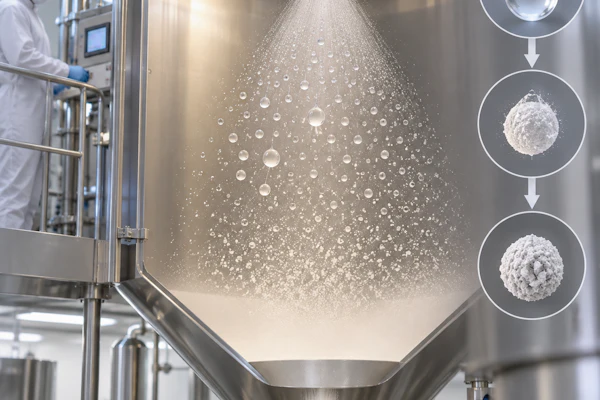
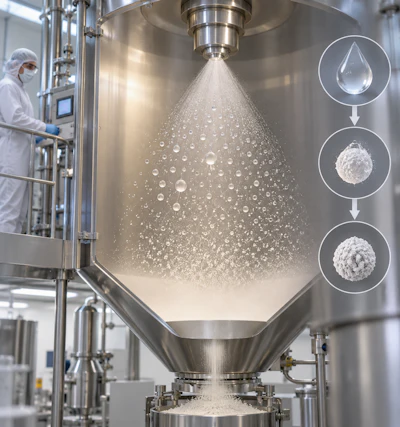
Spray drying begins with drug and excipients in a liquid feed that is atomized into droplets. Those droplets dry extremely rapidly—in a fraction of a second as they enter the drying chamber—and ultimately become fine powder particles, says Watts.
Spray drying is already used widely in pharmaceutical manufacturing, particularly to improve the solubility of poorly soluble oral drugs by stabilizing them in an amorphous state. For inhaled products, the technology provides an additional advantage: manufacturers can manipulate the physical and aerodynamic characteristics of the resulting particles.
“We can engineer the powders to be a few microns larger or a few microns smaller, depending on the drying rate, depending on the way we create the liquid atomization plume that eventually dries,” says Watts. “We're engineering these particles from a solution form into a solid form.”
Scaling From a Two-Story to a Four-Story Dryer
As commercial demand increased, Catalent sought to expand production capacity by transferring the process from the PSD-4 spray dryer to the larger PSD-7.
“We're going from a two-story spray dryer to a four-story spray dryer,” describes Watts.
Because development runs on equipment of that scale consume significant time and resources, the team first used thermodynamic modeling to establish initial operating conditions. The Catalent team already understood the conditions that produced the desired powder on the PSD-4. The goal was to use those known conditions to calculate starting parameters for the PSD-7, including the drying-gas environment, heat exposure, solvent behavior, and utility requirements.
The model helped the team determine how much gas would be required and estimate energy demands for equipment such as condensers used to remove solvent from the circulating process stream. But a model could only provide a starting point.
“Of course, it's all theoretical until you actually put it on the equipment,” says Watts. “That's when we began to fine-tune the process.”
When the Model Met the Manufacturing Floor
Inside the dryer, high-pressure nitrogen and liquid feed meet at the atomization nozzle, producing a three-dimensional cone of droplets. Catalent found that the original spray pattern was too narrow at the larger scale.
By widening the spray plume angle, the team increased the droplet drying rate. The faster drying helped preserve the intended particle morphology and hollow structure, producing powder with aerodynamic characteristics comparable to historical PSD-4 material.
“We discovered that we needed to create a larger angle to enable more rapid drying,” says Watts. “We were able to get a higher drying rate, which enabled the particles to form correctly, which allows them to fly—or have the correct aerodynamic properties.”
But once the particles left the spray dryer, another manufacturing challenge began. “The powder, when it comes down, looks like snow,” says Watts. “It's very low density, very fluffy.”
Those characteristics may be ideal for aerosolization but are less convenient for high-speed capsule filling. Low-density powders tend to have poor flow properties, making consistent dosing more difficult than with conventional pharmaceutical powders.
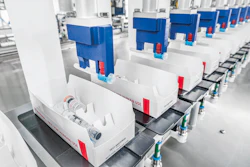
Customized filling technology was therefore incorporated into the manufacturing operation. Operators wearing appropriate protective equipment continuously monitor the equipment and adjust parameters to maintain consistent capsule fills at production speeds.
Additionally, scaling the spray-drying operation meant that substantially more powder had to move through this downstream process.
To accommodate the larger batches, Catalent transitioned from roughly 200-L intermediate bulk containers (IBCs) to 1,000-L IBCs. Those containers were hoisted above the filling equipment, with both encapsulation and blistering operations running longer than they did with the smaller batches.
That increased processing time required additional attention to validation and sampling.
“We needed to sample throughout that and ensure that the powder was within specification the whole time,” explains Watts.
Packaging Becomes Part of Product Performance
For an engineered powder whose performance depends on maintaining precise physical properties, packaging is more than a container at the end of the manufacturing line.
Inbrija's powder is highly moisture sensitive. As a result, capsule filling and blister packaging take place under controlled humidity conditions below 20% relative humidity.
“The whole operation takes place [in] very dry conditions,” says Watts.
Once the powder has been filled into capsules, the package must maintain that protection through distribution and shelf life. Catalent uses a cold-form aluminum blister designed to provide a high moisture barrier.
“There is no perfect moisture barrier,” Watts notes, but the aluminum-based cold-form blister provides one of the strongest moisture barriers available for pharmaceutical packaging.
Preventing moisture ingress helps preserve the powder characteristics established during spray drying, supports shelf life, and reduces the risk that environmental exposure will interfere with aerosolization and delivery.
“If you don't have a stable product, the shelf life is reduced, and there's more waste,” says Watts. Maintaining the product within its intended range from release through stability therefore depends not only on particle engineering but also on the environment in which the capsules are filled and the barrier properties of the final package.
This project demonstrates the interconnected nature of manufacturing and packaging for advanced inhaled therapies. A change made upstream—from atomization geometry to drying rate—can influence particle morphology and aerodynamic behavior. Those particles must then flow through capsule-filling equipment consistently, while humidity control and high-barrier blister packaging must preserve their properties until the patient uses the inhaler.
Attending the event later this fall? You can hear Watts talk about the Inbrija scale-up in greater detail during his presentation at PharmaSci 360 October 18-21.