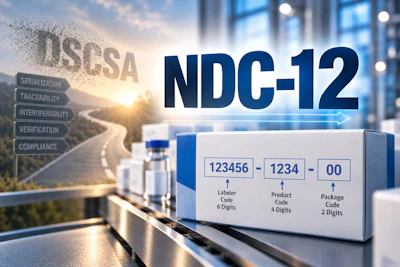
The FDA is transitioning the National Drug Code from a 10-digit to a uniform 12-digit format, with a hard stop deadline of March 7, 2033, requiring pharmaceutical manufacturers and supply chain partners to update systems, equipment, labeling, and processes across their entire operations.
- The NDC-12 transition deadline is March 7, 2033, with no extensions feasible due to limited remaining labeler codes.
- Companies have a seven-year preparation period (March 2026-March 2033) to update systems, labeling, barcodes, and packaging equipment.
- The FDA is consuming approximately 1,000 NDCs annually, with only about 10,000 codes remaining before exhaustion.
- The transition requires cross-functional coordination across regulatory, IT, packaging, finance, and supply chain teams, plus collaboration with trading partners and technology vendors.
- Companies should start assessments immediately to identify where NDC data exists in systems, plan equipment upgrades, and coordinate with other capital projects to avoid duplicate investments.
For pharmaceutical manufacturers still consumed with Drug Supply Chain Security Act (DSCSA) implementation and exception handling, another major industry transition is quickly moving onto the agenda: the shift to the 12-digit National Drug Code (NDC).
At the recent Healthcare Distribution Alliance (HDA) Traceability Seminar, conversations that might have been expected to center largely on DSCSA instead repeatedly returned to NDC-12, and how much work remains to prepare for the change.
“There was a lot less to do with exception handling and DSCSA and so much more conversation about NDC-12,” says Rose Campasano, principal consultant of Criterion Consulting. “A lot of the light bulbs started going on around the room.”
The What
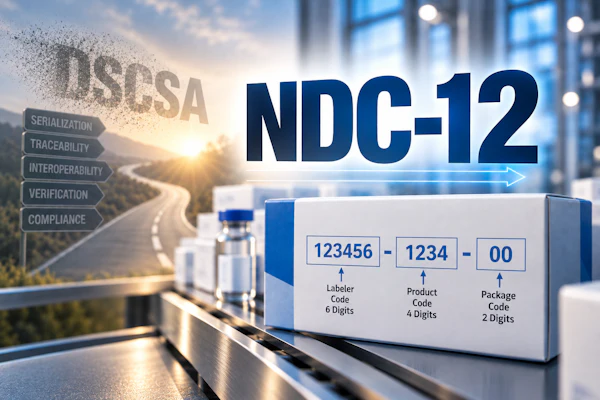
FDA’s final rule adopts a uniform, 12-digit format for the NDC as opposed to the current 10-digit format used today. The rule takes effect on March 7, 2033, which is when FDA will assign new 12-digit NDCs and convert all previously assigned 10-digit NDCs to the uniform 12-digit NDC format.
During the seven-year period before the rule takes effect (March 5, 2026 – March 6, 2033), FDA will continue to assign 10-digit NDCs in the current formats. Manufacturers, distributors, repackagers, relabelers, pharmacies, health care providers, payors and other supply chain partners should use this time to update their systems, processes, and infrastructure to handle the 12-digit NDC format by March 7, 2033.
“If you’ve heard the 2030 date, that is related to systems testing,” says Libby Dewey, manager, DSCSA, Cardinal Health, who participated in a panel on the three- year NDC-12 transition period at the HDA event. “There’s a general understanding that, with interoperability in the industry, we need to be able to test across multiple trading partners. The goal date for that testing to begin is around 2030.”
The seven-year period before the rule takes effect is intended to provide companies with sufficient time to update their labeling to ensure that updated labeling with NDCs in the new 12-digit format are ready for use on the effective date.
“That’s also the point when the FDA can take regulatory action against any product that is still in the industry or being introduced into commerce with the 10-digit format,” says Dewey.
Although 2033 may sound distant, the transition has implications for labels, barcodes, printing and vision systems, software, inventory management, production planning, and potentially packaging equipment itself. The NDC-12 focus at the seminar was to get the industry informed and ready.
“The overall tone of the event this year was collaborative, pragmatic, and cautiously confident,” says Libby “It seems to be very well understood that NDC-12 is more than a formatting update. The industry understands that this is a broad transformation, and it affects operational, commercial, and regulatory processes across the healthcare supply chain.”
Luckily the industry appears well prepared to take on the new challenge, or puzzle, as it was referred to by Kala Shankle, Healthcare Distribution Association’s vice president, regulatory affairs.
“These organizations are really good at solving complicated supply chain and interoperability problems,” says Shankle regarding this year’s event participants. “We just watched the pharmaceutical supply chain undertake an enormous transformation through the DSCSA and traceability. There was tremendous expertise in the room, and I think that begets the intrigue around the puzzle that it presents to the supply chain.”
The Why
Unlike some previous pharmaceutical traceability deadlines (DSCSA), the industry shouldn't plan on this one moving. FDA officials have been emphasizing that companies should treat the transition date as firm.
“I really think the message the industry should take from the FDA is this is runway, and you need to use it,” says Shankle.
Shankle described an FDA presenter that shared the math behind the rule. “We burn through 1,000 NDCs a year. The last estimate she had was that we have about 10,000 NDCs left…so you do the math. There's a reason there's a specific runway enumerated in the rule.”
The industry's experience during the COVID-19 pandemic also illustrates why preserving sufficient numbering capacity matters.
“During COVID, we went through something like 6,000 or 7,000 NDCs. I asked why and found out that one of the reasons could be that everybody starting to make hand sanitizer,” describes Shankle.
A sudden influx of products, like hand sanitizer, can accelerate the consumption of available codes and make long-term projections less certain. For packaging organizations, that makes 2033 less of a distant regulatory date and more of an endpoint for a lengthy conversion process.
The How
The consistent message heard from FDA, HDA, and industry speakers was straightforward: start now. That doesn't necessarily mean immediately replacing packaging equipment or redesigning every label. Instead, companies first need to understand where NDCs reside throughout their operations.
“High level, the messaging from all the panels was: Understand your own environment. You need to know where the NDC lives in your inventory and systems, and where systems make assumptions about the existing NDC structure. There's a lot of mapping that you have to do, and that's consistent for all supply chain actors,” says Shankle.
Another important thing the FDA mentioned is that companies shouldn't think about this transition in isolation.
“Each sector is going to be working on itself, but there are also the barcode changes in the final rule,” says Shankle. “That's really important for companies to think about: how that information is going to move through the supply chain.”
That inventory should extend well beyond the printed number on a pharmaceutical package. NDC data may reside in labeling systems, artwork files, enterprise software, databases, financial systems, warehouse systems, production equipment, scanners, cameras, printers, and other platforms throughout the organization.
This is one reason the transition cannot belong solely to regulatory affairs or packaging. Different departments may not even have the same understanding of their company's preparedness. Regulatory personnel may be familiar with FDA's rule, while IT sees NDC-12 primarily as a data-field change. Packaging engineers may be concerned with printing and inspection, while finance is looking at capital requirements.
Campasano recommends companies bring those perspectives together early. Additionally, implementation of the NDC rule will really be a collaborative effort. Similarly, Dewey says that it needs to be a supply chain-wide transition, not simply a labeling or FDA compliance project.
“No single organization controls the entire transition. Leadership is distributed across several groups, including the FDA, manufacturers, technology vendors, industry standards organizations, and trade associations,” says Dewey. “This can’t be implemented on an organization-by-organization basis. If one link isn’t ready, the entire workflow can break.”
The Question
For packaging professionals, one of the biggest questions is whether existing line equipment will be capable of accommodating the transition. A manufacturer could, for example, decide to eliminate a linear barcode containing the NDC and instead encode the information within a 2D DataMatrix barcode. But adding or changing encoded data can have downstream consequences.
“The printing technology may not be sophisticated enough,” says Campasano.
Barcode quality is one concern. A code that currently achieves a high verification grade could potentially perform differently as data changes. That means companies need to evaluate not only their label artwork but also printers, scanners, cameras, lasers, inspection systems, and associated software.
“How old is your equipment now?” Campasano asks. “If you make that decision, what's the impact?”
The situation has a familiar precedent.
During DSCSA serialization and aggregation implementation, pharmaceutical manufacturers and contract organizations made widespread investments in cameras, scanners, readers, and other packaging-line technology. As companies raced toward implementation at roughly the same time, equipment suppliers faced intense demand.
Campasano warns that another industry-wide equipment rush is possible if companies wait too long to determine what needs to be replaced or upgraded.
It’s Not a Competition
The transition also presents a budgeting challenge. Some companies Campasano spoke with have already begun internal assessments and expect to complete them by late 2026 or early 2027. Others have started raising the issue with finance because they recognize that implementation could require multi-year funding.
The challenge is that NDC-12 won't occur in isolation.
Pharmaceutical manufacturers will simultaneously be upgrading production lines, replacing aging equipment, implementing new software, launching products, and pursuing other digital transformation and capital projects.
Instead of forcing NDC-12 investments to compete with those initiatives, Campasano suggests looking for opportunities to combine them.
“If there's another project that's going into, let's say, the financial system to upgrade financials or whatever, make sure that maybe you can piggyback the changes into that change,” she says. “Instead of competing with it, collaborate.”
The same strategy could apply on the packaging floor. If a manufacturer already expects to replace a printer, camera, vision system, or packaging-line control platform before 2033, NDC-12 requirements can become part of the specification for that investment.
Doing so could reduce duplicate work while preventing companies from purchasing equipment today that will require another upgrade several years later.
Don't Forget Packaging Inventory
Physical packaging inventory presents another issue.
Manufacturers need to work backward from the transition to determine when labels and other printed packaging carrying the existing NDC format should stop entering production.
“If in 2033 you've got to start pushing out the labels with NDC-12s, what's your demand planning look like and your labeling look like so that you don't get caught with inventory that's got an NDC-10 on it?” Campasano asks.
Excess inventory could potentially leave manufacturers facing relabeling, rework, or obsolete packaging materials. For products with long shelf lives, planning could become particularly complex. Packaging, regulatory, supply chain, and production teams will need to understand how legacy products move through manufacturing and distribution and how long existing inventory may remain in the marketplace.
The Time is Now
For packaging teams, perhaps the most important lesson from the HDA event discussions is that NDC-12 should not be treated simply as a regulatory database change. Its effects could extend from enterprise systems all the way to the packaging line—and ultimately to the printed package itself.
Companies need to determine where NDC data resides, assess packaging and inspection equipment, evaluate barcode strategies, plan packaging inventory transitions, coordinate with trading partners, secure funding, and align the work with other capital and technology initiatives.
Those activities take time.
“The good news is that the FDA has provided a very lengthy implementation timeline, so there’s plenty of opportunity for the industry to prepare thoughtfully,” says Dewey. “Most organizations understand that it’s not a simple data-format change but a broader operational and technology transformation, although readiness varies across the industry.”
Campasano says the growing attention around NDC-12 suggests that awareness is finally spreading beyond regulatory and technical specialists to executives, finance leaders, packaging operations, and others who will ultimately need to support the transition. “Everything is evolving very rapidly now,” she says.
The next several years are going to be critical as companies move from assessment and planning into making system updates, testing, and trading partner coordination. March 2033 may still be years away, but the decisions that determine whether a company is ready for it will need to be made much sooner.
The key takeaway is to start preparing now. The FDA has shared that extensions are not feasible because they’re running out of labeler codes.