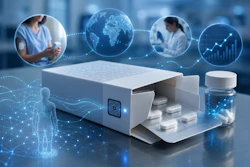
The global AI drug discovery market is projected to grow from $5.09 billion in 2026 to $17.56 billion by 2031, driven by pharmaceutical companies adopting integrated, cloud-based AI platforms that combine generative AI, high-performance computing, and laboratory data management to accelerate drug development and reduce costs.
- Market size expected to reach $17.56 billion by 2031, up from $5.09 billion in 2026, representing a 28.1% compound annual growth rate
- Pharmaceutical firms are shifting from isolated AI tools to fully integrated discovery platforms that manage complex datasets and workflows across entire R&D operations
- De novo drug design (creating novel molecular structures) was the largest use case in 2025, leveraging generative AI to rapidly generate and optimize candidate molecules
- Cloud-based deployment models are becoming essential for scalable infrastructure to handle massive biological datasets without large on-premises investments
- Asia-Pacific region is expected to see the highest growth rate, driven by increased R&D spending, government support, and expanding biotech ecosystems in China, Japan, South Korea, and India
The market for artificial intelligence in drug discovery is poised for significant expansion, projected to reach $17.56 billion by 2031, up from an estimated $5.09 billion in 2026, according to a new report from MarketsandMarkets. This growth, representing a compound annual growth rate of 28.1%, is driven by a strategic shift within pharmaceutical and biotechnology companies toward integrating AI across the entire research and development continuum to improve productivity and lower costs.
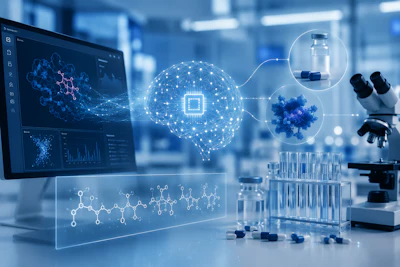
The report highlights a move away from using AI for isolated research tasks. Instead, companies are adopting comprehensive platforms that merge high-performance computing, generative AI, and laboratory data management. This trend is exemplified by the January 2026 announcement of a co-innovation lab by NVIDIA and Eli Lilly, with planned investments of up to $1 billion over five years to develop foundation models for biology and chemistry. According to the analysis, "AI infrastructure, proprietary foundation models, and integrated discovery platforms are becoming key differentiators as pharmaceutical companies transition toward data-driven and AI-native R&D environments."
Generative AI and Cloud Computing Drive Adoption
The use case of de novo drug design, or creating novel molecular structures, represented the largest market share in 2025. The report attributes this to the adoption of generative AI and deep learning, which allow researchers to "rapidly generate, screen, and optimize candidate molecules while reducing reliance on traditional trial-and-error approaches."
Supporting this technological shift is the rapid adoption of cloud-based deployment models. The need for scalable infrastructure to handle massive biological datasets and complex computational requirements is making cloud platforms essential for collaborative, multi-team research efforts without requiring large on-premises infrastructure investments.
Asia-Pacific Emerges as a High-Growth Region
Geographically, the Asia-Pacific region is projected to register the highest growth rate through 2031. This is fueled by increased pharmaceutical R&D spending, government support for AI and life sciences, and expanding biotech ecosystems in countries like China, Japan, South Korea, and India. The report notes that growing collaborations between pharmaceutical firms, technology providers, and research institutes are accelerating the adoption of AI-enabled discovery platforms across the region. Key players in the global market include NVIDIA, Google, Microsoft, Recursion, and Insilico Medicine.