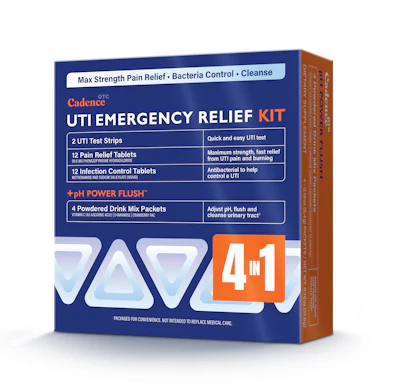
Cadence OTC's UTI Relief Kit combines test strips, pain relief medication, antibacterial agents, and a supplement drink mix into a single 48-hour early-response system designed to guide users through treatment at the first sign of symptoms.
- The kit includes four integrated components: test strips for detection, phenazopyridine for pain relief, methenamine as an antibacterial agent, and a vitamin C and cranberry drink mix
- FDA regulations prohibit packaging OTC drugs and supplements together, so Cadence designed a dual-package system with a cover card and shrink wrap to function as one unified product
- The kit is structured as a 48-hour regimen with clear labeling and instructions on each component to guide users through proper dosing and timing
- Packaging was engineered to meet retail constraints, including reducing height to five inches and designing side panels for alternative shelf orientations in convenience stores
- Each component is housed in labeled sleeves with a fold-out booklet containing a QR code linking users to healthcare providers for antibiotic prescriptions if infection persists
Key Takeaways:
· Cadence OTCs UTI Relief Kit combines testing, treatment, and support into a simple, early-response system.
· Regulatory limits led to a dual-package design that works as one cohesive kit.
· The kit offers clear guidance, QR-enabled care, and retail-ready sizing to improve access and usability.
When a urinary tract infection (UTI) strikes, timing is everything. That’s the ‘why’ behind the launch of Cadence OTC’s first-ever UTI Emergency Relief Kit. The unique packaging approach shifts how complex treatments are delivered at retail by combining two over-the-counter (OTC) medications side-by-side with a targeted proprietary drink mix supplement. According to Cadence’s co-founder and CEO, Samantha Miller, UTIs are a common problem and the medicines at stores today leave users feeling confused at what to take.
“The way these products were being sold was confusing and not effective. We identified that there was a kit that could be put together to help in the immediate moment—right when symptoms first start,” says Miller.
With the launch of its UTI Emergency Relief Kit, the company is introducing a bundled, multi-component solution designed to be used at the first sign of symptoms—an approach that not only rethinks product formulation but also places packaging at the center of the user experience.
The idea for the kit was born out of a common problem: consumers are left to piece together their own treatment plans. To aid in this, the four-part kit combines diagnostics, symptom relief, and infection control into a single system. The kit includes:
- Test strips to detect and confirm the presence of a UTI
- Phenazopyridine for pain relief
- Methenamine, an antibacterial agent
- A drink mix formulated with vitamin C, cranberry PACs, and D-mannose
What sets the formulation apart is how these components work together, plus the kit helps users know what to take and when.
“These components exist individually,” says Miller, “but they’ve never been brought together in a way that actually works as a system.”
The kit is designed as a 48-hour regimen, guiding users through a structured, multi-dose approach during the critical early window.
When Regulation Shapes Design
While the concept of a bundled solution may seem straightforward, executing it was anything but. Current FDA regulations prohibit OTC drugs and dietary supplements from being packaged together in a single unit. That meant Cadence OTC had to rethink how to deliver a unified experience while maintaining strict separation.
 The dual-package system includes a drug/device carton containing the medicines and test strips, as well as a supplement carton containing the drink mix. Each package functions independently, complete with its own UPC, labeling, and instructions.Cadence OTC
The dual-package system includes a drug/device carton containing the medicines and test strips, as well as a supplement carton containing the drink mix. Each package functions independently, complete with its own UPC, labeling, and instructions. But to present them as a cohesive product, the company introduced a cover card and shrink wrap, effectively “kitting” the two units together at retail. The result is a package that appears unified on the shelf while remaining compliant behind the scenes. Beyond regulatory hurdles, the team faced another critical challenge: usability.
Miller stresses that UTIs are urgent and uncomfortable, and consumers may be navigating treatment decisions under stress. Packaging, therefore, had to do more than contain, it had to guide.
“We wanted it to be intuitive,” Miller explains. “Clear sleeves, clear labeling, and instructions right where users need them.”
To do that, each component is housed in its own labeled sleeve, with instructions printed directly on the packaging. So if the outer box is discarded, all necessary information remains accessible. A fold-out booklet then provides additional guidance, including a QR code that takes the user to a chosen provider that can then prescribe antibiotics should the infection persist.
“It’s a way to bridge between over-the-counter products and medical care,” Miller says.
Retail requirements added another layer of complexity. The original design exceeded six inches in height, which proved to be too large for many store shelves. The team ultimately reduced the package to approximately five inches, sourcing smaller test strips to meet the constraint.
Convenience stores presented an additional challenge: limited shelf space and alternative display orientations.
“One of our partners told us they could only sell it on its side,” Miller says.
That meant the team needed to redesign the side panel to function as a secondary front-facing display, ensuring branding and key information remained visible regardless of orientation. For Cadence OTC, the project underscores a key takeaway: packaging is not an afterthought, it’s a foundational part of the solution.
“We spent a lot of time on packaging right from the start,” Miller says. “It has to sell the product, explain it, and help the user all at once.”
While the kit is launching with a short-term exclusive at Walmart, Cadence OTC is prioritizing expansion into grocery and convenience channels, and Miller says the packaging will continue to evolve to meet users’ needs.
“We’re still refining; packaging is never truly finished—there’s always room to improve.”