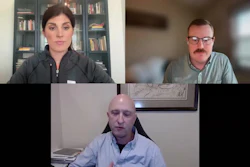
Matt Reynolds: Hello, I’m Matt Reynolds, editor of Packaging World magazine, and I’m joined by my colleagues across PMMI Media Group. I’m here with Liz Cuneo, editor of Healthcare Packaging; Sean Riley, editor of OEM Magazine; and Derrick Teal, chief editor of ProFood World.
We’re geographically spread out, with me in Chicago, Derrick near Detroit, Sean in the Philadelphia area, and Liz in Charleston. Since we can’t meet in person on Fridays, we’ve started a virtual “Safety in Numbers” discussion to share what we’re working on, compare notes, and make sure we’re not operating in silos.
Here in Chicago, the temperature recently reached 74 degrees before dropping to 34 overnight. The seasons are clearly changing, pollen is everywhere, and as you can probably hear, my voice is affected by allergies. That got us thinking about packaging—not just as a container, but as something with functional properties that play a role in how products are administered. Liz, you had an interesting story related to that.
Liz Cuneo: Yes, and I’ll add that it’s been in the 80s here, although we did have a few days in the 50s, which is enough to trigger allergies.
This week, I had an interesting interview with the CDMO company Kindeva. I met someone from their team at Pharmapack, and we discussed their green propellants, which they have introduced in the UK.
We talked about what this means for inhalers. While consumers interact with the canister and the plastic housing, the propellant is really the engine behind the device because it enables the drug to be delivered into the lungs.
Traditionally, these propellants have had environmental impacts, similar to aerosol sprays and their role in ozone depletion. The industry phased out chlorofluorocarbons in 1987 and replaced them with hydrofluorocarbons, which still contribute to greenhouse gas emissions.
Kindeva has developed a greener propellant that significantly reduces emissions while still effectively delivering the drug. However, transitioning to this solution is not simple. It requires a full redevelopment of the product, including new packaging and manufacturing processes.
Despite these challenges, the industry is moving in that direction, especially with upcoming regulatory deadlines. What stood out to me is that we were not discussing the plastic device itself, but rather the propellant as a critical component of the packaging system. It really highlights how broad and complex healthcare packaging can be.
Matt Reynolds: That’s a great point. When we talk about sustainability in packaging, there are really two major aspects.
One is physical waste, including plastic pollution, microplastics, and recycling challenges. This is often what people focus on because it is visible in the environment.
The other aspect is emissions, including CO₂ and methane, which contribute to climate change. In many ways, this is an even larger and more complex problem. So, it’s important to think about sustainability from a full life-cycle perspective.
Sean, I know Casey Flanagan was out in the field this week. One of the biggest trends we’re seeing is the need for faster equipment delivery and shorter lead times. However, supply chain issues and tariffs are making that difficult. How are companies addressing this?
Sean Riley: The definition of speed has changed. It used to refer to how fast a machine could operate, but now it refers to how quickly you can get that machine into your plant. With economic uncertainty and supply chain disruptions, acquiring equipment takes longer than ever. It’s not due to machine builders; it’s simply the current state of the industry.
Casey looked at an interesting solution: a rental model from Frain Industries. Instead of waiting six to twelve months for new equipment, companies can rent machines and receive them in as little as two weeks, or even a few days for certain processing equipment.
Frain recently opened a facility that houses around 2,000 pieces of equipment from 70 OEM partners. It functions like a showroom where companies can find nearly any equipment they need.
This model benefits both users and OEMs. Companies can rent equipment while waiting for new machines to be built, allowing them to become familiar with the technology. Once their permanent equipment arrives, they can transition smoothly and return the rental unit.
For CPG companies, this provides an immediate solution to urgent equipment needs. While the model itself is not new, the scale and accessibility of this facility make it particularly effective.
Matt Reynolds: Does this apply only to packaging equipment, or does it include processing as well?
Sean Riley: It includes both. In fact, what surprised me was how quickly processing equipment could be deployed, sometimes in less than a week.
Matt Reynolds: Derrick, are you seeing similar trends on the processing side?
Derrick Teal: Yes, we are seeing similar models. For example, companies like Formic lease equipment, which addresses both speed and labor challenges.
Many companies no longer have the in-house expertise needed to maintain increasingly complex equipment. Leasing allows them to rely on external support instead of hiring specialized technicians.
In some cases, there may be only one technician available in a region to service a specific piece of equipment, and wait times can stretch into months. That level of downtime can be extremely costly.
Because of this, some manufacturers are shifting toward simpler, more mechanical equipment. While these systems may require more frequent maintenance, they are easier to repair in-house, which helps maintain uptime.
This trend reflects a broader challenge: as experienced workers retire, valuable institutional knowledge is being lost. While simpler systems can help preserve that knowledge, more complex systems often require highly specialized expertise that is harder to replace.
Liz Cuneo: That reminds me of appliances at home. They’ve become so complex that even simple issues require expensive repairs. For example, our dryer needed a new electronic component that cost around $300. It made me question why appliances have become so complicated when they should be simple and easy to fix.
Because of that, we’ve decided that future appliances will be as basic as possible so we can troubleshoot them ourselves and avoid relying on specialists.
Derrick Teal: I see the same thing with cars. Older vehicles were relatively easy to repair, but modern cars, especially hybrids, are much more complex. When something goes wrong, you often have no choice but to call a specialist.
Matt Reynolds:That brings us to another important topic we haven’t mentioned yet: AI. Some OEMs are using AI to preserve institutional knowledge by recording experienced technicians and storing that information in large language models. This effectively creates a digital version of their expertise, which can be used after they retire. AI also has the potential to assist with complex diagnostics because it can draw on vast amounts of technical knowledge, including physics and engineering principles. Derrick, you also saw some AI-related news this week.
Derrick Teal: Yes. Coca-Cola’s CEO, James Quincey, announced that he is stepping down because he does not feel equipped to lead the company into the AI era. A similar situation occurred at Walmart.
This highlights how broad and poorly defined the term “AI” still is. It is often used as a buzzword, and many people do not fully understand what it means.
Even experienced professionals struggle to distinguish between AI and concepts like machine learning, which has existed for decades. This lack of clarity creates confusion at all levels, especially when organizations are told to implement AI without clear guidance.
Matt Reynolds: I think AI is best understood through its use cases.
One example involves RFID and NFC technologies, which generate massive amounts of data. Historically, we have not had the tools to manage that data effectively at scale.
AI changes that by enabling us to process and interpret large datasets, unlocking new potential for these technologies. It also allows for greater flexibility with imperfect data, which creates new opportunities, though it does raise some concerns.
We’re probably at time. Does anyone have anything else to add?
All: No.
Matt Reynolds: Alright, Liz has a half day with the kids, and it’s almost happy hour for the rest of us. Have a great weekend, enjoy some basketball, and we’ll be back soon for another discussion.
All: Thanks, everyone.