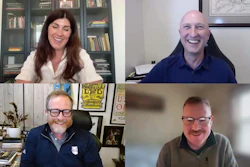
Matt Reynolds: Hi, I'm Matt Reynolds, editor of Packaging World magazine. Back with another edition of the End of the Line podcast, where my colleagues and I get together on a Friday afternoon to talk about what has come across our desks, what caught our attention over the past week, and how it all fits together.
I'm joined, to the left of me at least in my grid, by Liz Cuneo, editor of Healthcare Packaging magazine.
Further down the line, we've got Derrick Teal, editor of ProFood World.
And, as always, the faithful Sean Riley, editor of OEM magazine and another podcast host among the many hats he wears at PMG.
So, welcome everybody. How was the week?
Sean: Super.
Matt: Yeah, it's really smoky. I don't know if you've noticed, but I'm in Bethesda, Maryland right now, where the smoke from the Minnesota and Canadian wildfires has finally arrived. It smells like a campfire here, though it's probably better than it was in Chicago a couple of days ago.
So, we're just fighting through it.
Normally we'd say ladies first—that's our tradition—but there's a theme that keeps coming up in our discussions lately, and that's the next generation of packaging and processing talent. It's about training people to have not only traditional mechanical skills, but also the next-generation skills they'll need to operate advanced equipment and package or process products efficiently.
Sean and Derrick, whoever wants to take the ball and run with it, I think you both had some examples of this.
Sean: Yeah, sure, I'll lead off.
You probably remember my good friend—some might call him my best friend—Mike Rowe, who I talked to a few weeks back. I mentioned him on the End of the Line podcast, and he made a point he talks about often: part of the manufacturing workforce crisis goes hand in hand with shop classes disappearing from schools. A whole generation hasn't been exposed to skilled trades unless they actively sought them out.
This story actually comes from PMMI. Maria Ferrante worked on it, and it's about a relatively new program called Roots Education.
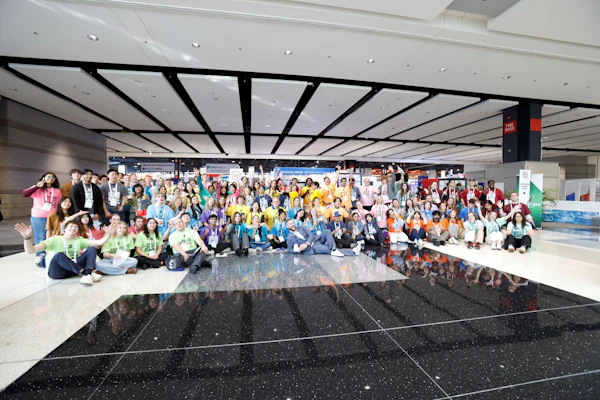
It's a unique education program that's now in about 100 schools—elementary schools, high schools, technical schools, and trade schools. The whole idea is that they partner with industry to bring machinery, technology, and career pathways directly into schools.
The way I think about it is, imagine if Ford had brought equipment into schools during the auto industry's heyday to teach students how to work in Ford plants. That's essentially what they're doing, tailored to different regions and industries. In Texas, for example, they focus on oil and gas because that's a major industry there.
PMMI has partnered with Roots Education and several PMMI members to provide equipment and mechatronics solutions that expose students to careers in packaging and processing.
It won't train them for one specific job, but it gives them a real sense of what a career in this industry looks like instead of just reading about it in a magazine.
I could see it being especially successful in places like Chicago and throughout the Midwest, where there's a concentration of food and beverage manufacturing. Students can learn on actual machinery in school and then move directly into those industries.
So far, they've had success placing students into jobs at companies like Amazon and Amcor.
The program focuses on Industry 4.0, safety, mechanical foundations, equipment installation, robotic programming, technical communication, and leadership. The goal is to prepare students to enter the workforce with a strong foundation—and in some cases even leadership skills.
I just thought it was a really interesting example of the industry taking an active role in solving the workforce challenge instead of simply waiting for students to graduate.
Matt: Yeah, I always hear that showing students a real-world application of what they're learning helps light the path.
Learning math or mechatronics can lead in so many directions—automotive, aerospace, oil and gas. But when you actually put students on packaging and processing equipment, you're introducing them to a career path they might never have considered.
That's really interesting, and it's great to hear PMMI helping lead the way.
Derrick, you mentioned you had something similar related to workforce and the future of manufacturing.
Derrick: Yeah, not so much education, but definitely workforce.
We've talked before about humanoid robots. In fact, I'm assembling one right now—that's what I've been doing this whole time.
The reason I bring it up is because Hyundai, which owns Boston Dynamics, is dealing with labor concerns in Korea. Hyundai workers are currently striking, and part of their concerns revolve around humanoid robots entering factories and potentially replacing jobs.
Some workers are even asking that if humanoid robots are introduced, employees should receive some form of compensation or protection.
The reason this matters—even though it's happening in automotive—is that packaging and processing often look to the automotive industry to see what comes next.
If you're introducing humanoid robots into a unionized factory, what happens? What kind of pushback do you get? How are labor agreements handled?
It's really uncharted territory, and I think whatever precedent gets set in automotive could eventually influence food and beverage processing and manufacturing here in the U.S.
That's what caught my attention this week.
Matt: Casey Flanagan isn't with us today, but I'm sure his ears are ringing.
He's our resident AI—and especially humanoid robot—expert.
I can definitely see how what's happening in automotive could spill over into all of our industries.
Sean: Casey's not here because some jerk is making him do something else right now. I don't know who that would be.
Matt: Sounds like a real tyrant.
Sean: Yeah, he is. Terrible.
Matt: Well, now for something completely different.
Derrick, Sean, and I are always talking about packaging equipment and automation, but Liz gets to cover some of the more unique areas outside of traditional consumer goods and food and beverage.
Liz, you were telling me about home healthcare and the role packaging plays there.
Liz: Yeah, home healthcare has really been growing for a while now.
We're taking more ownership of our healthcare, and I think some of it started during COVID with at-home testing. Now we're administering more medications ourselves through injections, and we're seeing more healthcare kits being shipped directly to people's homes.
One interesting example is called Map My Mole. It's pretty much exactly what it sounds like.
It's an image-capture kit that allows users to take medical-quality images of their moles at home.
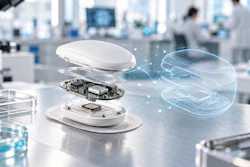
The kit includes instructions, of course, but the unique part is a clinical dermascope—a magnifying lens that attaches directly to your smartphone. Once attached, it allows users to capture medical-quality images that are then sent to a board-certified dermatologist for evaluation.
The images get sent back—not the kit—and the dermatologist provides their professional assessment.
It's an interesting product because that lens has to be very well protected during shipping. At the same time, like any home healthcare kit, the packaging has to be intuitive and the instructions have to be crystal clear.
There's no healthcare professional standing next to you.
As someone in one interview pointed out, people are often stressed when they're using these kits. They're unsure of what to do, so clear instructions, ease of use, and accessibility were all major design considerations.
It's a unique product that we don't see every day, so I thought it was worth sharing.
I don't know if anyone else has experience with at-home testing kits.
Matt: It's funny—I got sent one to test my gut health.
I did the finger-prick test, which actually hurt more than I expected, and mailed everything back.
Then I lost the card with the unique code I needed to access my results.
I got the email saying my results were ready, but without that card there was no way to retrieve them.
So... I still don't know how my gut health is.
Liz: Oh no!
Matt: I tore apart my house looking for that card.
Liz: I'm glad the process was secure, but now I can't get my gut health results by guessing a password or calling someone. That was my one shot.
If I find the card, I'll report back.
Matt: Well, that sets up quite the cliffhanger for next week's podcast when Liz reports on her gut health.
Liz: Thanks for the pressure!
Matt: It strikes me that the lens in that kit must be fairly expensive or delicate.
We're always thinking about fast-moving consumer goods, where packaging is a race to use less material at lower cost and lighter weight.
Here, packaging is protecting a potentially expensive piece of equipment, so it really has to do double duty.
You don't want to skimp on packaging in a case like that.
Liz: Exactly.
That lens was really the unique part of the kit that required protection.
A lot of at-home kits are mostly paper components. The blood test kit I used had just a small lancet and paper materials.
In this case, protecting the lens was important, but just as important was making sure users understood exactly how to use the product correctly and felt comfortable doing it.
Matt: Interesting.
Maybe we'll all check our gut health—or map our moles—before the next podcast.
Liz: Mole mapping together? That's weird.
Matt: Yeah... that's weird.
Well, does anyone have anything else?
I've got one final item.
Last week I talked about the Oregon injunction related to EPR requirements for a subset of obligated producers on the distributor side.
This week there was another preliminary injunction, this time involving California's SB 343, better known as the Truth in Labeling law. The law governs what recycling claims and symbols—including the chasing arrows—can appear on packaging, along with California's recyclability criteria, including the so-called 60-60-60 threshold.
I wouldn't say companies should stop redesigning packaging because of this. It's only a preliminary injunction.
From the broader perspective, though, any uncertainty tends to slow packaging redesign efforts.
The brand owners I talk with say it's not time to hit the brakes. Companies are still moving toward these sustainability goals because these transitions will take years regardless.
Still, it's interesting to see this growing uncertainty around EPR, sustainability regulations, and truth-in-labeling laws in California, which often sets the pace for the rest of the country.
We'll continue covering that in Packaging World next week.
Anything else?
Is everybody else dealing with the smoky weather?
Sean: Yeah, they told us not to go outside in Philadelphia today.
Matt: I'm only a few miles south of you, Sean, and I didn't hear that advice—which means I definitely didn't follow it.
So I'm going to head inside now.
Everybody have a great weekend, enjoy your time, and we'll talk to you next week on another edition of the End of the Line podcast.
We'll get the outro right one of these weeks.
Thanks, everybody.
All: Bye!