Label waste is regulated packaging's overlooked sustainability problem because pre-printed inventory systems create excess stock that gets destroyed when forecasts shift, artwork changes, or products discontinue. A Label Waste Index audit makes this waste visible and measurable across purchasing, quality, operations, and warehousing functions.
- Pre-printed label systems create buffers between production and consumption that amplify overproduction, excess handling, and disposal in high-mix, low-volume operations.
- A Label Waste Index audit separates confirmed waste, at-risk inventory, and validated process floor to quantify the sustainability opportunity across multiple functions.
- Material substitution alone is slow and expensive in regulated environments; process redesign and on-demand printing offer faster, less disruptive sustainability levers.
- Label-related costs span artwork control, supplier proofing, warehouse storage, inventory tracking, and disposal, but rarely surface as a single unified metric.
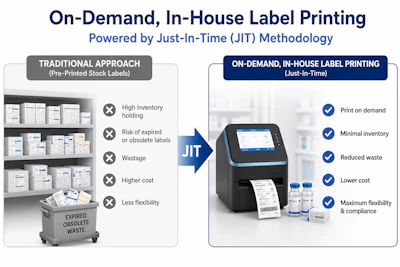
- On-demand labeling shifts from forecast-driven inventory to point-of-use production, reducing speculative stock and aligning each label to a specific work order and product lot.
Walk to the floor of a high-mix medical device packaging operation and the costliest waste is often the one nobody looks at as waste. It is not the tray, pouch, carton, insert, or shipper — those get optimized every cycle. It is the label inventory: pre-printed rolls staged by SKU, language, geography, revision, shelf life, lot, and artwork version. These are often held under controlled access because each roll is part of the quality record. Some of these labels are used in the final product exactly as intended. But the rest wait for a regulatory update, an artwork correction, a discontinued product, a market exit, or a passed expiration date, and then they are destroyed.
That waste rarely earns the scrutiny applied to sterile barrier downgauging or secondary packaging material and configuration optimization. In regulated manufacturing, labeling is part of the controlled packaging system, quality record, and important communication medium for UDI, lot number, expiration date, storage condition, manufacturing identity, and jurisdiction-specific content. A label is at once a compliance artifact and a physical material stream. That dual role is exactly why it deserves a more serious sustainability consideration.
Luckily, there is a practical way to start: run a Label Waste Index (LWI) audit. The audit separates confirmed waste from at-risk inventory and the validated process floor. This distinction prevents a team from overstating the sustainability opportunity while still making a label waste stream visible that is usually dispersed across purchasing, operations, quality, warehousing, and EHS.
The Label Waste Index (LWI) audit Use LWI as a practical site-audit tool, not an industry benchmark.
Example: a product family purchases 10,000 labels in 12 months. 8,900 are applied to released products, 700 remain usable in controlled inventory, 300 are destroyed or made obsolete, and 100 are consumed through setup, verification, or controlled rejects. Result: confirmed LWI = 4%, avoidable waste = 3%, validated process floor = 1%, and at-risk inventory = 7%. The point is not that every site will see these values. The point is that every site can run the same audit. |


The sustainability problem is not only material choice
Packaging sustainability programs usually begin with material substitution: thinner structures, recyclable formats, bio-based substrates, or simplified material families. Those strategies matter. But in regulated healthcare packaging, they are rarely the fastest or least disruptive lever. A material change can ripple into performance, biocompatibility assumptions, sterilization compatibility, adhesion, print durability, shelf-life claims, and distribution robustness, each carrying its own validation and change-control burden. Even an attractive change can be slow and expensive to implement.
Labels live under the same constraint. A label is more than a printed sticker; its facestock, adhesive, liner, ink or ribbon system, print method, and durability profile are all part of a controlled labeling process. Changing any of them may require documented technical assessment, artwork review, quality approval, supplier qualification, and, depending on the product and jurisdiction, regulatory assessment before implementation.
None of that makes sustainable label improvement impossible. It simply shifts where the practical lever sits. The first move may have nothing to do with the label material and everything to do with how labels are produced, controlled, and consumed.
Why high-mix, low-volume operations amplify label waste
The problem amplifies in high-mix, low-volume (HMLV) environments. A manufacturer running dozens of SKUs across multiple languages, regional variants, kit configurations, and differing UDI or product identifier requirements can end up managing hundreds of label variants. Each one carries its own artwork file, approval history, revision status, supplier print order, minimum order quantity, inventory location, and expiration control.
The economics of pre-printing rarely line up with real consumption. Suppliers print in efficient batches. Manufacturers order against forecasts. Production draws against actual demand. When a forecast shifts, a market opens or closes, or an artwork revision lands, the leftover inventory is simply stranded.
This is not a purchasing error so much as a structural feature of the conventional model. Pre-printed label systems put a buffer between label production and product packaging. The buffer absorbs uncertainty, but it also manufactures the conditions for overproduction, excess handling, obsolete stock, and disposal. In a high-volume, low-mix plant the buffer is tolerable because inventory turns quickly. In HMLV packaging, that same buffer can become a slow-moving liability.
The hidden cost structure
The unit cost of a label is easy to see. The full cost of a label system is not.
A conventional pre-printed process spans artwork control, supplier proofing, purchase orders, incoming inspection, warehouse storage, environmental controls where applicable, inventory counting, lot and revision tracking, line-side staging, issuance, reconciliation, and disposal of obsolete or expired stock. On the line, operators select the correct roll, confirm the version, verify the lot or control number, manage partial rolls, and guard against mix-ups at changeover. Quality, meanwhile, has to keep issuance and use consistent with the approved device, packaging, or batch record.
That matters because a labeling error in regulated manufacturing is not an ordinary defect. A wrong label, revision, UDI, expiration date, market language, or production identifier can escalate into a nonconformance, a complaint, a field-action contributor, or a regulatory reporting event, depending on the product and failure mode.
The sustainability cost is just as distributed. Unused label stock carries embedded material, printing, shipping, handling, storage, and disposal impact. Because those costs are split across procurement, quality, operations, warehouse management, and EHS, they almost never surface as a single, unified number. Combined together, they become a packaging process metric that quality and finance can both understand.
What to measure before proposing a solution
Before anyone buys a printer, someone has to count the label nobody counted.
A credible baseline should capture:
1. Annual labels purchased, by SKU and revision
2. Annual labels consumed in production
3. Labels scrapped due to artwork revision, regulatory update, discontinuation, expiration, damage, or excess inventory
4. Active label variants by SKU, language, market, and packaging configuration, including how many shipped zero units
5. Average and maximum label inventory age
6. Warehouse space dedicated to label stock
7. Label-related nonconformances, deviations, or line stoppages
8. Time from approved artwork change to production-ready label availability
9. Labor to receive, inspect, issue, reconcile, and dispose of label stock
10. Supplier shipments, rush orders, and expedites tied to label availability
Counted this way, the list above expands the Label Waste Index into its drivers. These numbers change the conversation. Instead of asserting that on-demand printing is more sustainable, the manufacturer can point to confirmed waste, inventory at risk, quantified line-side complexity, and actual change-control delay. That is a baseline an engineering, finance, quality and manufacturing can act on.
Circular economy applied to process, not only materials
Circular-economy language usually attaches to material loops: reuse, recycling, composting, remanufacturing, or recovery. These matter, but they sit downstream of a more fundamental principle: preventing waste from being created in the first place.
That distinction is sharp in regulated packaging. A label printed in bulk months ahead of need, then rendered obsolete, can only be recycled or destroyed after the fact. The upstream question is whether it needed to exist at all.
On-demand printing reframes the process. Instead of producing inventory against a forecast, the system generates a label at the point of use, bound to the specific work order, product, lot, expiration date, UDI, and approved template. The closer the process moves toward one product, one label, printed once, the less room remains for speculative inventory.
Why this is a packaging issue, not just an IT project
It is tempting to file label modernization under automation, software, or operations. However, in regulated healthcare manufacturing, that framing is too narrow.
Packaging sits at the junction of the physical label, the package configuration, sterilization and shelf-life requirements, the distribution environment, usability needs, labeling specifications, and the production process. A change to the label system can affect package release, inspection processes/strategy, line clearance, barcode readability, operator workflow, and the quality record. Packaging engineers see these interfaces because they work at the boundary between product, process, quality, regulatory, and supply chain. That is precisely why process-based label sustainability belongs inside the packaging development and operations conversation, not adjacent to it.
The goal is bigger than clearing obsolete rolls. It is retiring a structurally wasteful control model without giving up patient safety, traceability, or compliance.
The practical thesis
Regulated manufacturers cannot always substitute packaging materials quickly. But they often have far more room to redesign how packaging components are generated, controlled, and consumed.
Labeling is a strong place to start. It is measurable, operationally meaningful, and tied directly to compliance. It is acutely exposed to SKU complexity, language variation, and regulatory change. In HMLV environments, it quietly generates waste that no single function owns. A Label Waste Index audit finally makes that waste visible.
The label nobody counted should now be counted.
Part 2 examines how on-demand labeling can be implemented in regulated environments, what validation should cover, and how to build a business case credible to packaging, quality, regulatory, operations, finance, and sustainability stakeholders.