The FDA's new NDC rule requires a uniform 12-digit format by March 2033, marking a transition bigger than Y2K that will reshape pharmaceutical supply chains. Industry leaders at GS1 Connect emphasized that 2D barcodes, RFID, and data standardization are critical for compliance, supply chain visibility, and patient safety.
- The FDA's NDC rule changes the format from variable 10-digit to uniform 12-digit (6-4-2 structure), effective March 7, 2033, with a 3-year transition period.
- NDC will no longer embed within GTIN, requiring updates to barcoding systems, healthcare IT systems, and organizational interfaces.
- 2D barcodes and RFID technology enable item-level verification, real-time inventory tracking, faster recalls, and direct consumer engagement with product information.
- Data standardization and strong data governance are increasingly critical for regulatory compliance, sustainability reporting, and supply chain resilience.
- Industry predictions for 2050 center on identification standards as trust layers, AI-driven autonomy, and distributed, resilient manufacturing over pure efficiency.
At this year’s event, the focus was on the National Drug Code (NDC) Rule, supply chain visibility, RFID applications, and how GS1 standards improve data accuracy and interoperability. Over three days of sessions, networking, and touring the expo space, I learned a lot about how companies are approaching 2D barcodes and NDC changes, as well as the emerging technology in the space. Didn’t make the event? Here’s what you missed.
Overheard at GS1 Connect
“The NDC rule will be bigger than DSCSA and harder than Y2K.” Herb Wong, Chief Customer Officer, Antares Vision Group.
“I think in our world, the most important thing to consider in this transition is that it is truly a transition and not just a change. The aspect that data is so important, and with the enablement of the 2D barcode, you're ultimately able to capture, pass, and consume more data. That data then lends itself to compliance and being compliant with current regulations, as well as being able to adjust quickly to new regulations as they emerge. Beyond that, it transitions into patient safety, visibility into where things are coming from, where things are going, and how they got there.” Josh Thorp, Head of Global Sales Development, Loftware.  PMG editors
“I think a lot of the pharma and packaging industry has already adopted many of the technologies we're seeing here: 2D barcodes, RFID, and NFC. It's a matter of figuring out how to reuse those technologies for different purposes. One thing that we do as a connected products platform is allow brands to have more granular control of individual products. You already have serialization, but now serialization is tied to an NFC or RFID tag. Instead of managing a batch or a lot, brands can have granular control over a single individual product. What's really cool is that this technology has existed for 20–25 years, but now everyone is carrying a computer in their pocket.
Simply by tapping a product, anyone can access statutory product information, production details, expiration dates, lot information, and where the product was manufactured. In addition, they can access non-statutory information such as brand content, usage instructions, coupons, promotional materials, product details, provenance, and product history.
It also allows consumers to contact support and receive assistance specific to the product they purchased. At the same time, it enables brands to receive all of this information back without having to ask users to manually read off the lot number, expiration date, and other details.
This technology allows brands to verify that a product is authentic while also gaining visibility into where that product is moving for the first time after it leaves the warehouse or supply chain and enters the hands of the consumer.
That allows brands to communicate directly with consumers and engage with them using technology that may already be implemented in their packaging, warehouse operations, and supply chain processes.” Diego Mey, Founder, ForgeStop.
Unpacking the NDC
The FDA's final rule standardizes the NDC to a uniform 12-digit format (6-4-2 segment structure), replacing the current variable 10-digit format. Taking effect on March 7, 2033, the change provides all stakeholders with a 3-year transition period to update labeling and supply-chain systems. It is during this transition time (only) that both 10-and 12-digit formats will be acceptable.
Another implication with the increase in length of the labeler code, the NDC will no longer be embedded within GTIN. Historically, manufacturers directly embedded the NDC within the GTIN-14 structure. However, the direct translation is becoming obsolete due to the transition to a 12-digit NDC.
There are three categories of systems impacted by the change in the NDC format: the barcoding system, the systems used by organizations within the healthcare industry, and the interfaces between organizations. This transition will be significant and widespread. While the deadline is 2033, industry experts all agree that the time to start is now.
“What’s not changing? No retroactive updates, no immediate relabeling, and then no resubmission.” Ullrich Mayeski, Community Engagement Director-Healthcare, GS1 US.
A Look at Data
At GS1 Connect, data was top of mind. Strong data governance is becoming increasingly important as organizations navigate workforce changes and leverage AI. What’s more, the growing role of data standardization is supporting EPR compliance and sustainability initiatives, creating a strong tie between data and sustainability. GS1 US recently released a playbook to help companies report packaging data for compliance purposes.
 PMG editors
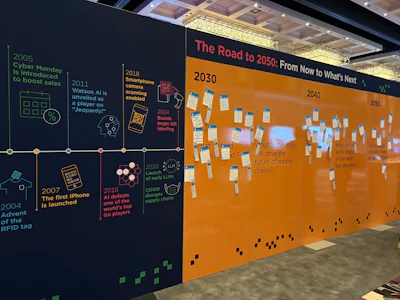
The Road to 2050: From Now to What’s Next
At the GS1 Connect event, GS1 US Innovation Team staff hosted the ‘Road to 2050 Wall,’ a full wall devoted to predicting future trends. The wall was on prominent display in the expo hall during show hours. Attendees were encouraged to answer a series of questions:
- What should we solve next?
- What technology will drive the future of supply chains?
- How will your work change in the next few decades?
- Where does industry need to be in 2050?
Attendees were able to fill out sticky notes with future predictions on where industry technology is headed. The top three themes were:
- Identification & traceability now rival AI as the headline trend. The cards push our core from "tracking" to item-level verification against a digital twin, RFID across medical supplies, and code scanning that connects shoppers directly to manufacturers. Identification standards become the trust layer for everything from retail safety to off-planet supply chains.
- AI remains the dominant force and is now a participant too. Nearly half the cards center on AI and the autonomy it powers. The wall holds AI's split personality in plain view: value creator and personalizer versus "replacement of humanity." Which one we steered toward is the defining question of 2050.
- Production goes distributed, proximate, and sovereign. Microfactories, bio-manufacturing, trustless materials, and 3D printing reimagine the supply "chain" as agile, point-of-need manufacturing. This is tied to national security, resilience, and material sovereignty. The winning principle isn't just efficiency; it's resilience, with humans kept at the center.