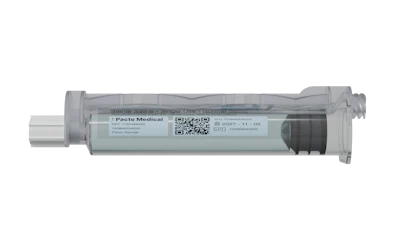
Compact prefilled syringes developed by Pacto Medical reduce storage footprint by approximately 40% while maintaining the same medication volume and compatibility with existing systems, potentially lowering supply chain costs by roughly 35% through reduced packaging, more efficient shipping, and decreased sterilization requirements.
- Compact prefilled syringe design cuts storage footprint by approximately 40% while maintaining medication volume and system compatibility
- Supply chain costs could decrease by roughly 35% through reduced packaging materials, improved palletization, and fewer sterilization chamber runs
- Cold chain logistics represent a major opportunity, as temperature-controlled shipping and storage are significantly more efficient with compact designs
- The detachable plunger rod system is installed immediately before use, requiring no changes to syringe barrels or medication-contact components
- Pacto Medical targets saline flushes as the first application, with products expected to appear in emergency kits within 12 to 18 months
In hospitals, ambulances, disaster zones, and military settings around the world, prefilled syringes are a valuable tool as they are sterile, accurate, and ready to use. Clinicians can administer medications quickly without drawing from a vial, reducing contamination risk and minimizing dosing errors during critical moments.
But according to Pacto Medical co-founders Ian Speers and Robert Halvorsen, one major problem has been hiding in plain sight for decade: their size.
“They were huge,” says Speers. “Every time I’d open a box of prefilled syringes, there were only about 30 in a given box, and we’d go through them really quickly. I realized we were taking a lot of time, effort, money, and carbon to move each of these boxes through the system.”
That observation eventually led to the founding of Pacto Medical, a medical device startup focused on redesigning the plunger rod to save space in each box. This compact prefilled syringe technology is designed to reduce packaging volume, improve supply chain efficiency, and better support emergency and logistics-constrained healthcare environments.
From Disaster Response to Device Design
The passion behind Pacto Medical stands out as much as the unique syringe design. Speers’ path into healthcare packaging innovation did not begin in manufacturing or engineering. His background is in public health, emergency medical services, and medical logistics.
He started his career working as an EMT and search-and-rescue technician before transitioning into nonprofit work focused on medical logistics and supply chain management in low-resource and disaster settings, primarily across Africa and the Middle East.
There, he noticed a disconnect between the products commonly used in high-resource healthcare systems and what was actually available in the field.
“A lot of the care we wanted to deliver was being challenged by the availability of products,” Speers explains. “I started to realize that what a product looks like, the amount of space it takes up, and how much it costs to move from the point of manufacture to the point of care delivery really matters.”
That realization pushed him to examine prefilled syringes more closely. “What if we could make that more efficient? Could that help us deliver care in a more effective and affordable manner?”
While traditional prefilled syringes rely on a full-length plunger rod that extends outward, this makes the overall device significantly bulkier during storage and transport. Clinically, this format is effective, but it creates inefficiencies across packaging, sterilization, shipping, and storage. So, Speers began to explore how he could take his findings and create a new solution.
“I came back from those experiences, started grad school, and had a bit more time to dig into this page of frustrations that I had accumulated over the years, and I realized that I really needed an engineer to help me create a lot of these products,” says Speers.
To turn the concept into reality, he reached out to longtime friend Robert Halvorsen, a mechanical engineer whose previous work included consumer electronics and product development projects for companies like Amazon and Ember. Halvorsen immediately recognized the potential and brought in another engineer he knew from his grad school, Ryan Stinebaugh.
“He told me about these prefilled syringes and said, ‘That plunger rod sticks all the way out — we’ve got to do something about them,’” Halvorsen recalls. “And I said, ‘That’s something I can prototype.’”
Redesigning the Plunger Rod
Three years later, the company has developed a compact prefilled syringe design that cuts the overall storage footprint roughly in half while maintaining the same medication volume and compatibility with existing syringe components and systems.
 Pacto Medical's founders (from left) Ryan Stinebaugh, Ian Speers, and Robert Halvorsen.Pacto Medical
“When you’re ready to use it, you just take this off, install it, and then you’re ready to go like any other prefilled syringe,” Halvorsen explains.
The company’s strategy is intentionally conservative from a regulatory and manufacturing standpoint. Rather than altering the syringe barrel, plunger stopper, or components that contact medication, Pacto Medical focuses exclusively on the plunger rod itself.
“We don’t change anything that touches the medication,” says Speers. “Because we know if we do, the regulatory burden immediately goes way up.”
That decision also minimizes manufacturing disruption for pharmaceutical companies and syringe manufacturers already operating established production lines.
“We’re trying to make it as easy for them to say yes as possible,” Speers says.
The approach could allow manufacturers to integrate the compact design without requiring a complete overhaul of existing tooling or filling systems.
Solving a Real-World Space Problem
For healthcare workers operating in constrained environments, the benefits extend well beyond convenience. Combat medics, emergency responders, disaster relief teams, and ambulance crews often work with tightly packed kits where every cubic inch matters.
 A common prefilled syringe design.Pacto Medical
 Pacto Medical's SlimshotPacto Medical
As a result, clinicians sometimes resort to improvised workarounds, he explains, including removing plunger rods entirely and reusing a single rod across multiple syringes. “If they lose the plunger rod, they’ll use a finger, they’ll use a pen,” Halvorsen notes. “It’s not clinically the best.”
The founders of Pacto Medical believe compact prefilled syringes could improve both preparedness and medication accessibility in emergency settings by allowing providers to carry more medications within the same storage footprint. The company’s first target application is the 10mL saline flush, one of the most widely used prefilled syringes in healthcare. The product is already ubiquitous in IV start kits, emergency carts, and hospital workflows, making it an ideal entry point for commercialization.
Packaging, Sustainability, and Cold Chain Implications
While the clinical advantages are compelling, the downstream packaging and logistics benefits may be equally significant for healthcare manufacturers and supply chain stakeholders.
Halvorsen said that while the weight of the syringe remains the same, the packaging materials used are significantly reduced, which has far-reaching implications. Supply chain savings come from multiple areas including smaller secondary packaging requirements, more efficient palletization and shipping density, and reduced sterilization chamber runs. According to the company, reducing syringe volume by approximately 40% can lower supply chain costs by roughly 35%.
“The material use is dramatically reduced because these are stored in plastic wrappers,” Halvorsen explains. “Our wrapper is half the size.”
But cold chain logistics may represent one of the largest opportunities.
Many injectable medications require refrigerated or frozen transport, making packaging density especially important due to the high cost of temperature-controlled shipping and storage.
“Those shipping boxes are expensive,” says Halvorsen. “Those trucks are very expensive to keep a large volume of stuff cold. If we can be more efficient in packing those cold shippers, the savings are significant.”
Designing With Clinicians, Not Just for Them
One of the company’s defining philosophies is continuous user feedback.
“I think as soon as we stop interacting with end users, we'll fall right on our face,” says Speers. “It's always our goal to continue to be as close to the problem as we possibly can.”
To do that, Pacto Medical has spent significant time conducting hands-on testing sessions with nurses, physicians, and emergency care providers at hospitals, conferences, and healthcare innovation events. The founders say those interactions have shaped nearly every design decision.
“It took about a year to optimize this design,” says Halvorsen. “Every new piece of innovation did not come from me thinking really hard in my chair. It came from going out and giving it to a nurse and watching them play with it.”
The company recently held a design workshop with clinicians at Mass General Brigham in Boston, where they gathered direct feedback on medication use cases, workflow pain points, and device usability.
“We've gotten to the point now where we've gotten this feedback a few times. They'll say, ‘Was that it?’ ‘Yes,’ It's supposed to be that simple, but it took us time to go to the nurses and iterate and get feedback to make it that simple,” explains Halvorsen.
That user-centered approach has also influenced another product currently in development: a dosing clip designed to reduce cognitive load during medication administration.
The adjustable clip enables providers to preset dosage levels on the plunger rod based on patient size or weight, potentially reducing dosing errors during high-stress pediatric emergencies.
“About 25% of pediatric resuscitation doses are misdosed,” says Halvorsen. “We think there’s a big impact to be had by reducing that cognitive load for providers.”
Balancing Innovation with Adoption
For many startups entering healthcare, regulatory complexity and adoption barriers can stall promising technologies before they ever reach the market. Pacto Medical’s founders say understanding those realities early has been essential.
“Really knowing your regulatory pathway and understanding how you can make something that will actually be adopted and manufactured rather than just a cool science project — that’s critical,” Speers says.
By limiting design changes to the plunger rod, the company hopes to streamline approvals while minimizing risk for manufacturing partners. Its initial commercialization efforts are focused on saline flushes, with plans to expand into other emergency drugs in the near future. Pacto Medical expects its compact saline flush products could begin appearing in emergency kits within the next 12 to 18 months.
Longer term, the founders see opportunities across vaccines, cold-chain pharmaceuticals, emergency medications, and home healthcare applications. But for Speers, the mission remains rooted in the healthcare inequities he witnessed firsthand years ago in humanitarian settings.
 Instead of redesigning the entire syringe, Pacto Medical engineered a detachable plunger rod system that is installed immediately before use.Pacto Medical
By redesigning one of healthcare’s smallest and most overlooked components, Pacto Medical believes it can influence the entire supply chain that surrounds it.
“We're going to get to the heart of this, we're going to go upstream to where design and manufacturing decisions are being made, and we're going to get into those rooms and provide a better alternative, which will then cascade those benefits down, so that people like me in humanitarian settings or disaster settings or pre-hospital settings have something that is designed for them, with them,” says Speers.