Matt Reynolds: Hi, I'm Matt Reynolds.
I'm the editor of Packaging World magazine, and I'm here with my colleagues, Liz Cuneo from Healthcare Packaging and Derrick Teal from ProFood World.
We're here on a Friday for another End of the Line podcast. We've got a skeleton crew today. One of our anchors on this podcast, Sean, is at a conference, and most of our offices are at a summer party on Lake Michigan this afternoon.
So we're spread far and wide. I'm in Wisconsin, Derrick's in Michigan, and Liz, I think you're in South Carolina now, but soon to be in Michigan as well.
We're missing out on the party, but we'll have a little party of our own with the End of the Line podcast.
So, ladies first. Liz, what's been coming across your desk this week? Anything interesting? Anything new?
Liz Cuneo: Yeah, we just published the first part of a two-part article series called The Label Nobody Counted: Why Labeling Is Regulated Packaging's Overlooked Sustainability Problem.
It's an interesting look at labeling. The label itself isn't really the sustainability problem—it's how we manage labeling. The article focuses on label changes, obsolete inventory, and all the waste that comes along with that.
It gives pharma readers a different way to think about where they might be losing money and negatively impacting their sustainability efforts. One idea I found particularly interesting is treating label waste like any other manufacturing KPI.
The author talks about measuring it through a Label Waste Index. As with anything, you have to define the problem before you can fix it. It's about understanding how many labels you're throwing away so you can improve the process and make a real sustainability impact.
It's a practical article with actionable ideas for improving sustainability through better labeling and inventory management. Part two will be out in the next couple of weeks.
The series is written by a highly regarded packaging engineer in the medical device space, so it's definitely relevant and timely. It's just a different angle on sustainability, which I think is pretty neat.
Matt Reynolds: So they're basically keeping track of the types of materials, the weights of the materials, the gauges—is this related to EPR reporting at all?
EPR compliance requires companies to know exactly what packaging they're using and how much of it. This sounds similar, but focused specifically on labels.
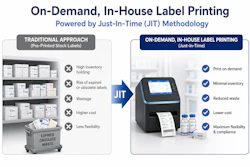
Liz: It kind of poses the question of whether on-demand printing is really the future when we're talking about sustainability.
The idea is moving away from huge preprinted label runs and toward printing only what you need. That makes companies more nimble as regulations continue to change.
As far as EPR goes, I'm not sure there's a direct connection, but on-demand printing definitely helps reduce obsolete labels and unnecessary waste.
Matt: So it's really about efficiency.
Being green can also mean saving money because you're reducing materials and buying less inventory. Of course, you have to rely on digital printing, and variable-data digital printing at high speeds can be challenging.
But if you're not producing at the speed of something like Coca-Cola—where you're filling thousands of bottles per minute—I would imagine pharmaceutical operations can accommodate variable-data, on-demand printing much more easily than some of those extremely high-speed consumer goods operations.
Liz: Absolutely. It's just an interesting way to look at sustainability.
Instead of completely changing your materials or redesigning your packaging, it's asking, "How can you print your labels more efficiently?" As a byproduct, you end up creating less waste.
Matt: Good. Derrick, what's new with you? You're in Michigan, hopefully avoiding all lettuce—especially shredded lettuce.
Derrick: Yeah, exactly. That's actually what I wanted to talk about this week: diarrhea.
Liz got to talk about blood, so I figured we'd turn this into the bodily fluids podcast. Maybe that'll be easier to remember.
Before this really became a major story, a friend of mine who works construction got really sick. This happened during one of those weeks when temperatures were pushing 100 degrees.
He was out on a construction site, and the only restroom available was a portable toilet baking in that heat. If you're dealing with digestive issues, that's about the worst place you could be.
The interesting part is comparing this to what happened a couple of years ago with Boar's Head. Public opinion turned very quickly against the company once people learned what was happening at its facility.
This outbreak has been different. People initially thought Taylor Farms was responsible. Then the FDA said it wasn't. Right now, much of the frustration is actually being directed at the FDA and the regulatory agencies overseeing the investigation.
If and when the source is ultimately confirmed, I think the bigger criticism may still be aimed at the FDA for not identifying it sooner.
Matt: I've heard Taylor Farms. I've heard Taco Bell. There's been a lot of conflicting information. Are you saying we still don't know exactly where it's coming from?
Derrick: They're fairly certain some cases are connected to Taylor Farms, but there was one specific Taylor Farms facility in Mexico that the FDA initially identified before later retracting that statement.
There are now multiple outbreaks, and because investigators haven't pinpointed a definitive source, there's a lot of speculation.
Some people argue staffing cuts at the FDA have made it more difficult to identify outbreaks quickly. Others point to changes in testing requirements.
Whatever the reason, they still can't definitively identify the source, so they can't tell consumers exactly what to avoid or determine precisely what should be recalled.
People might assume it's lettuce at Taco Bell, but maybe it's lettuce supplied by Taylor Farms—or maybe it's onions or tomatoes. Produce outbreaks can involve several different items, and we just don't know yet.
What's been fascinating to watch is how public frustration has shifted toward regulators instead of focusing solely on the food manufacturer.
That said, regulatory agencies are the backstop. Manufacturers still have the primary responsibility for food safety.
Nobody wants to be the company that failed to follow proper food safety procedures and then suffers the public relations fallout.
The other story that caught my attention happened just last Thursday. Coca-Cola filed a report with the Securities and Exchange Commission disclosing that its Fairlife brand had experienced a ransomware attack.
That's something we really want to cover more at ProFood World because cybersecurity is becoming increasingly important.
Utilities are dealing with cyberattacks. Hotels are dealing with cyberattacks. Food and beverage manufacturers are too.
The challenge is that IT and operational technology don't always integrate well inside manufacturing facilities.
If a company as large as Coca-Cola can be affected, imagine the impact on a small or midsize manufacturer with fewer resources.
Companies need to prioritize cybersecurity. If nothing else, they need strong employee training.
We all know how much cybersecurity training we go through—and we're probably pretty far down the list of potential targets.
Matt: Pretty far down the list.
Derrick: Hopefully. But as AI becomes more sophisticated, these attacks are only going to become easier to execute. We're already seeing AI used in robocalls and scams.
The takeaway is simple: don't cut corners on food safety, and don't cut corners on cybersecurity.
Matt: Those are good lessons for everyone.
I don't have much this week. I've been knee-deep writing stories already in progress, but I did hear from my colleague Anne-Marie Mohan, who covered this year's Brand Owner Boot Camp.
It's an invitation-only event hosted by Braskem International, formerly Nova Chemicals.
The organizers intentionally keep the press out because they want brand owners to speak freely without worrying about being quoted.
That means companies like Mars, Kraft Heinz, General Mills, Walmart, Aldi, and Target can have candid discussions.
Fortunately, we had someone in the room who was able to share some of the major takeaways.
One of the biggest themes was what you might call "the last 10%."
Most companies have already converted the majority of their packaging to recyclable, mono-material, or paper-based solutions wherever practical.
But there's still a stubborn 10% of packaging—particularly flexible packaging—that simply can't move away from multilayer materials because of product protection or shelf-life requirements.
Getting from 90% to 100% sustainability goals is proving to be the hardest part.
Another takeaway was that material innovation is happening, but not quickly enough.
Recycled-content materials and new packaging structures continue to improve, but they're still not where they need to be for the most demanding food applications.
Companies have teams of scientists working on these problems, but they're still significant hurdles.
Mechanical recycling also came up repeatedly.
It's the workhorse of today's recycling system, but obtaining FDA Letters of No Objection for mechanically recycled materials used in food-contact applications remains difficult.
Using recycled material for products like dish soap is one thing. Using it for food packaging—or pharmaceutical packaging—is another. Food-contact applications require much stricter standards.
Finally, EPR continues to be a major challenge because of its fragmented implementation across states.
Programs are gradually becoming more harmonized. Newer states like Minnesota and Maryland have adopted approaches that are more similar to one another.
Organizations like the Circular Action Alliance are helping create some consistency, but companies selling products nationwide still have to navigate slightly different requirements from state to state.
That's why I thought your point about on-demand label printing was interesting, Liz.
Everything has to be measured and reported. If reporting requirements differ from one state to another, that adds another layer of complexity.
The overall takeaway was that no single company can solve these challenges alone.
Suppliers, brand owners, retailers, consumers, recyclers, and reclaimers all have to work together across the value chain.
We heard a lot about that at the Packaging Recycling Summit a few weeks ago, and it came through again at this year's Brand Owner Boot Camp.
Am I missing anything? Anything else come across your desk?
Liz: Not really. I'm definitely feeling the summer slowdown, but I'm sure things will ramp up once the fall trade show season starts and Pack Expo gets underway. And I'm sure we'll be covering EPR indefinitely. I'm surprised we didn't talk about humanoid robots. Maybe it's good to take a week off.
Derrick: We'll get Casey on next time. He's working on a story about humanoid robots.
Liz: I did see something about a humanoid robot performing surgery, which was pretty interesting.
I'm trying to figure out how I can work that into Healthcare Packaging coverage. It's not really a packaging story, but it's certainly interesting enough to talk about.
Matt: You need more bodily fluids in there. I also saw a product launch where a company brought a humanoid robot on stage to demonstrate a product.
About halfway through the presentation, the robot collapsed into a heap.
Nobody knew what to do, so they grabbed an apron and draped it over the robot so people would stop looking at it.
My question is: why did they have an apron ready? They must have been expecting something like that.
There are clearly still a few kinks to work out with humanoid robots. We'll hear more from Casey next week.
Liz: It's funny. Funny—not funny. Poor robot.
Matt: Well, good to talk to everybody.
We're on the outside looking in while everyone else is at the PMG summer party, but we'll join them in spirit and get all the updates next week.
Liz: Sounds great.
Matt: All right. Thanks, everybody.