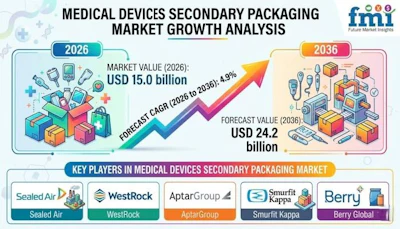
The global medical device secondary packaging market will grow from $15 billion in 2026 to $24.2 billion by 2036, driven by aging populations and emerging market infrastructure investments. Success depends on regulatory expertise, material innovation, and region-specific market access strategies.
- Market projected to expand at 4.9% CAGR from $15 billion (2026) to $24.2 billion (2036)
- Emerging markets lead growth: India at 7.5% CAGR and China at 6.2% CAGR versus mature markets at 4-5.8%
- Plastic dominates material choice at 46.8% market share, with boxes leading product types at 39.4%
- Regulatory approval speed is a critical competitive differentiator, with FDA accelerated pathways and EMA centralized procedures favoring companies with robust clinical data
- Price pressures from centralized procurement and generic competition compress margins in mature markets, requiring cost optimization and supply chain efficiency
Key Takeaways:
- The global market is projected to grow from $15 billion in 2026 to $24.2 billion by 2036, fueled by an aging population and healthcare infrastructure investment in emerging economies.
- Regulatory approval speed is a critical competitive differentiator, with companies holding robust clinical data gaining first-mover advantages through accelerated pathways in the U.S. and E.U.
- High-growth opportunities in India (7.5% CAGR) and China (6.2% CAGR) contrast with margin pressures in mature markets due to centralized procurement and generic competition.
The global market for secondary packaging for medical devices is on a steady growth trajectory, poised to expand from an estimated $15 billion in 2026 to $24.2 billion by 2036, according to a report from Future Market Insights.
This 4.9% compound annual growth rate (CAGR) is underpinned by fundamental drivers, including the expanding geriatric population in developed nations and significant healthcare infrastructure investments in regions like South Asia and Latin America. However, for businesses operating in this space, capitalizing on this growth requires navigating a complex landscape of regulatory hurdles, pricing pressures, and divergent market access conditions. A central challenge impacting competition is the variability in regulatory approval timelines. According to a recent market analysis, “Companies with sophisticated clinical data packages get the advantage of being first movers through FDA accelerated pathways and EMA centralized procedures.”
This places a premium on robust clinical trial data and regulatory expertise. The challenge is compounded by disparate reimbursement structures globally. In the United States, market access is heavily influenced by commercial payer formularies and Medicare coverage, while in Europe, cost-effectiveness evaluations by bodies like NICE and G-BA are paramount. This fragmentation forces companies to develop region-specific strategies to ensure product adoption and profitability.
Material and product choices remain critical to meeting clinical and supply chain demands. Plastic is projected to be the dominant material in 2026, accounting for 46.8% of the market, while boxes are expected to lead product types with a 39.4% share. These selections are not arbitrary but are dictated by specific end-use requirements, including the need for sterile barrier compatible packaging, tamper evidence, and durability for products ranging from surgical instruments to diagnostic equipment.
While mature markets like the United States (5.8% projected CAGR) and Germany (4.0% projected CAGR) offer stable demand, the most rapid growth is forecast for emerging economies. India is projected to grow at 7.5% annually through 2036, with China following at 6.2%, driven by policy-led adoption and expanding infrastructure.
Yet, these opportunities are accompanied by intense competition. Price-sensitive public healthcare systems and the adoption of generic alternatives are compressing margins for branded products. This pressure makes cost optimization, supply chain efficiency, and portfolio diversification key strategic priorities for established players like Sealed Air and WestRock as they contend with high barriers to entry, including manufacturing scale and established customer relationships.