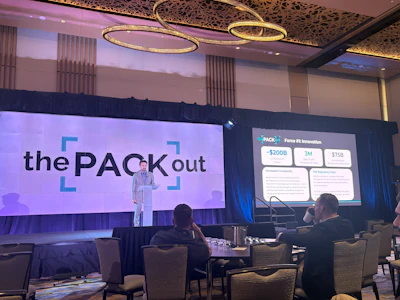
The PACK Out event revealed that AI will have the biggest industry impact by 2030, while manufacturers must balance innovation with regulatory pressures including EtO sterilization alternatives and PFAS packaging compliance.
- AI predicted as the biggest industry impact by 2030, but experts caution against implementing technology just for the cool factor
- Innovation and new product development led organizational priorities at 39%, driven by pressure to increase speed to market and lower costs
- About 50% of medical devices use EtO sterilization, but alternatives like VHP require extensive materials testing and compatibility studies
- PFAS regulations and packaging laws require companies to meet Packaging Declarations of Conformity by August 12, 2026
- Successful product redesign requires identifying all user groups across manufacturing, distribution, healthcare delivery, and internal operations
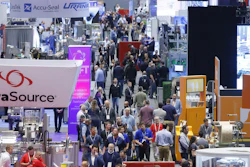
I had the pleasure to travel to Maryland for The PACK Out's fifth anniversary event. It was my second time attending and it felt like a reunion for med device manufacturers and suppliers as they shared new ideas, solutions, and technologies to keep furthering the industry. Over the three days of networking, exhibits, and sessions, I learned and listened and distilled the event down to 10 takeaways that stood out to me, read on.
Insights From The PACK OUT:
1. Greg McKeown, author of Essentialism: The Disciplined Pursuit of Less gave an engaging keynote on productivity, personal growth, and time management. He defined essentialism as identifying what is absolutely vital, eliminating everything else, and executing flawlessly on the few things that matter. He offered both personal and professional examples. “If it’s not a clear yes, it’s a clear no.”
2. What trend will have the biggest impact? In a live audience poll, attendees predicted that AI will have the biggest impact on the industry by 2030. But one expert clarified that AI does not distinguish truth from false; it is just data. Also, “Beware of the cool factor—are you implementing just to implement?”
3. The audience also weighed in on the biggest issues they face, which include pressure from leadership to increase speed to market and lower costs. In real time, attendees voted on their organization’s top priority. Innovation/ new product development led the charge at 39%
4. Sterilization was a hot topic in the lens of finding alternatives to Eto like VHP, vaporized hydrogen peroxide. While EtO is under pressure, one speaker noted that about 50% of devices are sterilized with EtO. And while there are alternative pathways, this requires new materials testing and compatibility studies. “It’s important to remember that uninterrupted patient access is the primary objective.”
5. Also, on the topic of sterilization, simulation is frequently used to predict the most effective sterilization methods (Sam Upadhyaya from Edwards Lifesciences says to do this you must know the material properties). Plus, how the devices are positioned in the box before sterilization greatly impacts the sterilization success. Attendees (including me) engaged in a brief workshop on this idea using simulation.
6. Are companies greenhushing? Samantha Smith of KeeneySmith Consulting, said sustainability is still big, but companies are being a bit quieter about it than in years past. “Holistically the work is still getting done, it just looks different than two years ago,” said Smith.
7. Bobby Patrick VI, Sr. Vice President, Government Affairs at AdvaMed presented the state of MedTech and the ongoing global trade pressures. Manufacturing is growing as 70% of the U.S. market is supplied by domestic production. But tariffs threaten the supply chain. With it being highly regulated, a limitation is that the industry cannot change suppliers quickly to avoid tariffs.
8. State policy including EPR packaging laws and PFAS regulations are top of mind. Nearly all devices contain at least one PFAS substance. Making changes to med device packaging has far reaching implication and takes years. Brian Farison, technical fellow, Network Partners Group, discussed PPWR and the waste hierarchy, and said that PPWR asks two big questions (requiring data collection and documentation). Qualitative— Is your packaging compliant? And quantitative. While there are “pockets of ambiguity,” as he calls them, PPWR is approaching and four things are required by August 12, 2016, the deadline for Packaging Declarations of Conformity. “The journey starts with awareness, then through data and documentation you get to readiness,” Farison said.
9. Recycling plastics at the hospital level may be a near-future possibility. Katherine Hofmann, PhD unpacked the Houston Regional Healthcare Plastics Recycling Program Playbook — a real-world, partnership-driven framework that tackles the hard stuff: staff behavior change, regulatory compliance, contamination risk, and economic feasibility — all in the context of pre-patient healthcare plastics.
10. Melissa Carter from Abbott shared a fascinating project she managed— a redesign of a blood collection kit. The redesign journey was driven by the need to improve usability for various “customers” along the kits journey from manufacturing to distribution/logistics to the healthcare worker and back through distribution/ logistics to finally, the internal lab. Melissa said she had to ask herself, "who is the user?" In this case, it was multiple groups and the package redesign needed to be redesigned with those groups in mind. For her, it started by identifying what she knew and then investigated what she didn’t know.