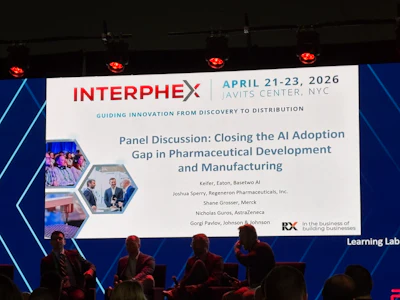
This week, I had the pleasure to travel (for the first time) to INTERPHEX, a global pharmaceutical and biotechnology event that merges industry innovation with expert-led conference sessions. During the three-day show, I met with exhibitors to see the latest and greatest, listened in on panel discussions and presentations, and networked with fellow attendees to learn as much as I could. Since this event covered way more than packaging, I was able to see more than I typically see, things like modular cold storage, processing equipment like mixing and batching, software solutions, and more. I distilled the three-day event down into the top 10 trends and observations I made at the show. Here they are:
- Experts agree that centralizing data (structured first, then non-structured data) is key to using data, via AI and data analytics, to make meaningful process changes. The advice is to “start simple, then build in complexity. Maintain consistent schema across the company, then rely on the language.” And language is very important for AI. “When you ask your staff, you may have 18 responses for what 'batch' means… If we don’t know, how can AI know?”
- How do big pharma companies scale quickly and efficiently? A rep from Lilly explained how the company is scaling through “disciplined replication.” He defined that not as blindly copying, rather building a roadmap to scale. “We found a good template… a purpose-built facility, with heavy use of automation and robotics.”
- A panel of CDMO experts agree that there is a difference between a partner and a vendor, and you must be selective on who you want to be a partner with… it takes dedication. “Be aligned with common goals, make investments together to develop a partnership.” But also there is governance; common goals supported by written agreements. Be on the same side of the table for the patient and work it out together.
- Humanoid robots are interesting and novel, but the human form has limitations. “And so much of what the industry is trying to solve for is human limitations. So while they're innovative, are they the answer?”
- Flexible machines- this is a topic we’re all hearing about. Multiple batch sizes, customization, and personalized medicine all lends itself to equipment flexibility. Machines today must be flexible while reducing the need for human touch, per Annex 1. Less human interference means less error, less contamination, and a safer product. These machines must offer the flexibility as well as the post-purchase service. One expert said, “we don’t offer a machine anymore, we offer a solution.”
- New pharmaceutical facilities are being built with autonomy in mind. Due to growth in the biologics space, there is a wave of greenfield builds that are more agile, flexible, and modular. Plus, CDMOs are investing more in their facilities to offer more and improved services to their customers as pharmaceutical companies continue to outsource production.
- Modular cold storage solutions are a popular choice for pharmaceutical companies needing to expand cold storage but with limited facility space. The rise in biologics, personalized medicine, and other temperature-sensitive drugs means these companies need more space than ever. Modular solutions mean they can add as much or as little space as needed, within their existing footprint, often utilizing outside space.
- Operator-friendly equipment has been trending and continues to be the case. A top reason remains the difficulty in finding skilled, and reliable, operators. And simple, intuitive workspaces mean less pressure to find highly skilled labor, less training time, and reduced downtime for the equipment running. A win-win for everyone.
- Recycled materials for use in medical device and pharmaceuticals? Experts told me that the industry is just not there yet. But another common thought is to look past the materials, “there is more to sustainability than materials themselves.”
- Speaking of which, the topic of sustainability was discussed in one session with practical takeaways offered. Sustainability should be considered at concept stage, not after the device has been created. There are five areas to implement sustainability – the shipper, housing, disassembly, testing, and the system. Also, secondary packaging has no contact with the drug itself, thus recycled plastics in secondary housings require no regulatory change. What’s missing is validation data and willingness to go first. “The industry tends to keep what works. But sometimes it is time for a change.”