The manufacturer packages various combinations for customers worldwide, including a syringe, vial and two needles, as shown here.
Gerhard Schubert GmbH
A pharmaceutical company partnered with Gerhard Schubert to build an automated cartoning system that packages eleven different vaccine formats at 270 products per minute while meeting strict pharmaceutical hygiene standards. The modular robotic solution replaced plastic trays with sustainable carton board partitions and operates across six packaging lines at three European production sites.
The system packages 270 products per minute across 11 different vaccine format configurations without major adjustments
Nine modular robotic frames arranged in an 18-meter compact line handle carton erection, product loading, and quality verification
Integrated vision systems with cameras verify materials, product placement, and codes to prevent batch contamination and product discards
Sustainable design replaced thermoformed plastic trays with carton board partitions, maintaining single carton format for global consistency
Changeovers between formats take less than 30 minutes, enabling rapid adaptation to different vaccine product combinations
Key Takeaways:
· Depending on the target market, the company supplies vaccines in multiple configurations—from single vials or syringes to packs containing two vials without injection aids.
· An important role in the project was played by Schubert’s in-house Packaging Competence Center, where experts in packaging materials and machine compatibility work together.
· The system can package up to 270 products per minute across a wide range of configurations without major adjustments.
Cleanliness is critical across manufacturing, but of course, hygiene requirements are especially strict in the pharmaceutical industry. Not surprisingly, syringes and needles are only assembled and filled with vaccines in doctor’s surgeries or health care facilities. Doctors receive the required items in cartons that are pre-packaged by the vaccine manufacturer.
For one global pharmaceutical company, vaccines are a key part of a portfolio that also includes treatments for cancer, respiratory conditions, and infectious diseases. The company’s vaccine packaging, however, involves more than just vials and needles. Depending on the target market, the company supplies vaccines in multiple configurations—from single vials or syringes to packs containing two vials without injection aids. In total, the manufacturer offers eleven product formats that vary in size, weight, and quantity of contents. Despite these variations, all are packed in the same carton size to maintain packaging consistency across global markets.
Handling that level of product variation required an automated packaging solution capable of processing multiple formats in a single carton while meeting strict pharmaceutical hygiene standards. Sustainability was also a priority, requiring a move away from thermoformed plastic trays toward carton board partitions that securely separate the products inside each carton.
Another key requirement was effective line clearance. The system had to prevent products from rolling away or becoming trapped inside the equipment—an essential feature for pharmaceutical packaging environments.
In total, six packaging lines were planned for installation across three European production sites. While each installation required minor adjustments, all were based on the same core system design.
Modular robotic packaging solution
To meet these requirements, the manufacturer partnered with Gerhard Schubert, based in Crailsheim, Germany. The company’s modular TLM system provided the foundation for a customized solution, supported by Schubert’s experience in pharmaceutical machine construction. Schubert-Pharma specializes in top-loading packaging systems designed for safe, reliable operation and GMP-compliant design.
An important role in the project was played by Schubert’s in-house Packaging Competence Center (PCC), where experts in packaging materials and machine compatibility work together. While one team evaluated sustainable material options, another simultaneously developed the packaging line design.
The final system consists of nine modular frames arranged along a compact line measuring just 18 m (about 60 ft). Robots perform key tasks such as erecting cartons, gluing components, and loading products. A central element of the system is Schubert’s Transmodul transport units. These inductively powered carriers move cartons through the line while processing steps occur.
Carton blanks are removed from a multi-lane magazine by a combination of F3 and F2 robots and placed onto the Transmodul units. As they travel along the line, the blanks are glued and prepared for erection. Additional F2 robots then erect the cartons into their base form.
The process runs in parallel at the start of the line. Two groups of six carton blanks are processed simultaneously during each cycle. “This means that twelve boxes are ultimately erected on a Transmodul,” explains project manager Luca Blümlein.
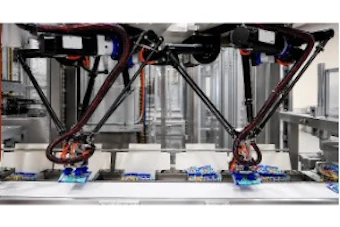
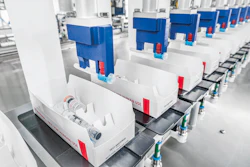
The machine fills the boxes standing on the Transmodul from above in accordance with the TLM principle.Gerhard Schubert GmbHAutomated partition and product loading
Next, the system folds twelve carton board partition boards per cycle and glues them into the erected cartons. Once the partitions are in place, the machine loads the required combination of vials, syringes, and needles. The process concludes with leaflet insertion, carton closing, and sealing.
An F2 robot first folds the partition boards using a dynamic folding unit before transferring them over a gluing station. The glued partitions are then inserted into the cartons traveling on the Transmodul units.
Meanwhile, syringes enter the line lying flat on a feed chain. An F2 robot picks up 24 syringes at once and places them onto a grouping table, which separates them into two groups of 12. Another F2 robot picks up each group and loads the cartons. Vials and needles are loaded using similar robotic handling systems. Once the products are in place, robots insert an information leaflet on top before the cartons are sealed, printed, and labeled. Finished cartons are then discharged onto an outfeed conveyor.
Vision systems ensure accuracy
Throughout the process, integrated camera systems verify materials and product placement. The system checks codes on carton blanks, confirms the geometry and shape of erected cartons, and verifies partition boards. Additional cameras monitor each product feed to ensure the correct vials, syringes, and needles are loaded.
Before every new batch, Schubert performs qualification tests on the camera systems to ensure they reliably detect missing products or incorrect labels.
“This ensures that the line will not package the wrong product for the respective batch—and prevents batches from having to be discarded,” says Blümlein.
The machine includes a test mode accessible through the operator interface. During testing, operators can introduce dummy products or obscure codes to confirm that the system correctly detects errors. Test results are automatically recorded in the batch report.
Machine design supports line clearance
The line also incorporates features designed specifically for pharmaceutical environments. The system is built so that products always remain visible and inside the machine—even if a fault occurs.
To support this line-clearance concept, the interior of the machine is lined with stainless steel panels. This eliminates gaps where products could become trapped and improves overall process reliability. The design supports stable production for vaccines, which must remain continuously available.
Collaboration enables sustainable packaging
Developing the line required close collaboration between the manufacturer and Schubert-Pharma. Engineers at Schubert-Pharma evaluated the feeding systems and worked to design carton board partitions that would fit within the existing carton footprint.
The goal was to maintain a single carton format capable of handling multiple product combinations while providing the same level of protection as the thermoformed trays used previously.
Working together with the PCC, the teams developed a partition concept that met these requirements. “Direct communication and an iterative approach were the decisive factors,” says Blümlein.
The PCC also helped refine the carton design, so the internal partitions and outer carton structure worked together efficiently. The result is a highly flexible packaging line capable of handling multiple vaccine formats. The system can package up to 270 products per minute across a wide range of configurations without major adjustments. Only one format—two vials without syringes or needles—requires a change to the filling tool. Changeovers take less than 30 minutes. The flexible design allows the manufacturer to adapt quickly to different product formats while maintaining a reliable global vaccine supply.
See What’s Possible in Life Sciences Packaging at PACK EXPO International
Explore new machinery & materials from 2,600 exhibitors. Gain insights from 150+ free educational sessions. Find solutions to tackle the toughest challenges—for life sciences & beyond—at North America’s largest packaging & processing event.
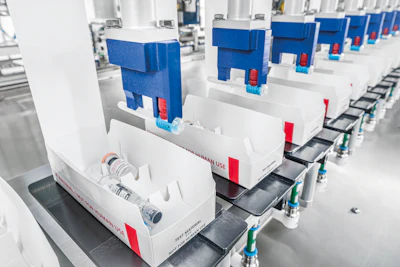
 The machine fills the boxes standing on the Transmodul from above in accordance with the TLM principle.Gerhard Schubert GmbH
 The machine fills the boxes standing on the Transmodul from above in accordance with the TLM principle.Gerhard Schubert GmbH