Key Takeaways:
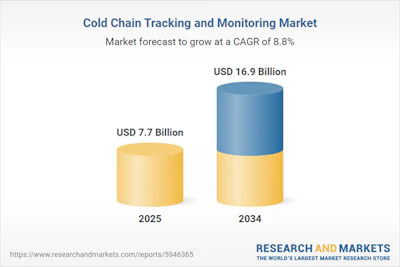
- The global market for cold chain tracking is projected to grow from $7.7 billion in 2025 to $16.9 billion by 2034, reflecting an 8.82% compound annual growth rate.
- North America leads the market, holding a 33% share, largely due to high demand from its advanced pharmaceutical and healthcare industries for products like vaccines and specialty chemicals.
- Adoption of IoT, AI, and analytics is becoming critical for optimizing logistics, ensuring regulatory compliance, and reducing spoilage of temperature-sensitive goods.
Increasing demand for temperature-sensitive products across the pharmaceutical, healthcare, and food and beverage sectors is driving substantial investment in the global cold chain tracking and monitoring market. According to a new report from ResearchAndMarkets.com, the market is expected to more than double in value, expanding from $7.7 billion in 2025 to a projected $16.9 billion by 2034.
This growth, representing a compound annual growth rate (CAGR) of 8.82%, is fueled by a convergence of factors, including stricter government regulations for product safety and the logistical complexities of a booming e-commerce landscape. The United States, in particular, is a significant driver within the dominant North American market, which accounted for 33% of the global share in 2025.
Technology and Regulation Drive Adoption
The need for real-time visibility and precise temperature control is pushing companies to adopt smarter cold chain systems. Technologies such as the Internet of Things (IoT), GPS, and RFID are becoming essential tools for enhancing supply chain transparency and minimizing the risk of spoilage. According to the report, the integration of analytics and artificial intelligence (AI) is further optimizing logistics by improving route planning and storage conditions.
These technological investments are also a response to rigorous quality standards and government mandates that require verifiable temperature control throughout the supply chain. For businesses dealing in high-value goods like pharmaceuticals, failure to comply can result in significant financial and reputational damage.
Pharmaceutical and E-Commerce Sectors Fuel Demand
The pharmaceutical industry, especially with innovations in mRNA-based therapies and vaccines, has intensified the need for unbroken, temperature-controlled supply chains. The secure delivery of these sensitive biological materials is a primary factor propelling market growth.
Simultaneously, the expansion of e-commerce, a market valued at $1.16 trillion in 2024, is creating new challenges and opportunities. As more temperature-sensitive products, from specialty foods to medications, are sold directly to consumers, the demand for reliable last-mile cold chain solutions increases.
In response to these trends, key industry players such as Carrier Global Corporation and SmartSense by Digi are focusing on integrating advanced technologies like AI and blockchain to improve data transparency and operational efficiency, positioning themselves to capture a larger share of this expanding market.