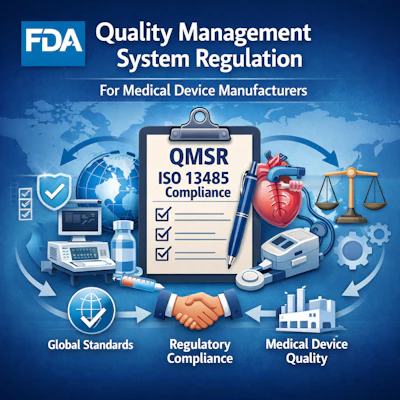
The FDA's Quality Management System Regulation became enforceable on February 2, 2026, requiring medical device manufacturers to adopt ISO 13485 standards and implement risk-based thinking throughout their entire quality systems. Manufacturers must now demonstrate how risk considerations influence decisions at every level and ensure documented procedures match actual practices.
- QMSR became enforceable February 2, 2026 after a two-year transition period, replacing the previous CGMP requirements with ISO 13485 standards
- Risk-based thinking is now mandatory across all quality system processes, from supplier qualification to post-market surveillance
- FDA inspection model has changed from the traditional Quality System Inspection Technique to an integrated, interconnected systems assessment
- Documentation must reflect real-world practices, not just prescriptive compliance, with clear evidence of process control and effectiveness
- Organizations should conduct gap assessments immediately and update inspection readiness strategies using integrated, scenario-driven approaches rather than traditional mock audits
On February 2, 2026, the FDA’s Quality Management System Regulation (QMSR) became effective and enforceable. After a two-year transition period following the rule’s publication in 2024, medical device manufacturers are now expected to operate fully within this updated regulatory framework.
The QMSR amends device current good manufacturing practice (CGMP) requirements by incorporating ISO 13485, the international standard for medical device quality management systems. While this alignment may reduce duplication for some organizations, it also introduces new expectations around how quality systems are designed, documented, and maintained.
Structural Changes in Quality Systems
Although many familiar elements remain such as design controls, corrective and preventive action, and document management, the way these components are applied has evolved. QMSR emphasizes the integration of risk-based thinking throughout the entire quality system rather than confining it to specific processes.
This means manufacturers must demonstrate how risk considerations influence decision-making at every level, from supplier qualification to post-market activities. Additionally, documentation is no longer about meeting prescriptive requirements alone. It must clearly reflect how processes function in practice and how they are controlled.
The result is a system that prioritizes effectiveness and coherence over simple adherence to checklists.
Redefining the Inspection Model
In parallel with the regulation taking effect, the FDA has introduced a revised Compliance Program Manual for medical device inspections. This updated guidance replaces earlier inspection frameworks and signals a departure from the long-standing Quality System Inspection Technique (QSIT).
Under the new model, investigators are encouraged to assess the quality system as an interconnected whole. Rather than focusing narrowly on subsystems, inspections are likely to center on how well processes work together, how risks are identified and managed, and how issues are escalated and resolved.
For manufacturers accustomed to the predictability of QSIT, this evolution may require a shift in how inspection readiness is approached. Flexibility, transparency, and a strong command of internal systems will be increasingly important.
 With enforcement now underway, manufacturers should focus on sustained performance rather than transition planning. Christine Tervo via AI
Identifying Gaps and Vulnerabilities
Organizations that already operate in alignment with ISO 13485 may have a relative advantage, but alignment is not automatic. Differences in interpretation, terminology, and FDA-specific expectations can still create gaps.
Greater vulnerability exists among companies that have relied heavily on legacy inspection strategies or that maintain siloed quality functions. Limited integration of risk management, inconsistent documentation practices, and underdeveloped supplier oversight processes may all draw increased scrutiny under QMSR.
Resource constraints may further challenge smaller manufacturers, particularly those that delayed transition efforts or underestimated the scope of change.
Priorities Moving Forward
With enforcement now underway, manufacturers should focus on sustained performance rather than transition planning. A comprehensive gap assessment remains a critical first step, with particular attention to how risk is incorporated across processes and how well procedures align with actual practices.
Inspection readiness should also be reevaluated. Traditional mock audits based on outdated models may no longer provide an accurate picture of preparedness. Instead, organizations should test their systems using more integrated and scenario-driven approaches.
Equally important is ensuring internal consistency. Discrepancies between documented procedures and day-to-day operations are more likely to surface under the current inspection paradigm.
Finally, targeted training can help bridge understanding across teams, ensuring that personnel are equipped to support and defend the system during regulatory interactions.
Looking Ahead
The implementation of QMSR signals a broader evolution in how the FDA evaluates quality and compliance. By emphasizing risk, integration, and real-world performance, the agency is setting a higher standard for medical device manufacturers.
While the transition may present challenges, it also offers an opportunity to modernize quality systems and align more closely with global expectations. For organizations willing to adapt, QMSR provides a pathway to stronger, more resilient operations.