Liz Cuneo: Hello, everybody, and welcome to another End of the Line podcast video episode. I'm here with my fellow editors at PMMI Media Group, and this week we're talking about what crossed our desks, what we've learned, and what we've found intriguing.
As the host and editor of Healthcare Packaging, I'll start.
Happy Friday, everyone.
Group: Happy Friday.
Liz: It was a short week that somehow felt twice as long.
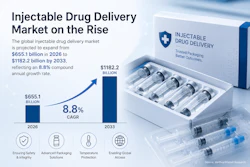
The highlight of my week was interviewing two entrepreneurs who started a medical device company. Their story centered on rethinking the design of the prefilled syringe.
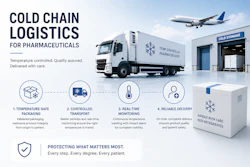
One of the founders, Ian Spears, is an EMT with a medical logistics background and extensive humanitarian experience. While transporting medicines to remote regions, including parts of Africa, he realized that traditional prefilled syringes take up significant space because of their length. That limits how many can be packed and transported.
He began wondering whether there was a more efficient design. Working with a college friend who is an engineer, he developed a prefilled syringe with a detachable plunger rod that stores alongside the syringe body. Before use, the plunger is attached and rotated into position. The design cuts the package length roughly in half, allowing twice as many units to fit in the same space.
I always enjoy hearing stories about people who identify a problem and create something new for the industry. It's a challenge most of us would never think about, but in humanitarian and emergency-response settings, every inch of package space matters.
The passion these founders have for the product was evident throughout the interview. I'm currently working on both an article and video about the technology.
Matt Reynolds: Speaking of syringes, I came across a technology that could eventually have significant implications for healthcare packaging, particularly as track-and-trace requirements and serialization continue to expand.
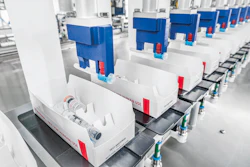
The technology is called XPlanar. It's been around for several years, and we first started seeing it appear at trade shows such as interpack. Essentially, it uses magnetically levitated tiles that move products without physical rails or mechanical contact.
Imagine a product sitting on a magnetic tile. The tile can move in any direction with no friction, allowing extremely precise handling and positioning.
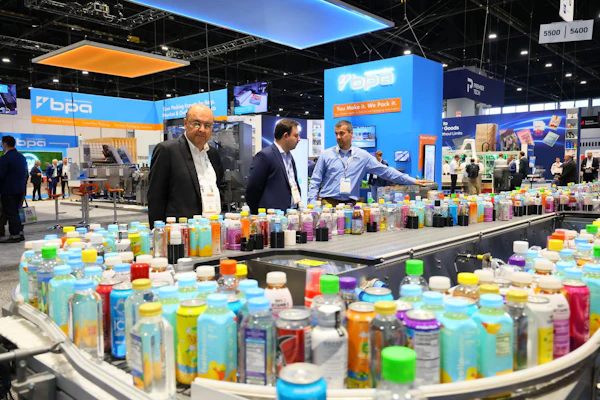
At interpack a few years ago, companies such as Sonic and R.A Jones were demonstrating early applications. This year, however, there were surprisingly few examples. One exception was Norwalt, which showcased a compelling use case.
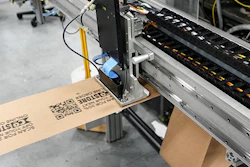
For applications such as syringes, ampules, cosmetics, or any cylindrical package requiring variable data printing, the technology allows a stationary printhead to remain fixed while the levitating tile precisely presents and rotates the product underneath it. That enables highly accurate serialization and customization at the individual-package level.
I see strong potential for cosmetics, medical devices, and pharmaceutical packaging. More importantly, Norwalt sees a market opportunity. Machine builders don't invest in technologies they can't sell, so their commitment suggests real demand is emerging.
Sean Riley: That's what makes XPlanar interesting. It's often discussed as a cutting-edge technology, but examples of real-world implementation have been limited. It's encouraging to see machinery suppliers beginning to commercialize practical applications.
Matt: Exactly. We spoke with the Beckhoff team at interpack, and coverage is already available on Packaging World, OEM, and Healthcare Packaging.
Sean: My topic this week centers on artificial intelligence.
We frequently discuss AI in positive terms—its role in data analysis, training, maintenance, and operational efficiency. But I recently attended a meeting with consumer packaged goods companies, OEMs, component suppliers, and engineers, and the conversation was notably different.
For the first time in a while, I heard significant skepticism.
One attendee described AI as an "arrogant beast." The concern wasn't that AI lacks potential; it was that it sometimes provides answers that appear correct but aren't. When an engineer receives a valve code recommendation from AI and later discovers it's wrong, trust erodes quickly.
Many participants expressed concern that the technology still requires constant verification. Instead of saving time, it can create additional work because every output must be checked.
There was also discussion around the rapid evolution of AI platforms. Two years ago, everyone was focused on ChatGPT. Today, there are multiple competing models. Companies are hesitant to build long-term machine architectures around technologies that are changing so quickly.
The takeaway was that many people remain unsure whether AI is fully delivering on its promise, particularly when it comes to machine-level applications.
Matt: One of the recurring themes was that AI can create double work. If you can't completely trust the output, you still have to perform the original task while also reviewing the AI-generated result.
We're in a transition period where organizations are investing time and resources into AI but haven't yet reached the point where they can fully rely on it.
Sean: Exactly. People want to adopt the technology and keep pace with the market, but many feel they're still validating everything themselves.
Derrick Teal: That discussion about technology adoption reminds me of a recent visit I made to Graeter's Ice Cream in Cincinnati.
What's fascinating is how little automation exists in their operation. Despite producing between 40,000 and 70,000 pints per day, much of the process remains manual.
The facility itself is highly energetic. Employees move throughout the plant almost like a choreographed performance, with music playing and people constantly shifting between roles.
Graeter's is known for handcrafted ice cream, and maintaining that designation requires limiting automation. Employees are cross-trained across multiple functions, which keeps work interesting and provides tremendous operational flexibility.
If someone is absent, there are plenty of trained employees who can step into that role immediately. Not surprisingly, employee turnover is very low.
One interesting fact I learned is that ice cream companies often judge one another based on their vanilla ice cream. The reasoning is simple: before adding mix-ins and flavors, the quality of the base product has to stand on its own.
Graeter's has used the same vanilla supplier since 1870, and only a handful of people know the source. They're extremely protective of that ingredient because it defines the quality of their product.
Liz: That example of employees moving between different tasks reminds me of an article Matt shared about humanoid robots and their current limitations.
Humans remain remarkably adaptable. A robot might be trained to perform a specific task, such as scooping ice cream, but people can move from scooping to labeling to packaging and back again throughout the day.
It's an interesting reminder that flexibility remains one of humanity's biggest advantages.
Matt: The article described humanoid robots as a somewhat brittle technology. They can become highly proficient at a single task, but redeploying them across different functions remains challenging.
That adaptability gap is something many developers are still working to solve.
Liz: From handcrafted ice cream to humanoid robots—that's quite a range of topics.
Thank you, everyone, for another great discussion. We'll be back next week.
Group: Thanks, everyone. See you next week.