The global cold chain market will grow from $276.5 billion in 2026 to $455 billion by 2031, driven by rising demand in pharmaceuticals, food and beverage, and chemicals sectors.
- Market expansion from $276.5 billion (2026) to $455 billion (2031) represents a 10.5% compound annual growth rate
- Primary growth drivers include temperature-sensitive pharmaceuticals and vaccines, fresh food preservation, and chemical safety requirements
- Storage and infrastructure identified as largest segment, with IoT monitoring and automated refrigeration as key technology enablers
- Light commercial vehicles (LCVs) projected for strong growth due to urban maneuverability and lower operating costs
- Europe leads regional adoption supported by stringent regulations, cold storage investment, and strong logistics infrastructure
Temperature-controlled logistics is set to expand from $276.5 billion in 2026 to $455.0 billion by 2031, a 10.5% compound annual growth rate, according to a May 29 MarketsandMarkets report.
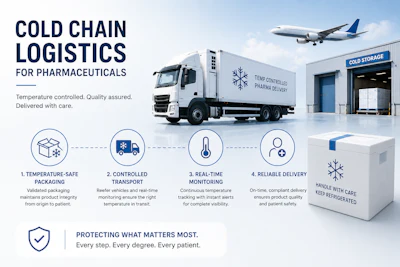
The study cites rising needs across healthcare, food and beverage, and chemicals as primary growth drivers. In pharmaceuticals, more temperature-sensitive drugs and vaccines are increasing compliance and resilience requirements across storage and transport. In food and beverage, cold chain processes are used to preserve freshness and extend shelf life for categories such as dairy, meat, seafood, produce, and beverages. Certain chemical inputs also require controlled temperatures for safety and performance.
Beyond core verticals, the report notes specialized use cases for temperature-controlled logistics, including artwork and historical relics, select electronics components, and horticulture.
Where growth is concentrated
- Storage and infrastructure: The report identifies storage and infrastructure as one of the largest segments, supported by investments in refrigerated warehousing, monitoring systems, and automation. It points to IoT-enabled temperature monitoring, automated refrigeration, and energy-efficient facilities as technology enablers, alongside public- and private-sector programs aimed at reducing post-harvest losses and meeting regulatory standards.
- Road transport: Within refrigerated road transportation, light commercial vehicles (LCVs) are projected to maintain strong growth. The report attributes this to LCVs’ urban maneuverability, lower operating costs, and a shift toward smaller, more fuel-efficient fleets aligned with sustainability goals.
- Regional share: Europe accounts for a significant share of the global market, supported by stringent regulations governing food safety and pharmaceutical transport, ongoing investment in cold storage and warehousing, and strong logistics infrastructure. Adoption of IoT and demand for frozen foods, biologics, vaccines, and fresh produce are additional factors cited.
What it means for decision-makers
- Capacity planning: Shippers and 3PLs should re-evaluate network design and allocate capital to temperature-controlled storage, monitoring, and contingency capabilities—particularly where biologics and fresh categories are expanding.
- Urban distribution: Retailers and e-grocery providers may find refrigerated LCVs advantageous for last-mile delivery economics and emissions goals, but should assess fleet utilization, routing, and charging/fueling strategies as volumes scale.
- Compliance and visibility: Healthcare and food suppliers should prioritize end-to-end temperature monitoring and documentation to meet regulatory requirements in key markets, including the EU.
- Technology roadmap: IoT telemetry, automation, and energy-efficient refrigeration can improve control and operating costs; integration with quality and transport management systems will be central to scaling.