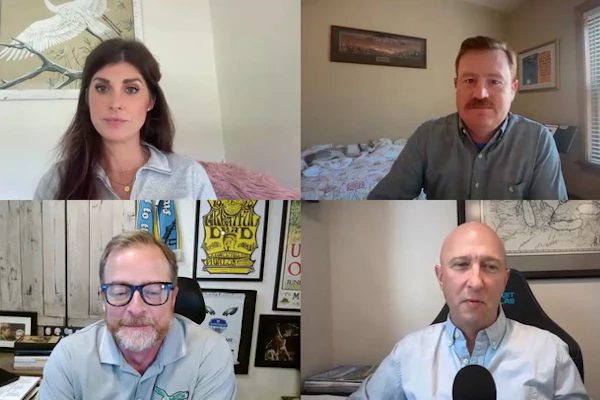
Liz Cuneo: Well, hello everyone, and thanks for joining another video episode of End of the Line, where we editors here at PMMI Media Group get together and talk about what’s come across our desks this week—whether that’s case studies we’ve visited or trends we’re seeing in the industry.
I’m here with editors Matt Reynolds from Packaging World, Sean Riley from OEM, Derrick Teal from ProFood World, and of course myself, Liz Cuneo from Healthcare Packaging. Sean, we were chatting before we hit record—you were at a pretty cool executive leadership conference and even got to meet a celebrity. Want to tell us about that?
Sean Riley: Sure. It was the PMMI Executive Leadership Conference—tons of great content that people will see online, and I shared some of it on LinkedIn. But the keynote speaker who wrapped everything up was Mike Rowe from Dirty Jobs.
He’s really invested in skilled labor and manufacturing, and in helping address the workforce gap. He shared some striking numbers—there are about 7 million unemployed people, but also 7 million open jobs that could be filled if people had the right skills.
It was a great presentation, and afterward I got to do a podcast with him for Unpacked with PMMI. We talked about his foundation, which PMMI actually donated $10,000 to.
The foundation focuses on getting people into the trades—offering two-year scholarships to trade schools and community colleges. So it’s not just manufacturing, but also welding, CNC machining, and other skilled professions. He was a really great guy—very down to earth and easy to talk to.
Matt Reynolds: Sean, did he talk about anything specific to packaging?
Riley: Not directly. He spoke more broadly about manufacturing. But he did frame the problem in an interesting way—he said the issue isn’t just the jobs themselves, it’s how we’re “packaging” them. We’re not marketing these careers well enough. He leaned into that idea—that the perception is outdated. Manufacturing jobs today aren’t dirty, dark, and dangerous like people imagine. They’re high-tech, often computer-driven roles.
So, while it wasn’t packaging-specific, it definitely touched on it conceptually.
Derrick Teal: Yeah, and I can build on that. A lot of newer plants are being designed with labor attraction in mind. One big factor is daylight.
Older facilities were essentially windowless boxes—sometimes even refrigerated environments where you’d spend your entire shift. But newer plants are prioritizing employee comfort. I recently visited a facility with a full glass curtain wall in the employee break area—tons of natural light. In the past, people would go sit in their cars for lunch just to get out of the building.
Now, with better-designed spaces, employees are more likely to gather, which improves culture and morale. Manufacturing has long had a reputation of being tough, isolating work in harsh environments, especially in food and beverage. But companies are really trying to change that.
Cuneo: That’s a great point, Derrick. It’s encouraging to see that shift toward improving the employee experience and focusing on retention.
Reynolds: Yeah, retention is key. In some regions, workers can easily move between nearby facilities for better pay or positions. Investing in facilities—making them more comfortable—can help create a “stickier” workplace.
Teal: There’s also research—mostly from office environments—around “sick building syndrome,” where people in enclosed spaces tend to call in sick more often. While I don’t have specific data for manufacturing, it stands to reason that access to natural light and outdoor views could improve attendance and overall well-being.
Cuneo: Absolutely. Switching gears a bit—from workforce and facilities to product quality—something that came across my desk this week was two healthcare product recalls, which isn’t something I see every day.
One was Xanax, recalled nationwide because it didn’t pass quality control testing related to how quickly the pill dissolves. It’s not a safety issue per se, but it could affect how the drug performs or how consistent the dosage is.
The other recall was even more concerning—eye drops that couldn’t be proven sterile. Not that they weren’t sterile, but the manufacturer couldn’t verify it, which is obviously alarming. That recall affected multiple brands, including private label products, and it was covered widely in the news. It raises questions about facility practices—whether something went wrong with sterility testing or quality assurance.
Riley: I actually saw that story. As someone who uses eye drops, I was surprised by how many private label products were involved. These brands work hard to position themselves as equivalent to name brands, so a recall like that is definitely concerning.
Teal: Do you know if it was self-reported or caught by regulators?
Cuneo: It was a mix. The eye drop recall was initiated by the manufacturer, while the Xanax issue involved FDA action due to the dissolution problem. So it shows both pathways—internal quality checks and regulatory oversight.
Teal: That makes sense. Sometimes companies catch issues themselves and act proactively, while other times it’s identified externally. There was even a recent case where a recall was issued and then later retracted after further testing didn’t confirm the issue. But in that case, the company still proceeded with caution and continued pulling product.
Reynolds: Switching topics again—something else that came up this week is how major retailers like Walmart and Amazon are influencing packaging standards.
These companies have massive influence. When they implement new requirements, the industry tends to follow. Amazon, for example, has programs like Ships in Own Container (SIOC) and Ships in Product Packaging (SIPP), which aim to reduce excess packaging.
They often defer to third-party standards like ISTA, which is helpful for brands. But they’re also evolving their requirements—especially for larger, heavier items that are more prone to damage in transit. That could mean new packaging expectations for things like bikes or grills, which would require brands to adapt.
It’s all tied to the customer experience. If a product arrives damaged, that disrupts the entire system Amazon relies on—what they call their “flywheel.” Packaging plays a critical role in keeping that system running smoothly.
Cuneo: That’s really interesting. I will say, though, there’s a bit of a downside. A friend of mine ordered a gift from Amazon, and it arrived without any outer packaging—so the recipient saw it before their birthday. It’s great from a sustainability standpoint, but it does take away some of the surprise.
Right—imagine ordering a bike for your kid and it just shows up in full view.
Reynolds: There might be a “this is a gift” option, but I’m not sure if that changes the outer packaging or just adds a gift receipt.
Cuneo: It’s an interesting tradeoff as we move toward less packaging in e-commerce.
Reynolds: Exactly—it’s a balance between sustainability, protection, and user experience.
Cuneo: Well, great discussion this week. Thanks, everyone, for sharing what you’re seeing across the industry. Always fun to connect.
Reynolds: Looking forward to that Mike Rowe podcast, Sean—let us know when it’s out.
Riley: Will do.
Cuneo: All right, thanks everyone.