Create a free Healthcare Packaging account to continue reading
From Manual to 'Lights Out': The Evolution of the Pharmaceutical Dissolution Lab
As regulatory scrutiny tightens and cost pressures mount, laboratory leaders are redefining what a fully automated dissolution lab looks like—and how to achieve it practically.
Dissolution testing stands out as a critical analytical process that dictates how an active pharmaceutical ingredient is released under specific conditions.
ERWEKA
Pharmaceutical dissolution labs are transitioning from manual to fully automated systems that eliminate human error, reduce variability, and achieve return on investment in under two years through scalable, phased implementation strategies.
Lights out labs require minimal human intervention and execute sampling identically every time, eliminating operator variability and transcription errors
Phased automation allows labs to incrementally upgrade from standalone testers to fully integrated systems without disruptive overhauls
24/7 automated operations clear QC bottlenecks, speed time-to-market, and typically deliver ROI in less than two years
Integrated architecture links dissolution testers, sampling modules, fraction collectors, and analytical systems through centralized control software for perfect data synchronization
Risk mitigation through automation reduces costly out-of-specification results, delayed batch releases, and regulatory investigations
Based on insights from Martin Kühn, Managing Director, and David Kötterheinrich, Head of Marketing at ERWEKA
Key Takeaways:
Fully automated "lights out" labs eliminate human variability and transcription errors, ensuring consistent and reproducible sampling.
Avoid disruptive overhauls by using scalable platforms that allow labs to incrementally upgrade from standalone testers to full integration.
Automated 24/7 testing clears QC bottlenecks, speeding up time-to-market and often delivering a return on investment in under two year.
In the highly regulated world of pharmaceutical quality control (QC) and research and development (R&D), dissolution testing stands out as a critical analytical process. It dictates how an active pharmaceutical ingredient is released under specific conditions, directly impacting patient safety, regulatory compliance, and batch release decisions.
Yet, a stark contrast exists in many modern pharmaceutical facilities: while production lines have heavily embraced automation, numerous dissolution labs continue to rely on partially manual workflows. Hand-sampling, paper-based documentation, and disconnected data systems remain common, introducing unnecessary variability, delays, and risk. As regulatory scrutiny tightens and cost pressures mount, laboratory leaders are redefining what a fully automated dissolution lab looks like—and how to achieve it practically.
Architecting the Automated Workflow
A traditional dissolution cycle is a multi-step process involving apparatus setup, media preparation, sample loading, timed sampling, filtration, and transfer to analytical instruments. When these stages are handled independently, each manual handoff becomes a potential point of failure, delay, or transcription error.
Transitioning to an automated environment requires architecting these elements to function as a unified, coordinated system. In a fully integrated lab, the dissolution tester, automated sampling modules, fraction collectors, and analytical systems (like UV–Vis or HPLC) are linked through centralized control software.
This synchronization ensures that timed sampling perfectly aligns with analytical measurements. Critical data points—such as temperature, paddle speed, and sampling intervals—are automatically recorded and fed directly into structured batch reports, eliminating the fragmented data silos of the past.
The "Lights Out" Lab: Mitigating Risk and Maximizing ROI
The ultimate expression of this integrated architecture is the "lights out lab"—a system requiring minimal human intervention. Analysts can prepare methods, load samples, and initiate runs that execute repetitive tasks automatically, often continuing overnight or over the weekend.
While reducing manual labor is a significant benefit, especially amid skilled labor shortages, the true value of automation lies in risk mitigation. Dissolution runs often span across multiple operator shifts. Manual handovers increase the documentation burden and the likelihood of deviations. Even subtle variations in an operator's manual sampling technique can influence reproducibility.
Automated systems, however, execute sampling identically every time. By standardizing these critical steps, labs reduce the likelihood of costly out-of-specification results, delayed batch releases, and subsequent regulatory investigations.
Financially, the return on investment (ROI) for these systems is compelling. Automated, 24/7 operations clear QC bottlenecks, allowing finished products to reach the market faster and improving working capital. Depending on testing volume, many laboratories report automation payback periods of less than two years.
Hand-sampling, paper-based documentation, and disconnected data systems remain common, introducing unnecessary variability, delays, and risk. ERWEKAA Phased Approach to Implementation
Perhaps the most crucial strategic insight for lab managers is that full automation does not have to be an overnight, rip-and-replace transformation. In fact, transitioning directly from manual workflows to full robotics can severely disrupt lab operations and staff culture.
A more sustainable, future-proof strategy is phased automation. Laboratories can begin by installing standalone, pharmacopeia-compliant dissolution testers. As throughput demands grow and budgets allow, labs can incrementally add automated sampling modules, followed by offline or online integration with analytical instrumentation.
Equipment manufacturers like ERWEKA have designed their portfolios specifically around this principle of scalability. By offering base platforms that support a wide range of methods (USP Apparatus 1 through 7) and can be progressively upgraded—even allowing for direct sample transfer into an HPLC analytical loop—labs can protect their initial capital investments while steadily advancing their automation capabilities.
Looking Ahead
Over the next decade, the priorities for dissolution laboratories are clear: comprehensive automation and uncompromised data integrity. As production timelines accelerate and labor constraints persist, the fully automated, "lights out" dissolution lab is no longer just a futuristic concept. Through thoughtful system architecture and scalable integration strategies, it is an achievable reality for today's QC and R&D environments.
See What’s Possible in Life Sciences Packaging at PACK EXPO International
Explore new machinery & materials from 2,700 exhibitors. Gain insights from 150+ free educational sessions. Find solutions to tackle the toughest challenges—for life sciences & beyond—at North America’s largest packaging & processing event.
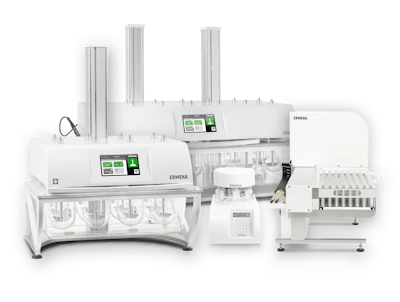
 Hand-sampling, paper-based documentation, and disconnected data systems remain common, introducing unnecessary variability, delays, and risk. ERWEKA
 Hand-sampling, paper-based documentation, and disconnected data systems remain common, introducing unnecessary variability, delays, and risk. ERWEKA