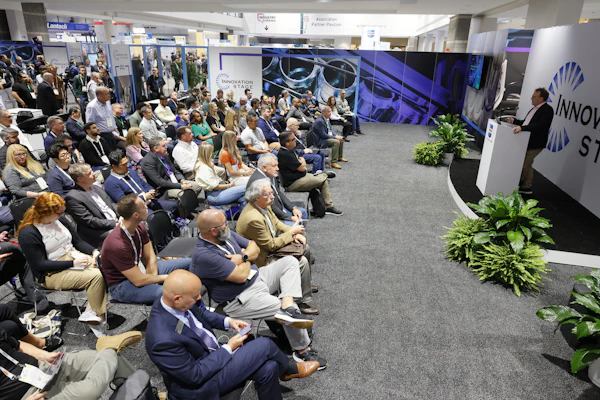
At ISTA’s TransPack Forum in Phoenix this week, Brian Wagner, co-founder of PTIS Global, framed the packaging industry’s next decade less as a set of predictions and more as a narrowing set of priorities.
“We asked in 2025, what’s going to be important in 2035?” Wagner said. “What should I consider doing now to maybe get there and be successful?”
That forward-looking exercise—part of PTIS’s recurring global survey of more than 180 industry experts—points to two dominant forces shaping packaging over the next decade: artificial intelligence and circularity.
AI shifts from emerging to dominant
In previous iterations of the research, AI barely registered. That has changed dramatically.
“AI was barely mentioned before,” Wagner said during his presentation. “Now they’re talking AI, machine learning. Number one.”
The shift reflects not just increased awareness, but real-world application across packaging development, manufacturing, and recycling.
“Companies like Nestle have reduced their speed to market for product and package development by months, lots of months,” Wagner said.
At the same time, AI-enabled systems are transforming how materials are identified and processed downstream.
“Amazon has made an investment in visual systems… that aren’t looking for codes on packaging,” he said. “They’re detecting the material itself in a very sophisticated way.”
That capability, paired with data collection and analytics, creates feedback loops that can influence packaging design at the brand level.
Despite the momentum, adoption is uneven. In many organizations, security concerns and governance structures are slowing hands-on engagement.
“A lot of companies are cautious of AI for really good security reasons,” Wagner said. “And that’s leading a lot of people… to not spend any time on AI.”
At the same time, the need for fluency is growing.
“There is… a language of AI,” he said. “We need to become literate in AI.”
That literacy is increasingly seen as foundational, not optional.
“Invest in AI literacy,” Wagner said. “Hopefully everybody’s doing that.”
Circularity: opportunity and risk
Running parallel to AI’s rise is the continued push toward circularity—one that Wagner describes in deliberately balanced terms.
“It says it’s one of the biggest opportunities and one of the biggest risks,” he said.
The opportunity lies in redesigning packaging systems for reuse, recycling, and material efficiency. The risk stems from failing to do so at scale.
“Failing to achieve circularity is one,” Wagner said of the top risks identified in the survey.
Regulatory pressure is accelerating that tension. Extended producer responsibility (EPR) policies and global legislation are shifting accountability toward brand owners, forcing more direct engagement with packaging outcomes.
“The projection is that the brand owners will play a bigger role,” Wagner said.
He ties that shift to both capability and necessity.
“The brand owners is a term I like to use all the time… the specifiers,” Wagner said.
Technical skills return to the forefront
Alongside these macro trends, the research also signals a shift in workforce needs.
“Science and technology priorities… AI integration again and new materials,” Wagner said, describing the focus areas for 2035.
In discussion, he noted a renewed emphasis on technical expertise within packaging organizations.
“In our world of packaging… science and technology, data and analytics, they’re back,” Wagner said. “We need to focus on ’em.”
That shift doesn’t eliminate the need for collaboration, but it does raise the bar for technical literacy as systems grow more complex and data-driven.
Fewer priorities, faster cycles
While the landscape is increasingly complex, Wagner argues that the number of meaningful priorities is actually narrowing.
“You could be trying to focus on a thousand things,” he said. “It’s really not.”
Instead, the research points companies toward a concentrated set of focus areas: AI, circularity, materials, and the systems that connect them.
At the same time, planning cycles are shrinking.
“Things are changing so quickly,” Wagner said. “You can’t wait 10 years to review them and update them.”
From projection to action
The PTIS research is not intended to predict a single future. Instead, it is designed to inform near-term decisions.
“Nobody predicts it, but we can project out and it can really help us with planning,” Wagner said.
That mindset—looking ahead while acting in shorter cycles—is becoming essential as technology, regulation, and market expectations converge.
As Wagner described it, the goal is not to track every possible trend, but to focus on the few that matter most—and build the capability to respond.
“Things are changing so quickly,” Wagner said. “It’s got to be much quicker.”
Matt Reynolds (00:05):
Hi, I am Matt Reynolds, editor of Packaging World Magazine here in Phoenix at the TransPack Forum that's part of ISTA, the International Safe Transit Association. I'm here with my friend Brian Wagner. He's part of PTIS. Brian, why don't you introduce yourself and explain what PTIS does and what you do?
Brian Wagner (00:20):
Thanks Matt. I really appreciate it. So I'm a co-founder of PTIS. I've spent my 43 year career in the world of packaging packaging degree from Michigan State University. And after 17 years of bouncing around big companies and small, I started PTIS with a partner, Mike Richmond. And we're now in our 26th year of management consulting staff augmentation, kind of all things packaging.
Matt Reynolds (00:43):
Okay. And for a few decades of that 26 years at least, you've been doing this. It was a triannual research. Why don't you describe some of the background there before we get into the meat of this year's research?
Brian Wagner (00:53):
Sure,
(00:54):
Absolutely. So back when I was at Kellogg's in 1998, we were part of a future of packaging program run by futurists in Washington DC. I'd never heard of such a thing, and it was really eyeopening that there is a science and art of looking at the future. Nobody predicts it, but we can project out and it can really help us with planning. So in 2004, we led our own program with roughly 15 companies from across the value chain. We met three times throughout the year, and that became the program. And every three years since we take another look out, 10, 20 years at the future, and we bring it back to how can we apply that in our strategies over the next one, three and five years.
Matt Reynolds (01:33):
And I think this most recent iteration was mostly collected in 2025 and it's projecting out to 2035. So what was really different this year? What really blew your hair back and wow, something's changed.
Brian Wagner (01:47):
And as an input to this future packaging program, we conduct a global thought leader survey. So that was the reference to my presentation this morning. I think the biggest thing is the pace of change. We were looking out probably nine years ago when we saw this thing that could be Gen AI. We didn't call it that. We were already talking about quantum computing, which could be out there, but nobody really knew how. And now they're really becoming a reality. They're moving quicker. And the environment's a big deal has been getting bigger. The population of the world is growing and resources are limited. But I think the pace of change because of technology.
Matt Reynolds (02:29):
Okay. And technology. You mentioned Gen AI. Why don't we ground that in real packaging use cases? Where do you see that impacting packaging already and where do you see projecting out to 2035 those impacts happening?
Brian Wagner (02:41):
Yeah, it is super interesting. We've researched that a bit, and AI itself goes back to the nineties, so it's not new. We've been using it and it's just gotten faster and faster and better and better. And companies like Nestle have reduced their speed to market for product and package development by months, lots of months. So the speed to market, the quality assurance without the use of people automation online, the internet of packaging and digitizing everything and innovation is happening in a lot of different areas. But within packaging, everything getting smaller, everything getting faster, everything getting smarter. Amazon has made an investment in visual systems, optical sensing systems on conveyors and municipal recycling facilities that aren't looking for codes on packaging. They're detecting the material in a very sophisticated way
Matt Reynolds (03:39):
And generating a lot of data about that material to learn about right down to the brand level, whether it's Dr. Pepper or Coke, they can tell and those brands that can be fed back to those brands to inform and impact their packaging.
Brian Wagner (03:49):
Exactly.
Matt Reynolds (03:50):
Good. And one quote that stood out to me today was you can't really predict, but you can prescribe. And one of your prescriptions was "invest in AI training and learning" just so these brands know how to use these systems.
Brian Wagner (04:04):
Yeah, no. One of the things about the Foresight work we do and looking out 10 years, we have to be careful because we present it and people go back to work to their day-to-day. And that's happening with AI. A lot of companies are cautious of AI for really good security reasons. Sure. Cybersecurity. And that's leading a lot of people in their jobs to not spend any time on AI. It's there. They're waiting for their company to dictate how they use it. And there is, there's a language of AI and that came out in the surveys. We need to become literate in AI. And the presentation I put together was a combination of Elon Musk Grock in terms of content, Microsoft Copilot.
(04:45):
It was something called Gamma AI that makes great slides. And a lot of people don't even know the terminology well. And now Claude apparently is making even better PowerPoints than Microsoft Copilot can, but Microsoft will catch up. It's just such a rapidly changing world. And the presentation after mine was on agents, agentic AI. That's fascinating. What was just a newsletter called Industry Intelligence is now an AI fed, four or five different agents, one piece R&D, one laws and regulations, another whatever. They are consumer research. And it reports up to an agent that's your buddy at work and your assistant.
Matt Reynolds (05:31):
So it's an aggregator that is also a synthesizer. Yes. So that's my job.
Brian Wagner (05:35):
Yeah,
Matt Reynolds (05:35):
It's coming from my job too. So another interesting, we're talking about all of the technologies that are out there, and I think this is kind of happening in parallel. The last few years, last few iterations of your survey, you've seen some of the softer skills being like come to the top, like collaboration, but now you saw right back to the top is that technical literacy
Brian Wagner (05:55):
At lunch today. That came up as the biggest finding. We're in a very technical group at the International Safe Transit Association, and they really believe material science, distribution testing, those technical elements of packaging are so critical. And I fully agree with them. But there is this other side, 180-some people replied to our survey and it is the soft skills. And I don't think people think about that. You don't go to school to learn collaboration. You don't go to learn necessarily how to communicate more effectively and compassion and those sorts of things. But in our world of packaging. science and technology, data and analytics, they're back
Matt Reynolds (06:36):
And
Brian Wagner (06:36):
We need to focus on 'em.
Matt Reynolds (06:37):
Back to collaboration though, one of the other AI and the high technology is definitely, it's number one with a bullet right now, but in the background is sustainability and more specifically circularity. And one of the things we talk about in industry is cross industrial collaboration, pre-competitive collaboration. So that's where you see those soft skills still extremely important for professionals and future professionals in our industry. Absolutely. So again, circularity, you were specific. You didn't say sustainability, you were more narrow and more specific in saying circularity. What did the results of the survey say about circularity between now and 2035?
Brian Wagner (07:14):
It says it's one of the biggest opportunities and one of the biggest risks.
Matt Reynolds (07:18):
So it's two sides to the same coin
Brian Wagner (07:19):
And it is tied to sustainability, but it really has to do with, in my mind, how do we develop products and packaging for end of life or end of use as opposed to let's keep using the same old products, the same old packaging that can't be recycled. We can be a whole lot smarter about the way we develop things, and that would be the complete circularity. We also need to look very holistically at packaging as the hero. As I look at it, food waste is a way bigger problem than packaging waste and more packaging in advanced processes like retort and aseptic
Matt Reynolds (07:57):
And
Brian Wagner (07:57):
So on.
Matt Reynolds (07:58):
It's shelf life extenders.
Brian Wagner (08:00):
Yeah. I think we need to keep that in mind. It's not just about making packaging that can be recycled. It's really looking at the big picture impact on the environment and making sure that we're being responsible for the raw materials that we extract and use.
Matt Reynolds (08:15):
Okay. Now another interesting, within that umbrella of circularity, something that came out in the research is historically everybody's looked to expected the retailers or government to be the leaders behind that. Retailers being the ones that have a lot of pull in the industry and government basically making everybody working instead of competitively, work together. But you're finding that brand owners themselves are likely to be the leaders in circularity packaging.
Brian Wagner (08:44):
That's what showed up in the survey. And again, we're asking in 2035, who's it going to be? And the projection is that the brand owners will play a bigger role. And I think it makes sense that right now with EPR in the United States, PPWR in Europe, they're looking for the brand owner to be responsible and a bit of a victim to some extent.
Matt Reynolds (09:07):
They're
Brian Wagner (09:07):
The target.
Matt Reynolds (09:08):
Yeah. They're coming for their wallets. Yeah,
Brian Wagner (09:11):
They are.
Matt Reynolds (09:12):
They
Brian Wagner (09:12):
Are. And I think because of that, they're not going to stand still. They are part of the EPR movement and making sure that it's being done responsibly. So I think that will continue. And they know more about packaging than do well certainly then do the laws of the regulators. Regulators, yeah, the elected officials.
Matt Reynolds (09:35):
But more than retailers as well. They know about shelf space. They don't know about the materials that go onto it necessarily. Although I would say there is a significant contingent that have their own private brands, that are private label brands that are dealing with the same things.
Brian Wagner (09:47):
The brand owners is a term I like to use all the time is the specifiers.
Matt Reynolds (09:50):
Okay, there you go. Okay. So we've talked about AI, we've talked about circularity, we've just talked about regulation and who's going to be leading how as a brand owner or A CPG or a contract packager, how do you balance all these things? When you just said to lead off, the pace of change is accelerating, how do you make sure that you've got all these plates spinning all at once?
Brian Wagner (10:10):
Yeah, so as I presented, I thought about we have a really narrow list of things to focus on. In truth, it's a complex world out there. You could be trying to focus on a thousand things. It's really not. We're saying focus on circularity, sustainability, AI, what it means for material science and so on. So the research has kind of narrowed that, and that's a good thing. Leveraging Foresight to a large extent doesn't mean you change what you're doing today. You monitor these things. We talk about horizon 1, 2, 3, and strong and weak signals that maybe these things are coming true and we do or don't need to invest in them. Because we're projecting, we can't predict the future.
(10:55):
So it's really important to monitor them and have somebody in your organization who can do that. And with brand owners specifically in the packaging department or supporting the packaging department and AI tools, again, there's going to be agents who can do that for you, where it won't necessarily take away from the time you're spending day to day and you can have it give you updates as needed. Or in the case of... I spoke with the VP of packaging with a company, big brand owner a couple of weeks ago, and she said she still wants to come to us as a consultant to do her technology scouting because she doesn't have time. She's working 10 hour days, most of it in meetings. Right.
Matt Reynolds (11:34):
And I know that feeling, but what you're saying is what I described is all these competing, all these elements that are competing for our attention, what you're describing is a convergence of these elements to all use AI to help solve some of these other problems. Absolutely. Or leverage government or leverage EPR to help incentivize people to move. So really it strikes me as more of a convergence. So Packaging Foresight, tell our audience how people can either get involved or find it. It's on your website or how can they leverage some of, whether it's your executive summary or actually to get involved in some of this in.
Brian Wagner (12:08):
Yeah, we would love to have you contact us. You can contact me directly at Brian, [email protected]. Website is PTs global.com. We've got a Packaging Foresight newsletter, and we would love to hear from you and have that discussion. And
Matt Reynolds (12:24):
You can also find PTs regularly in the pages. Yes pages, physical pages of a physical magazine of Packaging World magazine every, I'd say three months or so. Three times a year. Right. Good.
Brian Wagner (12:34):
We appreciate that.
Matt Reynolds (12:35):
I think we have just enough time to get down there, three minutes to go see Walmart speak. So we're going to wrap this up. Okay. Thanks a lot, Brian.
Brain Wagner (12:41):
Thank you.