Walmart's automated distribution centers are introducing new mechanical stresses—particularly sustained horizontal compression from robotic depalletizing—that traditional packaging designs were never built to withstand. Brands must redesign packaging with these forces in mind and adopt new testing protocols to meet emerging industry standards.
- Horizontal compression from layer-by-layer robotic depalletizing applies sustained lateral pressure across entire pallet layers, a force not present in traditional manual distribution environments.
- Shelf-ready packaging (SRP) with perforations is particularly vulnerable, as the structural weaknesses designed for retail convenience become failure points under automated handling.
- Testing protocols must evolve to measure vibration profiles, impact events, and sustained compression forces that legacy lab methods do not adequately simulate.
- Walmart's $35 billion automation investment has scaled these challenges rapidly, making packaging consistency and structural integrity critical to DC efficiency and throughput.
- Industry standards are shifting as Walmart's requirements influence broader packaging expectations, making compliance essential for brands relying on major retail distribution.
 Jim Thomson, CPP, PDP, Director, Packaging Product Development, Walmart US Supply Chain
As the retailer continues to invest heavily in distribution center automation, packaging performance is becoming tightly linked to system efficiency. Cases that once moved through largely manual environments must now withstand a growing range of machine-driven interactions. Many of those pack/machine or robot interactions were never part of traditional design or testing methods or assumptions. The number of “touches” from the CPG’s packaging line to the Walmart store shelf are changing.
“Automation is really re-shaping the packaging requirements that we see today,” Jim Thomson, Walmart’s director of product packaging, told a rapt audience at the International Safe Transit Association (ISTA)’s TransPack conference last week.
That shift is already surfacing new performance gaps. And one of the clearest examples is emerging in how packages behave under forces that, until recently, simply didn’t exist in distribution. At least, they didn’t exist at this scale.
While elements of this automation, such as layer-by-layer depalletizing, have existed in limited form for years, the rapid expansion of automated DCs following Walmart’s post-pandemic $35 billion supply chain automation investment has brought packaging-related defects into sharper focus. Prior to that expansion, depalletizing operations were limited enough that packaging failures did not draw significant attention. At scale, those same failure modes are now surfacing more consistently.
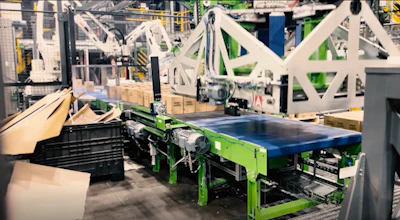
Editor's note: In the video below, note the single-layer depalletization occurring between the 0:32 and 0:40 second marks.
Automation exposes packaging variability
In manual environments, variability in packaging could often be managed on the fly. A human operator could compensate for a poorly sealed or damaged case, a shifted load, a missing or non-readable barcode, or an inconsistent case structure. Automated systems don’t offer that flexibility.
Consistency of weight, geometry, identification, and structural integrity becomes essential.
“When we start looking at case weight uniformity, I know that’s something that can be very difficult to control. Sometimes it can be controlled by adding multiple items in the case or maybe through the product design itself. But having consistent weights on these items, and having that center of weight or mass in the center, is going to really help move these items through supply chains and get them to the store where they can be sold, and strength needs to be matched to the dynamic loads,” Thomson said on stage. When execution is machine‑controlled, packaging performance must stand on its own — because machines execute exactly what they’re given, without adaptation or forgiveness, Walmart told the ISTA TransForum audience. Walmart
Traditional packaging design has largely focused on vertical (top to bottom) compression—how cases stack in transit or storage. That’s how things have been tested in the Packaging Lab on ISTA Transit Tables and in real world ship tests. But Walmart says it’s no longer sufficient.
“In the past you’ve always been looking at static loading or stacked cases, and that’s not going to change. But what is changing is there are other forces now that we’re seeing on these packages that haven’t been seen in the past,” Thomson said.
Those forces are being introduced and amplified by the systems driving Walmart’s next phase of DC automation.
Sustained horizontal compression
As more DC functions become automated in all phases, from receiving to storage to picking and depalletizing, and mixed pallet building, packages encounter new mechanical interactions. Robotic clamps, high-frequency vibration, and automated transfers all introduce stresses that are not well represented in legacy test protocols. One of the most significant is horizontal compression.
“The sustained horizontal compression is a really big deal and something that really needs to be looked at. When you have that depalletizer head … taking that entire pallet layer off to move it around, you haven’t seen those types of horizontal pressures in the past on packaging, and it’s something that needs to be considered,” Thomson said. According to Walmart, many of these stresses are not well represented in legacy test protocols. This gap becomes visible at scale.Walmart
Layer-by-layer robotic depalletizing systems lift entire tiers of product all at once, applying lateral pressure across cases to stabilize and move them. Unlike momentary impacts, this pressure can be sustained, and it acts on package structures that may not have been designed with that force in mind.
While horizontal compression itself is not entirely new in distribution environments—clamp handling has long been used for large or bulky goods—its application across full pallet layers introduces a different condition. Those forces have typically been applied to individual large units, not across multiple cases simultaneously. Applying sustained lateral pressure across an entire pallet layer of smaller cases creates a load scenario that most CPG packaging has not historically been designed to withstand.
I asked Brian Stepowany, owner of packaging consultancy Step Pack LLC, who previously held packaging leadership roles at B&G Foods, Kraft, Bumble Bee, Johnson & Johnson, and others, about his experience with these types of forces. He noted that in layer-by-layer depalletizing, compression forces are concentrated at the layer level rather than distributed across an entire pallet, increasing the stress applied to individual cases.
At the event, I also spoke to Tom Blanck, senior advisor with BoldtSmith Packaging Consultants about what this emerging trend means for brands and their packaging strategies.
“It is an added variable. It might not be the trump card that changes everything, but it could be. If you have shelf-ready packaging (SRP), they’ll perforate the case, and that just weakens the case entirely. So imagine a whole bunch of these boxes lined up and compressed together—depending on the product, all those perfs could fold and collapse, and you could have catastrophic failure immediately.”
The potential result, according to Blanck? Deformation, loss of structural integrity, and, in some cases, outright failure.
SRPs draw attention
The shelf-ready packaging (SRP) that Blanck described has emerged as an early indicator of where packaging design and warehouse automation may be misaligned in places.
Designed for retail convenience—with perforations or covers that allow store associates to remove a top panel and place the case directly on the shelf—SRPs inherently trade some structural strength for functionality. Not for nothing, that shelf-level, easy-open decorated case functionality and aesthetic only exists because demanded by the retailer in the first place.
In automated environments, those tradeoffs become more pronounced. According to Walmart at the ISTA TransPack Forum, SRP was not designed for automation, yet it flows through automated systems every day. Failures here made testing gaps impossible to ignore, they say. Walmart
Perforations create weak points. Adhesive bonds can become failure points under lateral pressure. Even small structural changes, like a slightly shifted lid or a partially compromised base, can disrupt how a machine interprets and handles the package downstream.
“Some of these challenges are not new. Designing a perforation which provides the necessary strength, and yet can be cleanly opened and looks good on the shelf, is an age-old problem,” one brand owner, who chose not to be named, told me.
Failures in SRPs have included cases where bottoms drop out, lids shift out of alignment, or geometry changes enough to confuse automated systems, slowing throughput.
At the same time, not all SRPs are failing under these conditions. Some designs are performing within expected ranges, suggesting that the issue is not the format itself, but how it is engineered. That distinction matters.
Performance is also highly dependent on what’s inside the case.
“It does depend. If you’ve got cake mix or things that are solid cartons inside, it may not be a problem at all. But if you’ve got shelf-ready packaging or something that’s light and airy and doesn’t provide any stacking strength or reinforcement to the case, it could be a killer,” Blanck said.
From a design standpoint, that may require material and structural changes.
“Through additional testing, time, and cost, companies will have to evaluate their shippers and display cases. Board grades used in lightweight applications will most likely have to be increased,” said Stepowany.
“The ratio between cut and board in perforations has to be evaluated. There may be a need to increase the amount of board between the cuts to increase strength. New dies and testing mean added cost and time.”
Rather than eliminating SRPs, the direction appears to be toward better-defined performance expectations—particularly around perforation design and overall structural integrity under horizontal compression.
From observation to measurement to standards
To better understand these new forces, Walmart has been studying packaging performance in live automated environments, working with partners to capture compression data, vibration profiles, and impact events.
The goal is to move from observation to measurable inputs—and from there, to updated requirements.
“We’re studying those horizontal compression forces, vibration profiles through automation, and the impact events during the transfer,” Thomson said.
That work is expected to inform both internal requirements and broader industry alignment around packaging performance in automated systems.
It also exposes a growing gap between real-world conditions and how packaging is currently designed, lab tested and then validated in the real world. According to Walmart, this work is not retailer‑specific. The goal is better alignment between real system inputs and how packaging is evaluated, they say. Walmart
Testing must catch up
Many existing test protocols were developed around traditional distribution environments. As automation introduces new stresses, those protocols may no longer be sufficient to predict performance.
“[Packaging] Labs are going to have to adapt to new protocols, and that may include new equipment being installed because, again, these are forces that haven’t been seen on packaging in the past that we really need to look at and validate before they flow into DCs,” Thomson said.
Walmart is already working to characterize those conditions. “We’re studying those horizontal compression forces, vibration profiles through automation, and the impact events during the transfer,” he added.
In practical terms, that could mean new methods to simulate sustained horizontal compression, updated vibration and impact profiles, and equipment capable of replicating automated handling conditions. Those methodologies are likely to be shaped by the data Walmart is now generating as it studies how packaging performs inside its automated network.
For third-party package testing labs, this represents both a challenge and an opportunity to evolve alongside the systems they are meant to validate.
When retailer requirements become industry reality
Thomson emphasized that Walmart has long aligned its packaging guidance with broader industry standards where possible. But the scale and speed of DC automation are creating situations where new requirements must be defined more quickly.
“We try to align as best as we can to industry standards. We don’t like to create Walmart-specific standards, but we will do that when we need to for specific products through supply chain,” Thomson said.
From a brand perspective, that reality is difficult to ignore.
“From a brand owner perspective, one of the biggest realities is if you sell a lot through Walmart, you’re going to have to deal with this sooner rather than later. Walmart is kind of the leader on this—they’re exploring and proving the efficiencies of automation. If that starts working for them, you’ll see others follow,” Blanck said.
The implications extend beyond design into cost and sustainability tradeoffs.
“As engineers try to optimize shippers and displays to lower cost and improve sustainability, using clamp-style handling will increase costs and board usage,” Stepowany said.
“Brands may overreact. Alternative designs should be considered, not just reinforcing current designs. Companies also need to understand when these changes will be required and which products will actually be impacted. Not all products will be affected the same way,” Stepowany said.
In practice, those decisions carry weight well beyond a single retailer. Costco and others are certainly implementing similar systems.
Suppliers design packaging to meet Walmart requirements because they must. Over time, those requirements often influence broader industry expectations—especially when they are rooted in real, measurable system demands.
A broader shift underway
Horizontal compression from layer-by-layer depalletizing is one of the first clearly defined examples of how supply chain automation and mixed pallet building is reshaping packaging requirements. It won’t be the last.
Walmart’s approach spans multiple automation systems and partners—from WITRON in grocery distribution to AI-driven platforms like Symbotic—each introducing different handling dynamics that packaging must now accommodate. At the same time, technologies such as Wiliot’s ambient IoT tags are adding new visibility into how packages move through those systems, helping define the conditions packaging must withstand.
As automated systems continue to evolve, they will introduce new forces, new failure modes, and new expectations for consistency and performance. Packaging that performs well in traditional environments may not meet the demands of these systems without adjustment.
“Probably the biggest thing is just to stay tuned. Walmart mentioned they put out their guidelines twice a year, and you can’t be complacent in your packaging. Keeping an eye on the damage signals is really important. If you see issues in certain parts of the distribution chain, that’s a sign there’s a hazard or handling condition causing it. The key is to figure out what that is, test for it, and use that to guide your design,” Blanck said.
The bototm line? For brands, material suppliers, equipment OEMs, packaging developers, and testing labs alike, a new DC automation variable is being added to an already complex equation.
Tertiary and secondary packaging must now be designed not just for transport and the retailer’s shelf, but for the machines that move it in between. And increasingly, those machines are setting (or resetting) the rules.