Pharmaceutical packaging must balance product protection with patient accessibility by incorporating clear labeling, visual aids, and thoughtful design that accommodates older adults, people with visual or physical impairments, and those managing multiple medications while maintaining child-resistant safety requirements.
- Design Challenge: Packaging must protect products and meet regulations while remaining readable and accessible for older adults, people with visual or physical impairments, and caregivers managing multiple medicines.
- Information Accessibility: Critical medication details like dosage, expiry dates, and warnings should use legible fonts, adequate contrast, clear layouts, and visual aids such as pictures or dosage schedules rather than text alone.
- Child Resistance vs. Adult Access: A study using soft aluminum foil for press-through packaging found that only 1 of 18 children could open it, while all 8 older adults with arthritis successfully accessed the product.
- User Testing Requirements: Effective packaging development requires involving target patient populations—especially older adults and those with limited dexterity—in real-world usability testing, not just controlled laboratory environments.
Packaging in the pharmaceutical industry is integral to regulatory compliance and product safety, protecting medicines and maintaining quality throughout storage and distribution. However, packaging focused on product protection and regulatory requirements alone does not necessarily mean it fulfills the usability preferences (or needs) of patients of all ages.
Older adults, people with visual or physical impairment, and those managing multiple medicines may experience difficulties identifying, understanding, or even accessing their medication. That’s why pharmaceutical packaging should balance product protection with accessibility, enabling patients and caregivers to identify and access medicines safely, with independence, and minimizing handling difficulties.
“Inclusive design is about creating products that deliver a good user experience for the broadest possible spectrum of people,” said Lucy Baldwin, who leads research and design strategy at Ensera Design in an interview with Healthcare Packaging.
Making Medication Information Accessible
Lengthy instructions, unfamiliar terminology, and language barriers can create difficulties, particularly for older adults and caregivers. That’s why manufacturers are opting for graphics and visual cues along with concise language understandable to the intended users.
Accessibility begins before the patient opens the drug package. They must first be able to identify the medicine and locate critical information, including strength, expiry date, dosage, storage instructions, and warnings. Information design should also be made with the limitations of older adults or people with visual impairment in mind.
Small fonts, poor contrast, and crowded layout can make medicine information difficult to read and understand. A study conducted in Singapore, examining older adult and family caregiver experiences with prescription medication labels found that participants often reported the labeling information too cramped to be able to clearly read it.
That’s’ why critical information such as dosage, usage, expiry date, and warnings should be presented in clear and consistent layouts, using legible fonts and adequate contrast. Visual aids, such as pictures, can help communicate instructions too. For example, visual schedules may use clearly labeled morning, afternoon, and evening sections to help patients follow their dosage routine. And drawings depicting how to open a pack and how to administer the medicine is oftentimes proving to be more helpful than words alone.
Balancing Child Resistance with Adult Accessibility
Child-resistant packaging is a critical safety requirement for many pharma products. Still, its design must account for the needs of older adults and people with physical impairments such as arthritis. Both child resistance and adult accessibility must be evaluated together, rather than treated as separate design requirements.
Rather than relying only on thicker materials or more difficult opening mechanisms, manufacturers can explore alternative material properties to achieve this balance. In a study titled, “Feasibility of Child-Resistant and Senior-Friendly Press-Through Packages: Potential of Different Materials,” Kiyomi Sadamoto investigated the use of soft aluminum foil for press-through packaging (PTP). The 30µm soft aluminum prototype required approximately 1.6 times the breaking force of conventional hard aluminum packaging material. During tests, only one out of the 18 children managed to open the prototype packaging, while all eight older adults (with arthritis) accessed the product.
“For medications sensitive to environmental factors, utilizing high-barrier and thin-gauge forming films is key,” says Kazuya Sugimoto, Packaging Technology Group, Sawai Pharmaceutical Co. Ltd. “Adopting a peel-and-push mechanism engineered for low push-out force offers a practical balance, preventing accidental access by children while remaining manageable for elderly patients.”
Improving Physical Access through Packaging Engineering
Physical access to the product can also be improved through appropriate design modifications. The effort required to open a package or retrieve its contents depends partly on the geometrical features and material characteristics.
“Forming film thickness plays a significant role in push-out ease, so selecting an appropriately thin film is effective,” says Sugimoto. “Additionally, designing cavities with an optimal draw ratio and minimizing headspace around the tablet or capsule reduces resistance, allowing for smoother dispensing.”
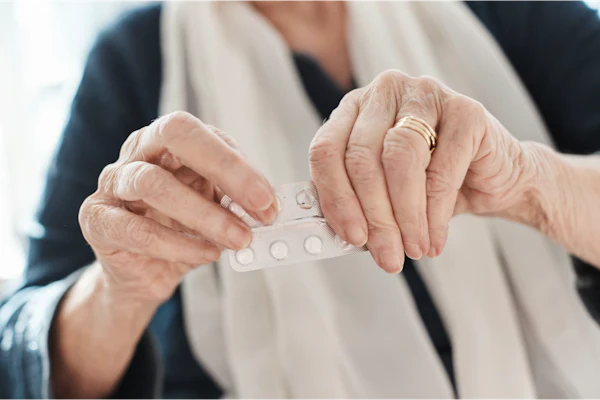
Opening the packaging itself presents another accessibility challenge. Older adults, especially those with limited dexterity, may struggle to open the package, and sometimes resort to household tools, as indicated in the study published on Oxford Academic called Age and Aging, conducted by Lorenzini, G. C., Bell, A., & Olsson, A. One participant reported, “Of the fifteen medications I have, there is only one I can get into [without tools].”
Integrating Usability into Pharmaceutical Packaging Development
Packaging in the pharmaceutical industry traditionally places a strong emphasis on product protection and meeting regulatory requirements. However, developing patient-centric packaging, especially for older adults, requires incorporating user feedback from the early stages of development.
According to Asmita Khanolkar Senior Director SMC Ltd, “Formative studies and usability testing drive packaging decisions, starting early in the development process for successful results of the overall therapy.”
Traditional usability testing often takes place in controlled environments — observation rooms with one-way mirrors, structured tasks, and scripted interactions. These studies are critical for regulatory approval and safety validation.
“Rather than relying solely on evaluations by in-house personnel, usability testing must involve the target patient population, especially older adults and individuals with limited manual dexterity,” says Sugimoto. “Furthermore, observing how patients handle blister packs in real-world settings is crucial for uncovering practical usability barriers.”
At the same time, improvements must not affect the packaging quality, child-resistant properties, or compliance with relevant regulatory requirements.