Key Takeaways:
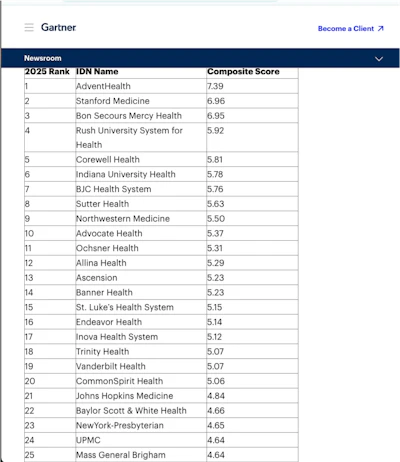
AdventHealth claims the No. 1 spot for the second consecutive year.
Intermountain Health and Mayo Clinic have achieved Masters status for eight consecutive years, recognized for sustained supply chain leadership at health systems.
Providers are increasingly deploying AI to streamline complex processes, reduce manual labor and generate actionable insights.
Gartner, Inc. has released its 17th annual Gartner Healthcare Supply Chain Top 25 ranking, recognizing U.S. health systems that demonstrate leadership in supply chain performance and innovation.
AdventHealth claims the No. 1 spot for the second consecutive year, followed by Stanford Medicine, Bon Secours Mercy Health, Rush University System for Health, and Corewell Health rounding out the top five. NewYork-Presbyterian and Mass General Brigham debut on the 2025 ranking (see image.
“Healthcare supply chains are under pressure to deliver cost savings, improve resiliency, and implement AI to transform their operations,” says Salil Joshi, Senior Director Analyst in Gartner’s Supply Chain practice. “This year’s leaders demonstrated the power of leveraging technology, including AI-driven insights, to extend their span of control, strengthen clinical partnerships, and build smarter, more agile supply chains.”
In its eighth year, the Healthcare Supply Chain Top 25 Masters category recognizes sustained supply chain leadership at health systems. This recognition is awarded only to supply chains that have achieved a top-five score at least seven times in the past 10 years. Intermountain Health and Mayo Clinic have achieved Masters status for eight consecutive years, while Cleveland Clinic earns this distinction for the second time. Their continued presence reflects intentional investment in their supply chains as a strategic differentiator.
Top Three Themes for 2025:
Resurgence of Cost Management
A volatile global trade environment has led healthcare providers to implement strategies to manage and mitigate impact. Leaders responded by building financial impact models surrounding potential tariff changes, diversifying suppliers and investing in real-time monitoring tools to track suppliers. These efforts helped organizations anticipate disruptions and reduce cost exposure. Additionally, health systems continued to expand their span of control into purchased services and pharmacy, while centralizing operations through consolidated service centers to drive efficiency.
Accelerating the Digital Supply Chain
Providers are increasingly deploying AI to streamline complex processes, reduce manual labor and generate actionable insights. This includes implementing AI-powered analytics platforms that allow natural-language queries for cost and outcome insights and using GenAI tools for contract review and predictive planning. Combined with robotic process automation and ERP modernization, these technologies are streamlining workflows and improving resiliency. Other digital initiatives include control towers for real-time visibility and RFID for inventory accuracy.
Expanding Clinical Collaboration Initiatives
Partnerships between clinical and supply chain leaders have deepened through greater alignment of supply strategies with clinical priorities to ensure patient care is never compromised. These collaborations have enabled breakthroughs such as procedure card optimization, reducing supplier variance and waste while improving compliance. Beyond these partnerships, health systems are leveraging procedural analytics dashboards and governance structures to standardize utilization and align cost with quality outcomes.
About the Healthcare Supply Chain Top 25 Methodology
The Healthcare Supply Chain Top 25 ranking is derived from two main analyses: quantitative measures and opinion components. Quantitative measures provide a view into how companies have performed in the past and establish proxy connections between financial health, performance and supply chain excellence. The opinion components offer a qualitative assessment of value chain leadership and demonstrated supply chain performance — crucial characteristics of our Top 25. The qualitative and quantitative components are combined into a total composite score.