Operational memory—the ability to retain decisions, relationships, permissions, and business context across systems—is the critical missing layer that enables AI agents to perform reliable work in packaging workflows rather than simply providing recommendations.
- Operational memory differs from chat history: AI agents need to understand how information connects across business systems, suppliers, permissions, and product lifecycle management platforms.
- Context prevents costly mistakes: When a supplier component fails, an AI with memory recalls approved alternatives and quality requirements rather than suggesting generic replacements.
- Governance is essential: Memory without proper controls increases risk; organizations must establish how retained information supports authorized actions.
- Start with low-risk pilots: Identify bounded workflows like supplier onboarding or SKU introductions with clear documentation, frequent handoffs, and auditable records.
- Real value requires action: The ROI ladder progresses from answering questions to making recommendations to reliably performing defined business tasks.
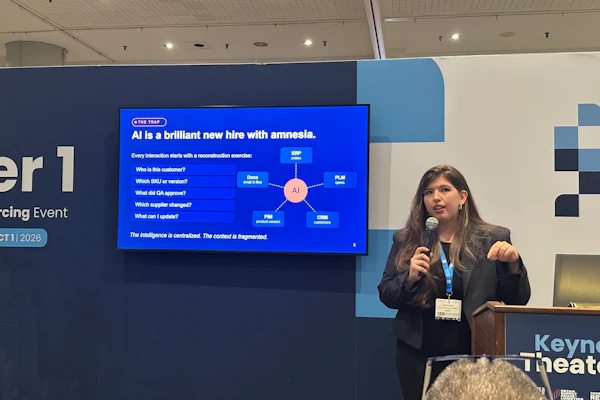
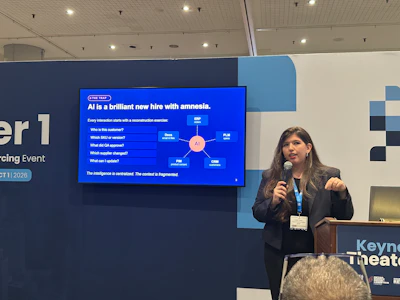
At the White & Private Label Expo in NY this fall, Mindy Sabel, a digital product and AI leader in the industry, and formerly with Bayer, presented on AI and why context is the missing layer between AI models and enterprise value. Outside of her “day job,” she has been building an AI enablement tool that could be implemented to help companies update claims on packaging, communicate between teams, and enable faster internal processes.
In her presentation, Sabel argues that smarter AI models alone won’t enable agents to perform reliable business operations. The missing piece is operational memory: the ability to retain decisions, relationships, permissions, and context across interactions and business systems.
In her presentation, Sabel outlined why increasingly capable AI models still need infrastructure that preserves business context before organizations can trust them to perform work.
“I like to describe the current model as a brilliant new hire—but a brilliant new hire with amnesia,” she said.
Beyond Chat History
There is a difference between operational memory and a record of previous conversations. An agent may recall a prompt or retrieve relevant documents without understanding how information connects across a business.
“What they’re missing is the operational memory connecting all the entities you work with, the systems you use, and the permissions surrounding them,” she said.
Those connections matter when work spans product lifecycle management, customer relationship management, and product information management systems. A decision may depend on supplier capabilities, minimum-order quantities, retailer requirements, and earlier choices that are scattered across systems.
For a packaging team, finding a specification is one step. Understanding which supplier it applies to, why an alternative was accepted, and what conditions govern its use adds another layer.
“Memory is the ability to understand all the moving parts involved in making a decision and use them to inform the next decision,” Sabel said.
Supplier Changes Need Context
Sabel offered a supplier shortfall as an example of where memory could improve an agent’s usefulness.
“Suppose a supplier misses a component. The agent wouldn’t simply suggest a generic alternative pulled from training data you don’t control. It would remember which alternatives had already been approved and what the quality-assurance requirements were.”
For healthcare packaging readers, the significance is the connection between an alternative and its approval context. An available component is not automatically an acceptable component. An agent supporting that workflow would need access to the relevant decisions and requirements before recommending a next step.
The same principle applies to launch schedules. Moving a date may affect another product’s development pipeline. Sabel argued that an agent with operational memory could identify those dependencies rather than simply retrieve a revised brief.
Changes to product claim copy provide another example. Finding the latest wording does not, by itself, explain the approval process or the implications of changing it.
From Recommendations to Action
Sabel described AI adoption as an ROI ladder: answering questions, making recommendations, and ultimately acting reliably.
Her argument is that greater value becomes possible when agents complete defined business tasks. But that requires more than a capable model. The agent must understand which accounts it can access and which fields it is permitted to update.
“Your ability to trust the process will be driven by the integrity of the entire system—not by one specific model,” she said.
For healthcare packaging teams, that places attention on how data, retained context, and permissions work together. A useful recommendation and an authorized system update involve different responsibilities.
She also cautioned that memory without governance increases risk. Preserving more information is only part of the task; organizations must establish how that information supports controlled actions.
Designing a Practical Pilot
Before launching another AI pilot, Sabel recommends answering five questions:
1. What should the agent remember after our interaction ends?
2. Which people, suppliers, or products need stable identities?
3. Which decisions and relationships should it remember?
4. What is the smallest, safest update it can make?
5. And how will the organization determine what changed and why?
“What relatively low-risk task could you trust it t update?” she asked.
She suggested beginning with lower-risk tasks within processes such as supplier onboarding or new SKU introductions. Repetition, frequent handoffs, clearly documented actions, and auditable records can help identify useful starting points.
“Traceability is important because you need to determine whether the agent followed every required step and identify who made each decision,” she said.
For packaging teams, the immediate opportunity is to define a bounded workflow and the context needed to complete it. That exercise can clarify where AI assistance is useful and where human review remains necessary.
“The real value comes when AI can perform work rather than merely acting as a consultant at your side,” Sabel said.