Key Takeaways:
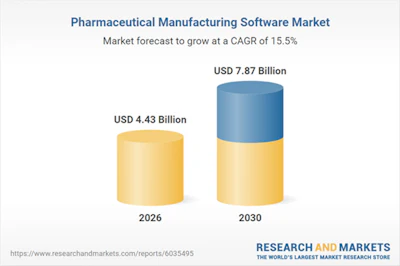
- The global market for pharmaceutical manufacturing software is projected to grow from $4.43 billion in 2026 to $7.87 billion by 2030.
- Adoption of AI, machine learning, and cloud-based platforms is a primary driver, enabling real-time production monitoring and automated compliance.
- While North America currently leads the market, the Asia-Pacific region is forecast to be the fastest-growing area.
As pharmaceutical companies face mounting pressure to increase output and navigate complex regulatory environments, investment in advanced manufacturing software has become a critical operational priority. The market is experiencing significant growth, expanding from $3.82 billion in 2025 to an anticipated $4.43 billion in 2026, according to a recent report from ResearchAndMarkets.com.
The surge is directly linked to the increasing volume of drug production required to meet global healthcare demands. According to ScienceDirect, 1,035 new drugs were approved between January 2023 and October 2024, illustrating the scale of production that modern facilities must support. Manufacturing software is essential for managing this complexity, improving data accuracy, optimizing resource allocation, and maintaining stringent regulatory adherence.
Technology Adoption and Process Optimization
A key trend driving the market is the integration of artificial intelligence and machine learning into manufacturing processes. Companies are leveraging these technologies to bolster predictive analytics and improve operational efficiency. For example, Mareana recently launched Connect CMC, an AI-powered tool designed to help smaller pharmaceutical and biotech firms automate data management for better efficiency and compliance.
Other significant trends include the adoption of cloud-based software, the expansion of smart manufacturing facilities, and the implementation of tools for real-time production monitoring and supply chain optimization. These innovations are moving the industry toward more automated and data-driven operations.
Market Consolidation and Global Dynamics
The competitive landscape is also being shaped by strategic acquisitions aimed at creating more integrated service offerings. The May 2023 acquisition of Smart Point Technologies by Antares Vision Group highlights a move toward consolidating compliance and service capabilities within a single provider. Key industry players driving technological advancements include McKesson Corporation, Oracle Corporation, SAP SE, and Rockwell Automation Inc.
Geographically, North America held the largest market share in 2025. However, the Asia-Pacific region is projected to experience the fastest growth through 2030, with countries like China and India expanding their pharmaceutical sectors and increasing software adoption.
Additionally, international tariffs on imported software and tools present a challenge, increasing costs for manufacturers. This pressure is also stimulating local software development, potentially reducing reliance on foreign imports over the long term and fostering regional innovation.