Pharmapack 2025 revealed ten major trends reshaping pharmaceutical packaging and device design, including digital labeling, sustainable auto-injectors, and patient-centric design approaches. Industry leaders emphasized that sustainability advances must always prioritize patient safety and medication adherence.
- eLabeling adoption is growing for sustainability and accessibility, though concerns remain about whether patients actually access digital pharmaceutical information online.
- Reusable auto-injectors from companies like AstraZeneca reduce plastic waste but add user steps, creating a trade-off between sustainability and ease of use.
- Take-back programs like Novo Nordisk's ReMed achieved a 32% return rate in Denmark in 2024, with goals to create closed-loop medical-grade recycling systems.
- Sustainability carries costs that customers may resist paying, requiring companies to choose between environmental compliance and minimal pricing.
- Patient safety and adherence remain non-negotiable priorities across all pharmaceutical packaging innovations, regardless of sustainability or design advances.
Pharmapack wrapped up last week with two full days of new product innovation, networking, and informative talks, sessions, and panel discussions on all of the latest topics. The tracks included device and packaging innovation, large volume drug delivery, sustainability, and then various workshops ranging from connected devices to patient adherence. I had the pleasure of following the device and packaging innovation track and learned of the many pressing issues our industry faces, as well as the new solutions rolling out to address them. I pared everything back to give you a quick list of the top trends I saw while attending the show. Here they are:
1. The rise of electronic labeling: eLabeling, or digital labeling, is become more and more popular. The reasons? Some think it improves the usability of the information as users can access the information anytime. It also improves sustainability since it reduces paper waste. But questions arose over whether users actually visit the pharmaceutical websites to read the label information. In a Lightning Talk session, Matt Bolton from MSD and John Bratton from Smurfit WestRock discussed how digital display labels are helping clinical trial companies get their drugs out to market faster. Read more about this initiative here.
2. Designing medical devices for usability and inclusion: several panel discussions were held on the importance of designing products so everyone can use them, even those with limited sight, dexterity issues, as well as different age groups. Robert Greene, Consultant, Patient Partner Consultancy, discussed the importance of creating a patient-centric design and that the best formula for this is to design the individual patient. But that raises the question, do we design for the majority, or the minority?
 Alper Hulusi, Head of Market Insights at Clarimed, shared that a real emergency setting is far different from the simulation scenarios that Clarimed facilitates. He talked about the importance of market research to create packaging that accounts for high emotion and stress to ensure the user can administer the drug safely.
4. Take-back programs may be the answer to reducing plastic waste. Baijia Huang, Global Environmental Lead at Novo Nordisk discussed strategies to reduce plastic impact. She shared results from ReMed™ the overarching program used to describe all take-back pilot initiatives in Novo Nordisk. One such program in Denmark for injection pens showed a 32% return rate in 2024. One of the company’s long-term vision for ReMed is to create a closed loop recycling system that keeps plastic at medical grade quality.
 Baijia Huang, Global Environmental Lead at Novo Nordisk shared results from ReMed™ the overarching program used to describe all take-back pilot initiatives in Novo Nordisk. One such program in Denmark for injection pens showed a 32% return rate in 2024.Pharmapack
6. Auto-injectors are getting more eco-friendly: new designs are launching to improve sustainability, including a fully mechanical, reusable auto-injector from AstraZeneca. Andrew Chapman, Senior Director, AstraZeneca shared that this new auto-injector functions the same as traditional two-step auto injectors once the medication is loaded. He discussed the research that went into the package design to ensure proper use.
7. There is a cost to sustainability, and not everyone is willing it pay for it. Alexander Schafer, Business Development Manager, Sharp, brought up the often-overlooked reality that sustainability comes with a price tag. There is a cost factor, and customers are sometimes not willing to pay. “We need to accept that it comes at a certain cost. What is the main objective? Being sustainable and complying to regulation, or keeping costs as low as possible? It cannot be both.”
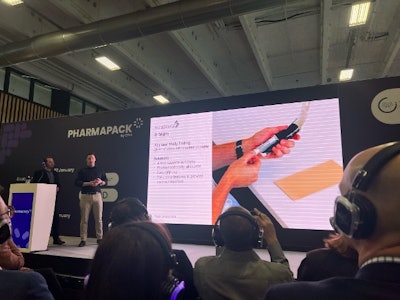
 In a Lightning Talk session, Matt Bolton from MSD and Brian Sheridan discussed how digital display labels are helping clinical trial companies get their drugs out to market faster.Pharmapack
9. The trade-offs of designing for human factors. Tom Oakley, VP Design and Development, Springboard, brought up the interesting point that designing for sustainability sometimes takes away from usability. An example is the rise in reusable auto-injectors that are more environmentally friendly, as they use less plastic waste. But users have another step to perform by loading the cartridge, making it appear less user friendly. Then concerns are growing around the usability of the product over hundreds of uses. So, while more sustainable, yes, perhaps less patient centric.
10. Patient safety and adherence remain key. No matter the panel discussion or expert-led workshop surrounding issues like sustainability and designing for usability, experts all agree that we cannot overlook the main point to pharmaceutical and medical device packaging, which is patient safety and adherence.