A new international report reveals healthcare's dependence on single-use plastics costs the U.S. and Canada $29 billion annually while generating 4.3 million metric tons of emissions. Five evidence-based circular economy strategies can reduce plastic waste by 54%, cut emissions 58%, and deliver $8 billion in annual savings by 2040.
- The U.S. and Canada generated 1.2 million metric tons of single-use healthcare plastics waste in 2023 alone
- Current costs to health systems reach $29 billion annually, with potential to rise to $37 billion by 2040 without action
- Five circular economy strategies include: refuse/reduce unnecessary plastics, reuse durable alternatives, substitute with compostable materials, improve recycling design, and procure low-emissions plastics
- If scaled across the system, these interventions could cut waste 54%, reduce emissions 58%, and save $8 billion annually by 2040
- Seven high-volume product categories analyzed: gloves, fluid bags, rigid devices, PPE, wipes, pharmaceutical packaging, and device packaging
Key takeaways:
- A new report reveals how the healthcare sector’s dependence on single-use plastics is driving up costs, waste, and greenhouse gas emissions.
- Experts agree that healthcare has become overly dependent on disposable plastics.
- The report highlights five practical, evidence-based circular economy strategies that U.S. hospitals and suppliers can scale today.
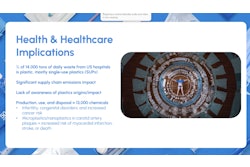
A new report from global sustainability consultancies Eunomia and Systemiq reveals how the healthcare sector’s dependence on single-use plastics is driving up costs, waste, and greenhouse gas (GHG) emissions. Among the regions analyzed, the U.S. and Canada generated the most healthcare plastics waste, together producing 1.2 million metric tons of single-use healthcare plastics waste, 4.3 million metric tons of CO₂e emissions, and costs to health systems as high as $29 billion in 2023 alone.
“This report presents the strongest evidence yet to galvanize the global healthcare community into urgent action on plastic waste,” says Pallavi Madakasira, Managing Consultant at Eunomia. “It offers a common set of priority interventions and a data-driven roadmap to accelerate progress. Most importantly, it shows that safe, proven, and cost-saving solutions are already within reach.”
The report, ‘A Prescription for Change: Rethinking plastics use in healthcare to reduce waste, greenhouse gas emissions and costs,’ quantifies the environmental and financial impacts of single-use plastics across seven high-volume product categories: gloves, fluid bags and tubing, rigid devices, rigid device packaging, PPE, wipes, and pharmaceutical packaging.
“Healthcare has become overly dependent on disposable plastics, locking hospitals into rising costs and increasing greenhouse gas emissions,” says Yoni Shiran, Partner and Plastics Lead at Systemiq. “By redesigning products and procurement around circular economy principles, we can protect patients, protect budgets, and build resilience against future shocks.”
The report highlights five practical, evidence-based circular economy strategies that U.S. hospitals and suppliers can scale today:
- Refuse and reduce unnecessary use (e.g. overuse of gloves).
- Reuse safe, durable alternatives such as gowns, trays, and masks.
- Substitute with paper-based or compostable materials where safe.
- Improve recycling through better design and segregation.
- Procure low-GHG emissions plastics from bio-based or Carbon Capture and Storage (CCS)- derived sources.
If scaled across the system, these interventions could, by 2040, cut single-use plastics waste in North America by 54%, reduce GHG emissions by 58%, and deliver almost $8 billion in annual savings (a 21% reduction) – compared to a Business-as-Usual scenario. But if no action is taken, costs could go up to $37 billion per year by 2040. Realizing this “High-Ambition Scenario” will require decisive and coordinated action from all system actors, including regulators and policy makers, who have sometimes exempted healthcare plastics from past policies.
“Protecting patient health is non-negotiable—but many plastics pose their own risks,” says Will Clark, International Supply Chain Transformation Director at Health Care Without Harm, a global non-governmental organization that provided a health sector perspective on the findings. “This report shows we can safely reduce or replace plastics, cut costs and environmental harm, and still deliver high-quality care.”
This report was produced by Eunomia and Systemiq in consultation with an independent panel of clinicians, hospital sustainability leaders, industry representatives, and academics from Europe and North America. It is available for download at: https://eunomia.eco/reports/a-prescription-for-change/ and https://www.systemiq.earth/aprescriptionforchange