Apace Packaging, a pharmaceutical contract manufacturer, completed a major upgrade of its serialization platform, ERP system, and packaging lines to replace aging infrastructure that was causing corrupted files and system failures. The upgrade included implementing Antares Vision's track-and-trace technology and a new Microsoft D365 ERP system, enabling the company to expand into new packaging formats like ointment tubes and liquid sachets while achieving full DSCSA compliance across all lines.
- Apace Packaging selected Antares Vision Group as its serialization vendor, implementing the company's Global Tracking System (GTS) across all four bottling lines and three blister lines.
- The upgrade eliminated recurring problems including corrupted EPCIS files, system lags, and unplanned shutdowns that plagued the legacy system in its final years.
- The project involved simultaneous implementation of new serialization hardware, Microsoft D365 ERP system, and physical facility modifications, taking longer than initially anticipated.
- Apace now uses UV ink helper codes on bottle bottoms to enable fast bundle tracking without requiring bottle orientation, improving efficiency at line speed.
- The upgraded capabilities enabled Apace to enter new markets, including ointment tubes, liquid sachets, and formed liquid cups, all fully serialized and compliant.
Apace Packaging has been in the pharmaceutical contract business since 2005 and has been doing it at a level that has put the company well ahead of many peers on one of the industry’s most demanding fronts: serialization and track-and-trace compliance.
Based in Fountain Run, Kentucky, the contract manufacturing organization (CMO) is running four automated bottling lines plus three blister lines, handling prescription medications almost exclusively.
Each of Apace Packaging's main filling lines is fully automated, serialized, and aggregated all the way to the pallet — a deliberate strategic decision made more than a decade ago that set the stage for what came next: a massive, simultaneous upgrade of its serialization platform, ERP system, and packaging lines that would leave Apace more capable and ready to take on packaging formats it had never attempted before.
And the upgrade has paid off, helping Apace grow beyond its oral solid dose core into kitting, repackaging, and ointment tube filling.
“We want to be a premier packager in the pharmaceutical packaging industry,” says Associate Director of Production Wendell Bell, who has been at Apace for 17 years in numerous roles. “We understand and acknowledge that patient safety is first and foremost, and we want to provide a safe and quality package to the patient.”
But if we flash back to a few years ago, we see an Apace that was facing problems that are today familiar to many operations: a system that had been state-of-the-art had aged out.
Early DSCSA adopters
Back in 2012, when most of the pharmaceutical packaging world was still working out what the looming Drug Supply Chain Security Act (DSCSA) would actually require, Apace made what at the time was a bold move into serialization systems. By the end of that year, the company had selected a vendor and was moving toward installation. By Memorial Day 2014, one bottling line and one blister line were up and running with full serialization. By Labor Day of that same year, Apace launched two more lines.
Apace’s decision to take a big leap into serialization was driven by aggregation. “We elected to go ahead and go fully aggregated to the bundle, to the case, and to the pallet all at the same time,” Bell says, “to eliminate that secondary process of having to come back and do aggregation later.”
It was a smart call, and it gave Apace a running start. But it also meant that by the time the system was approaching its tenth birthday, the company had a lot riding on aging infrastructure.
When good systems get old
Any operations manager who has lived with an aging computer-dependent system knows what eventually happens. Processors slow, hard drives accumulate wear, and the tasks that once ran clean start throwing errors.
For Apace, the main symptom of an antiquated system was corrupted EPCIS files — the electronic records that document serialization events throughout the supply chain and form the backbone of DSCSA compliance. “We started getting corrupt files and the system would shut down and we’d have to reboot,” Bell says. “A lot of this was due to the processors and hard drives and the system.”
At line speed, operators couldn’t see what the software was doing in the background. The corruption only became apparent when closing out a batch file, precisely the moment when Apace could least afford a problem.
“It made it obvious, so we said, ‘We really need to do an upgrade now,’” says Bell.
The search for a solution
By the end of 2020, Apace approached four or five serialization vendors, asked each to present and demo their systems online, and then put them through a rigorous evaluation led by an in-house DSCSA team that Bell describes as among the sharpest in the contract packaging business.
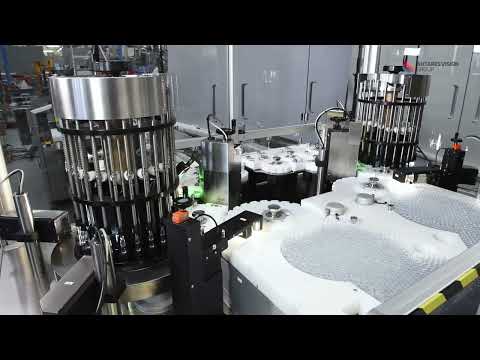
 After capped and topserted bottles exit the line, they are tracked via Antares Vision’s Omnivision platform.Apace Packaging
Apace narrowed down its list with in-person visits and by running live demos before making its decision to select Antares Vision Group, a global supplier of track-and-trace and inspection solutions with a deep presence in pharmaceutical packaging.
The decision came down to the equipment itself as much as the software. “It didn’t look like an afterthought,” Bell says of the Antares Vision serialization hardware. “It was actually a standalone piece of equipment that you would take and slide into your line, and it would do the function it was supposed to do and feed the product out the other side.”
Chris Collins, North America sales director at Antares Vision Group, had a longer view of the relationship than most sales directors get to have. He had contacts at Apace since its earliest serialization days, when the company had just two lines.
Collins notes that the industry itself had matured considerably since those early years. “In 2012, we [suppliers] were the smartest guys in the room,” he says. “Now you walk into a facility and the customers are the smarter people in the room, because they’re living it day in and day out.”
Doing it all at once
What Apace took on next was not, by any measure, a mere system swap but a complete overhaul. The CMO set an ambitious goal of not only upgrading serialization across all existing lines but also of installing a brand-new fourth bottling line with Antares Vision from the ground up. Further, Apace would also implement a new Microsoft D365 ERP system, and add an L3 serialization layer, Antares Vision’s Global Tracking System (GTS), that Apace had never had before — all at the same time.
“It was a huge challenge and undertaking, much bigger and to be honest, it took longer than we anticipated,” Bell says. The extended timeline reflected the complexity of the project rather than any single bottleneck. The ERP system required roughly 12 months to fully develop and integrate, and the serialization installation was phased across multiple lines over time, each requiring its own installation, debugging, and validation before moving to the next.
“It was a major undertaking,” Bell says.
The facility itself required physical changes, with lines extended and secondary packaging areas reshaped to accommodate the larger footprint of new equipment. Collins says that Antares Vision had technicians on-site for roughly three and a half months at the height of the installation, cycling in and out to cover multiple lines simultaneously.
 A robotic arm cases bundled pharmaceutical bottles after Antares Vision’s system captures each serial number at line speed, without bottle orientation.Apace Packaging
The integration also involved other major suppliers. Systems integrator Catalyx (formerly Xyntek) was brought in to handle IT-level configuration and SOP changes on the Apace side. Aside from Antares Vision, one of Apace’s main equipment suppliers is NJM Packaging, which the CMO turns to for labelers, cappers, and topsert machines. Other major suppliers to the upgraded line include ESS for robotic case packers, Pharmaworks for blister line equipment, Krämer tablet fillers, in addition to Kaps-All automatic induction sealers.
Bell notes that one of the trickier integration challenges involved getting the ESS robotic case packer, the Antares Vision system, and the line’s PLC controls to coordinate correctly.
“Getting the automatic robot case packer to pack bundles into cases — with the vision system reading those bundles and tracking those cases — was a challenge working with multiple suppliers,” Bell says. “It took a while to get the programming so we could track the bundles and the cases through the system, but everyone worked with us.”
Serious serialization
Following a bottle through the line from the descrambler room all the way to the pallet tag illustrates just what the integrated system can do.
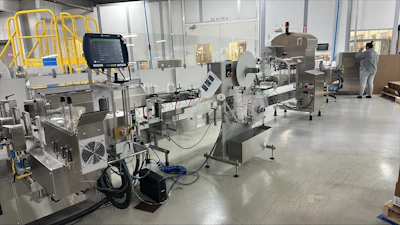
After the descrambler orients and air-rinses bottles, it feeds them into a primary packaging suite, where they move past the desiccant machine and then the tablet counter. Apace runs four-headed Krämer volumetric fillers on three lines and an eight-headed continuous-motion Krämer filler on the high-speed line. From there it’s on to the checkweigher for gross over- and underweight checking and an optional cotton or fiber fill station. Then, NJM’s belt torque capper and the induction sealer finish off the primary package before entering the secondary packaging area.
This is where serialization begins in earnest. At the NJM labeler, each bottle receives a label printed with lot number, expiration date, serial number, and GTIN, all encoded in a 2D Data Matrix code, thanks to the Antares Vision System, which inspects labels before application. Any bottle that fails inspection is rejected before it ever gets a label.
Next comes the topsert, usage and instruction labeling applied to the top of the bottle, followed by one of the more distinctive touches in the Apace operation: each bottle enters what Bell calls the “bottle tracker,” a station built around the Antares Vision Omnivision platform. The Omnivision prints UV ink onto the bottom of the bottle, invisible to the naked eye but readable under black light, to create what the system calls a “helper code.” Its cameras then perform a 360-degree read of the unoriented bottle surface, locate the 2D code on the label, and marry the serialization data to that helper code.
Efficiency by the bundle
The value of the helper code becomes clear during bundling. When bottles go into a shrink-wrap bundle, the label faces outward but the bottle bottom faces down. Antares Vision’s bundle print-and-apply system scans the bottle bottoms at line speed to identify every serial number in a given bundle without needing the bottles to be oriented.
“We print a helper code on the bottom of the bottle in UV ink — you need a black light to see it,” Bell explains. “We use the Antares Vision camera system to find the 2D code on the label and marry the serialization information to that helper code. Then when the bundle comes out of the heat tunnel, we scan the bottle bottoms for those helper codes, and we know exactly which serial numbers are in that bundle.”
 After 2D codes are verified to confirm bundle counts and contents, cases are sealed
and palletized.Apace Packaging
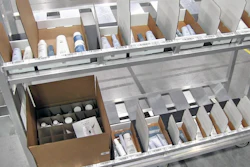
Two of Apace’s lines use manual case packing, while two others use ESS robotic case packers. On all four lines, before the case is sealed, an Antares Vision Top View Matrix Station camera looks down into the open case and photographs the 2D codes on the bundle labels inside, confirming what has been packed and how many bundles are present.
Cases are then taped before case labels are applied, aggregating all bundles to the case. That case label gets a final vision verification before the case goes either to a manual palletizing station. On Apace’s high-speed lines, they go into an automated palletizer. When a pallet reaches its full case count, the system prints a pallet tag representing every case, bundle, and bottle on it.
On Apace’s cartoning lines, the Antares Vision Print & Check EVO units handle serialization, printing and verifying directly on carton flaps at speeds up to 300 units per minute, with a Top View station managing carton-to-case aggregation as cartons are loaded.
At the center of all of this is the Antares Vision GTS (Global Tracking System), an L3 platform that hosts all SKU recipes, printing layouts, and camera formats on a central server, which can receive serialization data from all lines in real time. Because the GTS is a centralized system, it can modify a recipe for one line and automatically apply it to equivalent lines, thereby eliminating the station-by-station type of updating that was required under Apace’s legacy system.
The GTS system also enables something that proves particularly valuable in a multi-line operation: if a mechanical issue forces a line down mid-batch, the batch can be closed, sent back up to GTS, and resumed on another compatible line from exactly the serial number where it left off.
“If they have a critical batch that needs to get out, they can actually reallocate and resume on another line,” says Collins, who knows his customer’s lines intimately.
New lines, new mindset
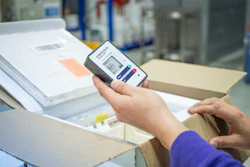
Apace’s serialization mastery also supports product remediation, another area of its contract services business. If a pharmaceutical product arrives at a third-party logistics (3PL) provider and fails to scan, the issue can create a DSCSA compliance failure and stop the shipment. With its upgraded capabilities, Apace can help identify and resolve the problem quickly.
“We’ve had a few 3PLs reach out and say, ‘We know you’ve been helping people fix their serialization — here’s a customer of ours that has an issue,’” Bell says. The work ranges from applying new case labels and re-aggregating, to re-serializing inner packs entirely, with Antares Vision printing and labeling systems central to the process.
Since the upgrade went live in late 2022, the problems that characterized the final years of the legacy system have simply stopped, says Bell.
“All the issues we were having before, like the corrupted files, the lags, the unplanned system shutdowns all kind of just went away.”
The expertise Apace built throughout the all-at-once upgrade has led it to tackle new packaging formats it had not previously attempted for its pharmaceutical customers, including ointment tubes, liquid sachets, and formed liquid cups. They are all now part of the Apace production mix, and all fully serialized.
“Going through these steps — the new lines, the new equipment, upgrading our system, learning this technology — it gave us the confidence as individuals here at Apace and as a company to go out and challenge ourselves by taking on new endeavors,” Bell says.