"I take care of the wars every day in medicine," says McEldowney, an orthopedic surgeon, "and I'm seeing drug abuse problems on a regular basis."
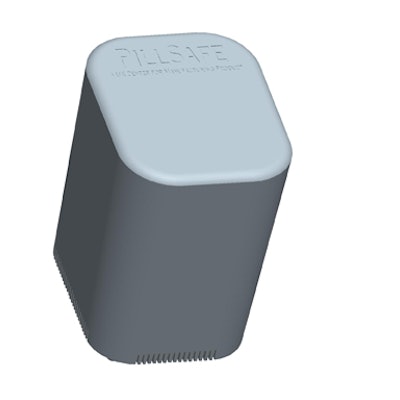
Made of ABS (acrylonitrile butadiene styrene), the pill dispenser is a square box that can accommodate a month's supply of 60 to 120 pills stacked in four separate rows. To dispense the drug, the patient pushes a button, and an internal timer keeps track of when last a pill was dispensed. If the button is pressed before the prescribed interval, the container will not release the medication. Should an individual attempt to force the mechanism or penetrate the bottle, a reactant next to the tablets will incinerate the contents in a matter of seconds.
"We are currently trying to find the exact combination of epoxy and rocket fuel to burn the pills so as not to cause danger to the person attempting to get into the container," says McEldowney. "The good news is you can't break this with your hand. You almost have to use a sledge hammer, so your hands aren't in danger of burning." Further testing is also needed to ensure that patients are not getting pills that are poisoned from the reactant's chemicals.
"Even if we don't find a disintegration process that the FDA approves, what we have done is put a mechanism in place so that people cannot destroy [the pill container] to get more pills," says McEldowney. "They're only going to be able to get one pill every 12 hours, if that's what they're prescribed. And it they go back to their doctor with a destroyed container, the doctor won't give them any more medication. It will add another difficulty factor for the abuser who wants to take the pills more often or sell them."
McEldowney envisions drug manufacturers using the PillSafe to package highly addictive drugs. He estimates the cost of one PillSafe container will be $8. R.A.M.M. is also working on making the containers reusable. "It's going to take time, money, and a substantial investment in new machinery," he admits, "but drug abuse is a big enough problem that's definitely worth the effort."
--By Kassandra Kania, Contributing Editor