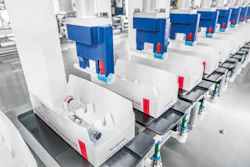
Filling machines with linear process sequences tend to be more efficient, easier to use, and easier to maintain than rotary filling systems. But filling speeds on linear filling systems are often limited by attempts to minimize the machine footprint. So when a Brazilian cosmetics maker asked groninger & Co. for a liquid filling system flexible enough to handle multiple bottle formats at 150/min while still occupying a minimum footprint, the German machine builder came up with an innovative design based on the eXtended Transport System (XTS) from Beckhoff.
The fundamental requirements for speed, flexibility, and minimal footprint made it impossible to implement the machine layout that groninger originally envisioned: a monoblock system consisting of a volumetric filling machine and a continuous-motion capper. The high output that the customer was seeking would have required extensive accumulating conveyors between filling and capping stations, and there was no space available for that. By opting for XTS instead, groninger was able to design a highly compact bottle-transport unit between the system’s filling and capping stations. “By eliminating the accumulation conveyors,” says groninger’s Otto Helmle, Sales Director, “we were able to reduce the system length from 7.5 meters (24.60 ft), as originally estimated, to approximately 6 meters (19.68 ft). It’s a linear system that still meets the output requirements of the Brazilian customer. Using conventional methods and approaches, this would only have been possible with a rotary filling system.”