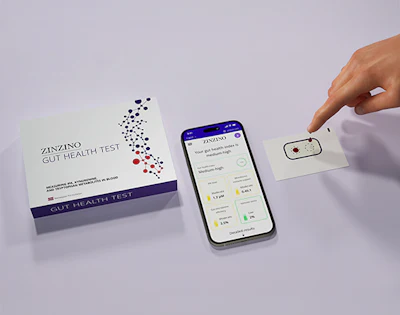
Zinzino's innovative at-home gut health test replaces inconvenient stool samples with a simple finger-prick blood test that measures key metabolites linked to gut function. The company combines minimalist Scandinavian design, sustainable packaging, and consumer empowerment to make wellness diagnostics accessible and intuitive.
- Zinzino's gut health test measures three blood metabolites—IPA, quininarine, and tryptophan—instead of relying on stool analysis
- The testing kit features FSC-certified cardboard, minimal-text visual instructions, and a foil sample pouch designed for security and sustainability
- Users complete the test at home with a finger prick, mail the sample to Zinzino's lab in Norway, and receive results within two weeks via anonymous code
- Packaging design prioritizes accessibility across 33 languages with color contrast, ample white space, and intuitive unboxing to reduce consumer intimidation
- The kit integrates a QR code that links directly to Zinzinotest.com for anonymous registration and result notifications
Key Takeaways:
· Zinzino works at the intersection of nutritional science, wellness, and consumer empowerment with at-home testing kits.
· The test is created in a minimalist design with easy-to-understand visual instructions and simplified opening.
· Creating packaging for a biological sample must prevent contamination, meet regulatory requirements, and remain intuitive for non-technical users.
For decades, consumers interested in understanding their gut health have had only one widely accepted option: stool-based microbiome testing. Effective, yes—but inconvenient, messy, and hardly user-friendly. Now, Scandinavian health and wellness company Zinzino (zinzino.com) is ushering in a new era of at-home wellness diagnostics with a simple alternative: an easy finger-prick blood test that measures key metabolites linked to gut function.
This innovative approach, paired with a thoughtfully engineered packaging system, aims to make gut health testing accessible, intuitive, and sustainable for everyday consumers. To learn more, I spoke with Gabrielle Helmer, the Chief Marketing Officer for Zinzino, who has helped shape the brand’s transformation into a global leader in test-based personalized nutrition.
Zinzino works at the intersection of nutritional science, wellness, and consumer empowerment with at-home testing kits aimed at delivering accurate data to users.
“Our mission is to empower normal consumers to feel secure and able to try out products at home," Helmer explains. "Everything we do is about preventative health.”
The company’s newest breakthrough is its gut health test that replaces stool samples with a simple finger prick. But what sets Zinzino’s gut test apart isn’t only the convenience—it’s the science. Instead of relying on stool analysis, the test measures three blood metabolites linked to gut activity: IPA, quininarine, and tryptophan.
"Normally, if you want to figure out what’s going on in your gut, you’d use stool samples,” Helmer says. “We wanted a cleaner, easier alternative. With this test, consumers can conduct everything themselves at home. It’s empowering.”
Consumers simply prick a finger, place a drop of blood on a sample card, sealed into an envelope (provided) and mail it to Zinzino’s independent laboratory partner in Norway. Within roughly two weeks, the results appear anonymously on Zinzinotest.com, linked only to the user’s unique code stored inside the testing kit.
“If you lose the code, nobody can trace the test back to you,” Helmer notes. “It’s very safe.”
Designing Packaging for Trust, Simplicity, and Sustainability
While the innovation behind the test itself is significant, Zinzino’s attention to packaging design is equally impressive—and central to the product’s success.
“We are all about empowering consumers,” Helmer says. “Most people are not doctors or lab technicians. The packaging must make them feel secure and able to do the test at home without worry.”
To do that the test is created in a minimalist design with easy-to-understand visual instructions and simplified opening. Zinzino’s in-house packaging designer has overseen every detail since 2018. Working closely with specialized printers and lab partners, the team ensures each element of the kit is intuitive, hygienic, and environmentally responsible.
Key packaging features include:
- FSC-certified cardboard: sturdy enough to protect contents but thin enough to reduce waste
- Protective plastic wrap: a thin barrier preventing humidity and contamination
- A foil sample pouch: seals the blood sample to maintain integrity during transport
- Minimal-text, highly visual instructions: accessible across 33 languages
- Color contrast and ample white space: enhancing readability and accessibility
- A simple unboxing experience: designed to reduce intimidation and increase consumer confidence
“We wanted simplicity and minimalism, which are part of Scandinavian brand perception,” Helmer explains. “The design must also meet European sustainable printing standards and be secure enough to protect the sample at every stage.”
Balancing Security, Sustainability, and Compliance
Creating packaging for a biological sample isn’t straightforward. It must prevent contamination, meet regulatory requirements, remain intuitive for non-technical users, and align with the brand’s sustainability values.
 Scandinavian health and wellness company Zinzino is ushering in a new era of at-home wellness diagnostics with a simple alternative: an easy finger-prick blood test that measures key metabolites linked to gut function.Zinzino
By prioritizing FSC-certified materials, recyclability, and minimal waste, Zinzino reinforces its commitment to environmental responsibility—a key pillar of the brand.
The kit also integrates light digital functionality. A QR code inside leads directly to the test-registration portal at Zinzinotest.com, where users enter their anonymous code and basic information. They can then opt for SMS or email notification once the results are ready.
“On other packaging we use QR codes for videos and concept pages,” Helmer says. “But for this test, the QR code leads directly to registration, making the process efficient and clear.”
Making At-Home Testing Accessible to All
As at-home wellness testing continues to expand, accessibility becomes more crucial. While many consumers are new to the process, Zinzino intentionally designs its kits to remove barriers.
“Everything is simplified,” Helmer says. “Minimal text, clear graphics, color contrast, and intuitive step-by-step visuals. We want anyone—even someone who has never done an at-home test—to feel confident.”
On the digital side, Zinzino’s web team ensures the company’s online experiences meet accessibility requirements, complementing the clarity of the physical kit. Zinzino’s gut health test isn’t just a product—it’s a statement about where consumer wellness is heading. By swapping messy stool samples for a simple drop of blood, and by packaging the experience in a way that is elegant, sustainable, and human-centric, the company is redefining what at-home diagnostics can feel like.
“We want to empower consumers,” Helmer says. “This test is part of a bigger movement toward preventative health—and making that accessible is at the heart of our brand.”