Collaborative robots solve efficiency losses caused by serialization in pharmaceutical packaging by automating palletizing, which remains 60-80% manual and creates major bottlenecks. Cobot solutions can recover 5-30% lost equipment effectiveness with faster deployment and 6-month ROI.
- Serialization reduces overall equipment effectiveness (OEE) by 5-30% on average due to increased system complexity and micro-stops
- Palletizing remains 60-80% manual in most pharmaceutical facilities despite earlier line automation, creating major throughput bottlenecks
- Cobot palletizing delivers $375,000 annual savings with approximately 6-month ROI payback in real-world implementations
- Collaborative robots offer faster deployment, smaller footprint, and flexibility for multiple SKUs compared to traditional industrial automation
- Success requires system-level integration with serialization and aggregation systems to maintain data integrity and real-time communication
Automation in the pharmaceutical industry can help drastically improve throughput, solve for inefficiencies and bottlenecks, and ensure smoother, safer product handling. At the end of line, robotic palletizing helps solve these issues and more.
Robotiq, an industrial automation company, recently hosted a webinar with OPTEL, a global provider of traceability, track-and-trace and vision systems, that discussed how pharma manufacturers are connecting serialization, aggregation, and palletizing.
The webinar focused on how pharmaceutical manufacturers can recover lost efficiency in packaging lines, especially after serialization efforts, by addressing bottlenecks at the end of the line using integrated cobot solutions.
A report from IDTechEx shows collaborative robots on a steep growth trajectory, with revenues expected to jump from $1.2 billion to nearly $30 billion in just over a decade. While used in various areas in manufacturing, end-of line solutions offer a unique advantage.
Nicolas Hardy, regional sales manager at Robotiq and Olivier Laboissonniere, cobot palletizing expert at OPTEL shared how serialization in the industry is improving compliance but may be reducing line efficiency. While serialization and aggregation add traceability and regulatory compliance, they also introduce complexity on the line that shifts packaging lines from smooth, flow-based systems to more interruption-prone, exception-driven operations. This in turn leads to reduced overall equipment effectiveness (OEE).
The culprit? According to the companies, palletizing is a major bottleneck, and yet a key opportunity. Despite automation earlier in the line, palletizing remains largely manual (60–80% in many cases), according to the experts. This creates inconsistencies, slows throughput, and increases errors. As a result, palletizing becomes one of the most impactful areas to target for performance improvements.
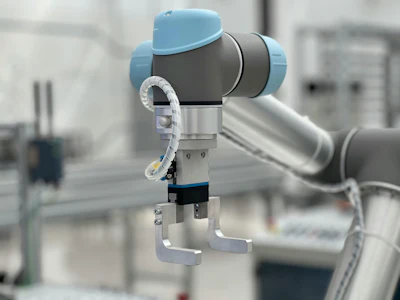
For such improvements, a potential solution lies in cobots. Cobot palletizing restores flow, but the experts say that only with a system-level approach to adoption. Collaborative robotic palletizing can stabilize end-of-line operations, reduce labor dependency, and improve consistency. However, success depends on integrating automation with serialization and aggregation systems. This ensures data integrity, proper system communication, and managing real-world variability.
Key Webinar Takeaways:
- Serialization can reduce OEE by 5–10% on average, with some cases up to 30%.
- Increased system complexity leads to micro-stops, more operator intervention, and slower recovery times.
- Cobot palletizing offers:
- Fast deployment and smaller footprint compared to traditional automation
- Flexibility for multiple SKUs and quick changeovers
- Improved consistency and reduced errors
- A real-world case showed:
- $375,000 annual savings
- ~6-month ROI payback period
- Critical success factors include:
- Maintaining real-time aggregation integrity
- Ensuring clean system communication (handshakes)
- Designing for real operating conditions and variability
- Modern solutions include tools like simulation software and ROI calculators to help companies evaluate and deploy palletizing systems quickly.