ASTM standards provide a structured framework for medical device packaging validation that ensures sterile barrier integrity, reduces recall risk, and accelerates regulatory approval through standardized seal strength, integrity, distribution, and aging testing methods.
- Five core ASTM methods work together: ASTM F88 (seal strength), ASTM F1929 and F2096 (integrity), ASTM D4169 (distribution simulation), and ASTM F1980 (accelerated aging)
- Seal process qualification establishes mechanical robustness by defining acceptable operating windows for temperature, pressure, and dwell time
- Post-conditioning testing verifies packaging maintains performance after distribution and aging stresses to confirm sterile barrier protection throughout product lifecycle
- ASTM F3263 provides a standard guide for qualifying packaging systems and establishing validated test methods across internal quality systems and supply chains
- Integrated validation strategy reduces ambiguity, improves regulatory submissions, strengthens inspection readiness, and accelerates time to market
By using standardized ASTM packaging test methods, organizations can generate consistent, reproducible data that strengthens regulatory submissions and supports inspection readiness. This framework reduces ambiguity in validation design, improves cross-functional alignment, and streamlines root-cause analysis. Ultimately, ASTM standards help build confidence in packaging performance, reduce recall risk, accelerate time to market, and support compliance with evolving regulatory expectations.
To help teams fully realize these benefits, the following at-a-glance reference reinforces the core ASTM packaging standards and clarifies how individual methods work together within a cohesive validation strategy. Even for organizations already familiar with these standards, this overview highlights key connections and practical considerations.
Integrated ASTM-Based Validation Strategy
An effective packaging validation program integrates multiple ASTM methods into a structured sequence, each contributing to a comprehensive evaluation of packaging performance:
- Seal Process Qualification: Establishes seal parameters using ASTM F88
- Initial Integrity Assessment: Evaluates baseline integrity using ASTM F1929 and ASTM F2096
- Distribution Simulation: Applies ASTM D4169 to simulate shipping stresses
- Aging Studies: Conducts accelerated aging using ASTM F1980
- Post-Conditioning Testing: Reassesses seal strength and integrity following distribution and aging
Evaluation of packaging systems under initial and worst-case conditions ensures compliance with sterile barrier system requirements for medical devices.
Seal Process Qualification
Seal process qualification establishes the mechanical robustness of the sterile barrier system. ASTM F88 is used to measure seal strength and characterize seal performance across a range of sealing parameters.
Validated sealing processes are supported by defining acceptable operating windows for temperature, pressure, and dwell time. In addition to providing quantitative strength data, ASTM F88 can identify failure modes such as adhesive failure, cohesive failure, or material tearing, ensuring seal consistency and reliability.
Initial Integrity Assessment
Baseline integrity testing confirms that packaging systems are free from defects that could compromise sterility. ASTM F1929 employs dye penetration to detect channel leaks, while ASTM F2096 uses internal pressurization to identify gross leaks through bubble emission.
These complementary methods provide a comprehensive evaluation of package integrity prior to further conditioning. Establishing baseline performance is critical for comparison with post-stress testing results.
Distribution Simulation
ASTM D4169 evaluates packaging performance under simulated distribution conditions, including vibration, shock, and compression. The standard offers multiple test cycles and assurance levels that can be tailored to reflect expected shipping environments.
Proper selection and justification of these parameters ensure that testing is representative of real-world conditions, providing confidence that packaging systems will maintain integrity throughout shipping and handling.
Aging Studies
Accelerated aging, conducted in accordance with ASTM F1980, is used to estimate the effects of time on packaging materials and seal integrity. The method applies elevated temperature conditions based on Arrhenius principles to simulate long-term storage.
Aging studies support shelf-life claims and are typically paired with real-time aging programs. Following aging, packages are subjected to integrity and strength testing to confirm continued performance.
 Christine Tervo
Post-conditioning testing verifies packaging performance after exposure to distribution and aging stresses. Seal strength is reassessed using ASTM F88, while integrity is reevaluated using ASTM F1929 and ASTM F2096.
This evaluation demonstrates that the sterile barrier system maintains performance under worst case conditions and confirms protection of product sterility throughout the lifecycle.
Guidance for implementation
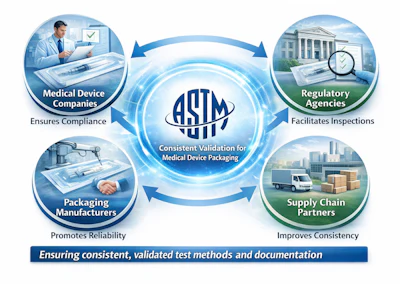
Guidance is available through ASTM International, including ASTM F3263 (Standard Guide for Qualification of Packaging Systems for Sterile Medical Devices). For medical device companies and packaging manufacturers, this resource provides a consistent reference for establishing and maintaining validated test methods across internal quality systems and supply chain partners.
ASTM standards provide a structured approach to medical device packaging validation. By periodically revisiting these core ASTM standards, manufacturers reinforce their understanding of methods for seal strength, integrity, distribution simulation, and aging. As a result, programs can become more compliant while strengthening decision making and enabling more efficient and confident packaging validation outcomes.