Intralox developed modular plastic belting more than 50 years ago. When the company introduced its ThermoDrive belting more than 15 years ago, it was with a view to providing a more sanitary, food-safe conveying solution—without the harborage points found in the connections between modular belt sections. But the flip side of that continuous belt technology is that maintenance required more effort. If any part of it becomes damaged, a large splicer is required to replace the section—an often cumbersome, expensive proposition.
“If I have a long conveyor or a high conveyor, I cannot take the belt off, so I need to cut it open, I need to take it off, I need to put it on, and I need to splice it with a big machine,” explains Hauke Bayer, ThermoDrive product specialist at Intralox. “That whole process takes roughly two hours. You need to bring the equipment in the production plant, preheat it.”
In many cases, particularly in the U.S., the food producer doesn’t even own splicing equipment, so depends on a third party to come in and splice the belts, which requires added cost and time. And the quality of the splice can be inconsistent.
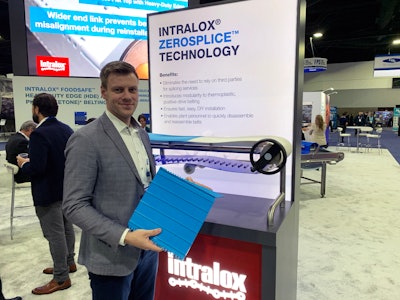
At the International Production & Processing Expo (IPPE) in Atlanta, Intralox was showing off its new ZeroSplice technology, which provides a compromise between the more hygienic ThermoDrive belt and easier-to-maintain modular belting. Users can now order ThermoDrive belts in custom lengths and connect them quickly and easily without field splicing—simply with the kind of interlocks and rod that the industry is used to.
“We also designed it in a way that it’s hygienic enough so you don’t need to open it to clean,” Bayer notes. “That was the other goal. Customers didn’t want to necessarily take it off every time they clean a belt, so it’s designed to be able to clean in place.”
ZeroSplice technology uses Intralox’s fully enclosed ThermoLace Heavy-Duty Edge. It’s compatible with Intralox’s full range of ThermoDrive products, including lug-driven and drive bar-driven products.
This is just the start of the journey for Intralox, Bayer says, as the company looks to bring further improvements to the market to extend the product line.
“Getting the right balance is what we really think this is all about—enabling customers to get as food safe as possible, but to reduce the risk of downtime as much as possible,” Bayer says, commenting on the kinds of accidents that can happen to break conveyor belts. “If the belt breaks, the whole production line potentially stops. And if you calculate the downtime and hours multiplied with the product losses, that’s a number.”